
As the Papers Told It

Lizzie Borden

As the Papers Told It

Waterbury Evening Democrat, 5 August 1892The Providence News, 2 September 1892Waterbury Evening Democrat, 12 October 1892The Salt Lake Herald, 6 November 1892

Original newspaper accounts, 1892–1893

August 1892 – December 189367 newspaper articles in the story, 4,026 in the full archive

On the morning of 4 August 1892 Andrew J. Borden, one of the wealthiest men in Fall River, Massachusetts, and his wife Abby were killed in their house on Second Street, in daylight. The indictment later counted the wounds: ten on him, twenty on her. His daughter Lizzie found his body, and a week later she was under arrest, soon to be charged with both murders.

For more than a year the papers followed her: through a hearing that left the state’s physical evidence in pieces, a Boston newspaper’s invented scandal and its retraction, an indictment, and a trial at New Bedford that ended in acquittal on a single ballot. Then they followed her home, to a town that never settled who had done it.

The numbers

4,026newspaper articles
4,147printings
354newspapers
48states and territories
17months in the papers

Each article is counted once, however many papers ran it. Printings counts every paper that ran it, so an article reprinted in five papers is one article and five printings.

How much the papers printed

Week of 1 August 1892: 45 printingsWeek of 8 August 1892: 258 printingsWeek of 15 August 1892: 221 printingsWeek of 22 August 1892: 261 printingsWeek of 29 August 1892: 383 printingsWeek of 5 September 1892: 89 printingsWeek of 12 September 1892: 31 printingsWeek of 19 September 1892: 33 printingsWeek of 26 September 1892: 21 printingsWeek of 3 October 1892: 15 printingsWeek of 10 October 1892: 137 printingsWeek of 17 October 1892: 26 printingsWeek of 24 October 1892: 13 printingsWeek of 31 October 1892: 9 printingsWeek of 7 November 1892: 13 printingsWeek of 14 November 1892: 33 printingsWeek of 21 November 1892: 38 printingsWeek of 28 November 1892: 128 printingsWeek of 5 December 1892: 95 printingsWeek of 12 December 1892: 8 printingsWeek of 19 December 1892: 4 printingsWeek of 26 December 1892: 24 printingsWeek of 2 January 1893: 6 printingsWeek of 9 January 1893: 1 printingWeek of 16 January 1893: 4 printingsWeek of 30 January 1893: 10 printingsWeek of 6 February 1893: 5 printingsWeek of 20 February 1893: 1 printingWeek of 6 March 1893: 2 printingsWeek of 13 March 1893: 4 printingsWeek of 20 March 1893: 1 printingWeek of 3 April 1893: 2 printingsWeek of 10 April 1893: 8 printingsWeek of 17 April 1893: 3 printingsWeek of 24 April 1893: 29 printingsWeek of 1 May 1893: 15 printingsWeek of 8 May 1893: 91 printingsWeek of 15 May 1893: 30 printingsWeek of 22 May 1893: 42 printingsWeek of 29 May 1893: 25 printingsWeek of 5 June 1893: 468 printingsWeek of 12 June 1893: 534 printingsWeek of 19 June 1893: 625 printingsWeek of 26 June 1893: 149 printingsWeek of 3 July 1893: 43 printingsWeek of 10 July 1893: 24 printingsWeek of 17 July 1893: 8 printingsWeek of 24 July 1893: 31 printingsWeek of 31 July 1893: 13 printingsWeek of 7 August 1893: 10 printingsWeek of 14 August 1893: 10 printingsWeek of 21 August 1893: 7 printingsWeek of 28 August 1893: 5 printingsWeek of 4 September 1893: 3 printingsWeek of 11 September 1893: 4 printingsWeek of 18 September 1893: 5 printingsWeek of 25 September 1893: 2 printingsWeek of 2 October 1893: 6 printingsWeek of 9 October 1893: 8 printingsWeek of 16 October 1893: 2 printingsWeek of 23 October 1893: 1 printingWeek of 6 November 1893: 5 printingsWeek of 13 November 1893: 3 printingsWeek of 20 November 1893: 5 printingsWeek of 27 November 1893: 3 printingsWeek of 11 December 1893: 1 printingWeek of 18 December 1893: 2 printingsWeek of 25 December 1893: 6 printings5 August 18925 August 18925 August 18926 August 18926 August 18926 August 18927 August 18929 August 189210 August 189211 August 189212 August 189212 August 189213 August 189214 August 189215 August 189216 August 189219 August 189225 August 189226 August 189227 August 189229 August 189230 August 18922 September 18926 September 189221 September 189223 September 189229 September 189210 October 189212 October 189212 October 189220 October 18926 November 189226 November 18921 December 18923 December 18925 December 18926 December 189230 December 18926 January 189312 January 18939 May 189326 May 189331 May 18933 June 18936 June 18937 June 18938 June 18939 June 189310 June 189313 June 189314 June 189316 June 189317 June 189320 June 189321 June 189322 June 189322 June 189324 June 189325 June 18938 July 189323 July 189324 July 189327 July 18934 August 189326 August 189324 September 189321 November 189318921893625 printings in the week of 19 June 1893

Every printing of every article, by the week it ran. The marks under the line are the articles in the story below; red ones were wrong.

Where it was printed

FewerMore

Printings in 48 states. Most: Rhode Island (466), New York (406), Maine (264). 134 printings could not be placed in a state.

How it unfolded

67 newspaper articles in 7 acts

Act One

Husband and Wife Butchered

5–11 August 1892

The first dispatches from Fall River could not agree on the simplest facts: which floor Mr. Borden died on, whether his wife had gone out to visit a sick friend. Within a day suspicion had settled on the family, on Lizzie and her uncle John Morse, and a drug clerk said she had tried to buy prussic acid. A week of searches turned up no weapon and settled nothing.

A double murder, and the family suspected

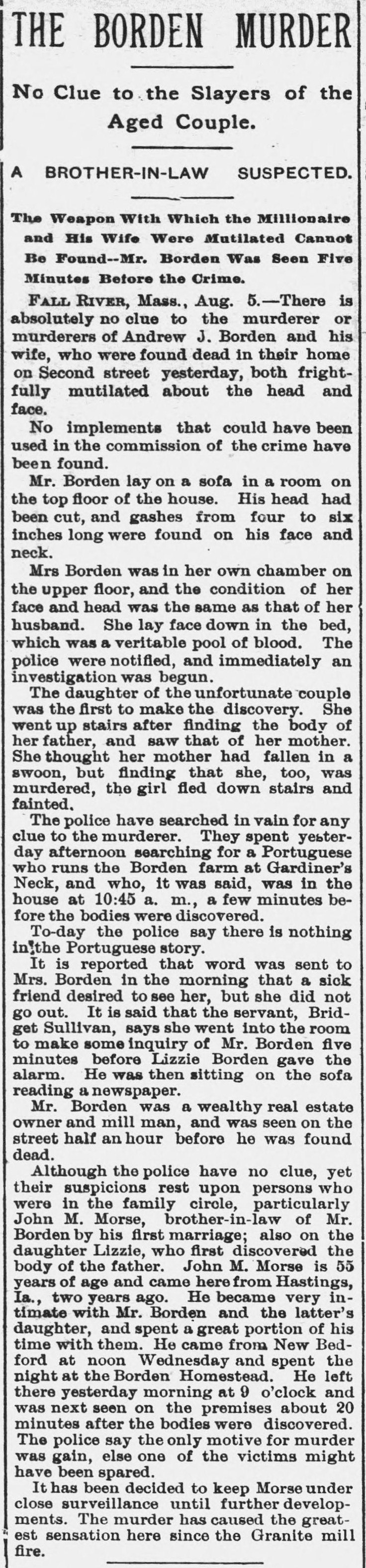
The day after the killings, a Fall River dispatch reports no weapon and no clue, and police drop a story about the Portuguese who ran the Borden farm. Suspicion rests on the family circle: John Morse, Mr. Borden’s brother-in-law by his first marriage, who had slept in the house the night before, and the daughter Lizzie, who found her father’s body. A week later it was Lizzie who was arrested.

Waterbury Evening Democrat · Waterbury, Conn.

This article was wrong. The papers corrected it the next day.

Wrong

Waterbury Evening Democrat · 5 August 1892 · page 1 · transcribed from the page image

THE BORDEN MURDER

No Clue to the Slayers of the Aged Couple.

See moreSee less

A BROTHER-IN-LAW SUSPECTED.

The Weapon With Which the Millionaire and His Wife Were Mutilated Cannot Be Found--Mr. Borden Was Seen Five Minutes Before the Crime.

FALL RIVER, Mass., Aug. 5.--There is absolutely no clue to the murderer or murderers of Andrew J. Borden and his wife, who were found dead in their home on Second street yesterday, both frightfully mutilated about the head and face.

No implements that could have been used in the commission of the crime have been found.

Mr. Borden lay on a sofa in a room on the top floor of the house. His head had been cut, and gashes from four to six inches long were found on his face and neck.

Mrs Borden was in her own chamber on the upper floor, and the condition of her face and head was the same as that of her husband. She lay face down in the bed, which was a veritable pool of blood. The police were notified, and immediately an investigation was begun.

The daughter of the unfortunate couple was the first to make the discovery. She went up stairs after finding the body of her father, and saw that of her mother. She thought her mother had fallen in a swoon, but finding that she, too, was murdered, the girl fled down stairs and fainted.

The police have searched in vain for any clue to the murderer. They spent yesterday afternoon searching for a Portuguese who runs the Borden farm at Gardiner's Neck, and who, it was said, was in the house at 10:45 a. m., a few minutes before the bodies were discovered.

To-day the police say there is nothing in the Portuguese story.

It is reported that word was sent to Mrs. Borden in the morning that a sick friend desired to see her, but she did not go out. It is said that the servant, Bridget Sullivan, says she went into the room to make some inquiry of Mr. Borden five minutes before Lizzie Borden gave the alarm. He was then sitting on the sofa reading a newspaper.

Mr. Borden was a wealthy real estate owner and mill man, and was seen on the street half an hour before he was found dead.

Although the police have no clue, yet their suspicions rest upon persons who were in the family circle, particularly John M. Morse, brother-in-law of Mr. Borden by his first marriage; also on the daughter Lizzie, who first discovered the body of the father. John M. Morse is 55 years of age and came here from Hastings, Ia., two years ago. He became very intimate with Mr. Borden and the latter's daughter, and spent a great portion of his time with them. He came from New Bedford at noon Wednesday and spent the night at the Borden Homestead. He left there yesterday morning at 9 o'clock and was next seen on the premises about 20 minutes after the bodies were discovered.

The police say the only motive for murder was gain, else one of the victims might have been spared.

It has been decided to keep Morse under close surveillance until further developments. The murder has caused the greatest sensation here since the Granite mill fire.

See the clipping

How the bodies were found

A Wilmington paper’s first account: Andrew J. Borden and his wife, among the city’s wealthiest people, killed with an ax in broad daylight. Lizzie, it says, spoke to her father as she passed through the room downstairs, went to the barn and ran in at a cry of distress. The household had been ill for three or four days, and the family doctor, Dr. Bowen, suspected an attempt at poisoning.

Evening Journal · Wilmington, Del.

Evening Journal · 5 August 1892 · page 2 · transcribed from the page image

HUSBAND AND WIFE BUTCHERED.

Hacked to Death with an Ax by Some Unknown Assassin.

See moreSee less

Fall River, Mass., Aug. 5--Andrew J. Borden and wife, two of the oldest, wealthiest and most highly respected persons in the city, were brutally murdered with an ax in broad daylight in their home on Second street, within a few minutes' walk of the city hall and the central business section. The Borden family consisted of the father, mother, two daughters and a servant. The older daughter has been in Fairhaven, Conn., for some days. The rest of the family have been ill for three or four days, and Dr. Bowen, the attending physician, was suspecting an attempt at poisoning.

About 8 o'clock in the morning Mrs. Borden received a note asking her to go and visit a friend who was ill. She left the house and shortly afterward her husband walked to one of the banks. He returned about 10:30 o'clock and sat on the sofa. The servant, Bridget Sullivan, then went outside the house to wash windows. In the meantime Miss Lizzie Borden, a daughter, arose from bed and walked down stairs, seeing and speaking to her father as she passed through the room. She supposed her mother was out. She went into the yard and stepped into the barn.

While there, she heard a cry of distress coming apparently from the house and she ran in. She went directly to a sitting room leading from the main hallway in the house, and there saw her father lying back on a sofa covered with blood and lifeless.

She ran out again shrieking and her cries attracted the servant and a neighbor. They made a hasty search for the mother and found her up stairs in a spare bedroom lying dead, face downward, on the floor. Medical Examiner Dolan was summoned, and he found Mr. Borden's head hacked to pieces in a horrible manner, no less than seven long gashes being on his face and skull, some of them an inch and a half deep through flesh and bone. Mrs. Borden, too, had been frightfully butchered about the face and skull. It is supposed that the murderer was concealed about the house when Mr. Borden came in and went up stairs with the intention of murdering him. Before he could accomplish his purpose Mrs. Borden's attention was attracted.

The murderer probably followed her into a spare room and struck her from behind. After being sure of his work the murderer probably went down stairs, where Mr. Borden had fallen asleep on the sofa and there dealt him the awful blows that ended his life. Robbery was not the motive of the crime, as no valuables nor money was missing. Two or three suspects were arrested, but none of them is believed to know anything of the crime.

See the clipping

A drug clerk says she asked for poison

A New York evening paper carries the first word of the drug store story: the Fall River Globe says a clerk at Smith’s drug store told police Lizzie Borden had asked him for poison, and identified her before the officers. The victims’ stomachs were sent to Boston for analysis. Suspicion still lay on Lizzie and on John Morse, whose hosts in South Dartmouth vouched for him.

The Evening World · New York, N.Y.

The Evening World · 5 August 1892 · page 1 · transcribed from the page image

TWO SUSPECTS IN THE FAMILY

POLICE HAVE A CLUE.

Fall River Double Murder Mystery May Be Solved.

See moreSee less

Drug Clerk Says Lizzie Borden Asked Him for Poison.

She's the Murdered Couple's D[au]ghter—Another Family Suspect.

[BY ASSOCIATED PRESS.] FALL RIVER, Aug. 5.—The Evening Globe will say this evening that a most important clue to the Borden double murder is in possession of the police.

From Clerk Eli Bence, at D. R. Smith's drug store, they learned last night that Miss Lizzie Borden had been in the store within thirty-six hours past and had inquired for a certain poison.

The clerk was asked to accompany the officers, and was closely questioned as to the time, the girl's condition mentally, the amount and quality of the poison she had called for.

The officers then took the drug clerk to a residence on Second street where Miss Lizzie was stopping for the time being. He did identify her and in her presence informed the officers that she was in his place of business and made inquiry for a bottle of poison.

Miss Borden's reply to this accusation is known only to the two policemen and herself.

TWO SUSPECTS IN THE FAMILY.

[BY ASSOCIATED PRESS.] FALL RIVER, Mass., Aug. 5.—The double murder of yesterday, in which Millionaire Andrew J. Borden and his wife were the victims has caused the greatest sensation known here since the Granite Mill fire. Far into last night great throngs of people surrounded the family residence.

Medical Examiner Dolan, assisted by other physicians, held an autopsy on the bodies of the victims of the tragedy. It was found that Borden sustained twelve cuts in the face and skull, varying in length from 4 to 8 inches, also suffered a fracture of the skull two by four inches and three inches deep. His wife's head and face were battered all out of shape.

The stomachs of both victims were removed and placed in alcohol to be sent to Boston to-day for analysis, with a view of determining whether or not milk poisoning was attempted.

Police suspicions rest upon persons who were in the family circle, particularly on John W. Morse, brother-in-law of Mr. Borden by his first marriage; also on the daughter Lizzie, who first discovered the body of the father.

John W. Morse is fifty-five years of age, and came here from Hastings, Ia., two years ago. He became very intimate with Mr. Borden and the latter's daughter, and spent a great portion of his time with them.

He came from New Bedford at noon Wednesday and spent the night at the Borden homestead. He left there yesterday morning at 9 o'clock and was next seen on the premises about twenty minutes after the bodies were discovered.

After the most careful searching it has been decided that neither of the victims engaged in a struggle, both being struck down instantly and hacked to pieces afterwards.

The police say the only motive for murder was gain to be eventually secured through the death of both parties. And the fact that so little ado was made by those who were most directly interested and so little attempt was made at first to discover the possible murderer is strengthening the police in the opinions they now hold.

At one time the police threatened to place Morse in custody, but it was decided to keep him under close surveillance until further developments.

Four policemen are on guard at the house to-day, and only a few very near relatives are allowed to enter. Those who went were a Mr. Morse, of New Bedford, a cousin of the suspected man, and another close friend, who gave his name as Fish.

These men can give no reason why Morse should be under suspicion other than the fact that he happened to be in this neighborhood at this time. He would not benefit by the death of either of the parties unless a will was made, which at this writing cannot be told.

Emma, the daughter who was visiting in the vicinity of New Bedford when the murder took place, is at home to-day and has charge of the house. Her sister Lizzie is not in a much better state than she was yesterday when she discovered her father dead.

NEW BEDFORD, Mass., Aug. 5.—John N. Morse, who is suspected of knowing something about the double murder at Fall River, made his home with Isaac C. Davis, at South Dartmouth. He belongs in Hastings, Ia., and has lived in Mr. Davis's family for about a year.

Members of the Davis family say Morse left South Dartmouth Thursday for Fall River for the purpose of purchasing cattle for Mr. Davis. He was expected home last night. They give him an excellent name, and do not believe that he is in any way connected with the affair.

See the clipping

The daughters offer a $5,000 reward

A Savannah paper prints the daughters’ notice: Emma and Lizzie Borden offer $5,000 for the arrest and conviction of whoever killed the couple. Police drop a nephew said to have quarrelled with them over property, and suspect poison in milk they drank before bed. By 11 August the milk was said to have left the Borden farm all right, and a report on 30 August found no poison in the stomachs.

The Morning News · Savannah, Ga.

UnconfirmedNo later report in this collection bears it out. CorrectionThis set right 3 earlier articles: Waterbury Evening Democrat, 5 August 1892, Evening Journal, 5 August 1892, The Portland Daily Press, 5 August 1892.

The Morning News · 6 August 1892 · page 1 · transcribed from the page image

WEALTHY COUPLE SLAIN

RELATIVES SUSPECTED OF KILLING THEM.

See moreSee less

Poison Probably Administered to Stupefy the Victims Before They Were Attacked With Knife and Ax. The Police Working on a Theory But No Arrest Made Yet.

FALL RIVER, MASS., Aug. 5.—Andrew J. Borden, a wealthy real estate owner and mill man, and his wife were found dead at their home, No. 92 Second street, about noon yesterday. Both had been mutilated about the head and face with an ax, cleaver or razor. Mr. Borden lay on a sofa in a room on the top floor of the house. His head had been cut, and gashes from four to six inches long were found on his face and neck. Mrs. Borden was in her own chamber on the upper floor, and the condition of her face and head was the same as that of her husband. She lay face downward in her bed, which, was a veritable pool of blood. After a most thorough and persistent search no trace has been found of the murderer. Four policemen are on guard at the house, and have been patrolling the neighborhood since the affair was made public. This morning State Detective Seaver and City Marshal Hilliard held a long consultation, and later on visited and interrogated Miss Lizzie, a daughter of Mr. and Mrs. Borden, at the house. The result of their investigation will not be known until an arrest of some kind has been made.

WATCHING A BROTHER-IN-LAW.

A strict watch that has been kept over John W. Morse, a brother-in-law of Mr. Borden by his first marriage, was even more strictly kept to-day than ever. It appears to be the desire of the police to make no arrests until after the funeral, unless it becomes known that the murderers actually entered the house and escaped within an hour, an idea that is scouted by the police at the present time.

The following advertisement appeared in to-night's local papers:

$5,000 REWARD.

The above reward will be paid to any one who may secure the arrest and conviction of the person or persons who occasioned the death of Andrew J. Borden and his wife.

EMMA J. BORDEN. LIZZIE J. BORDEN.

A NEPHEW SUSPECTED.

Late this afternoon it was reported at the police station that a young man said to be a nephew of Mr. Borden was suspected of the murders. It arose from the fact that some time ago Mr. and Mrs. Borden were overheard in angry talk with the young man over the division of some property. As the young man was parting from them at the front door he was heard to say: "By —— you have cheated me and I will make you suffer." The report was sifted and it was found that such a conversation had occurred, but it happened ten months ago and the young man had not been seen since. The police let go this clew readily and again turned their attention to the house.

LOOKING INTO MORSE'S HISTORY.

The antecedents of John W. Morse and his connections are being closely hunted and the girl Lizzie is again being subjected to a rigorous examination. Morse is 55 years of age and came here from Hastings, Ia., two years ago. He became very intimate with Mr. Borden and Lizzie Borden, spending a great deal of his time with them. He came from New Bedford at noon on the day before the murder and spent the night in the Borden house. He left there at 9 o'clock on the day of the crime and was next seen twenty minutes after the body was discovered.

POISONING SUSPECTED.

The police believe that there was either a previous attempt at killing by poison, or that poison was administered as a preparatory step for the crime. On the morning of their death both Mr. and Mrs. Borden arose from sleep feeling ill. They had drank milk before going to bed, and it is believed that if drugs were administered it was done then. It is here that the suspicion of a conspiracy coincides with the presence of the brother-in-law in the house. After Medical Examiner Dolan, assisted by other physicians, had completed his autopsy on the bodies the stomachs of both were placed in alcohol and sent to Boston for analysis, with a view to determining if poisoning had been attempted.

NO SIGNS OF A STRUGGLE.

The poison theory is borne out by the fact that the condition of the rooms in which the two bodies were found showed no signs of a struggle, not a piece of furniture being out of its place, while there was very little blood scattered about, although Mr. Borden sustained no less than twelve cuts on the face and skull, varying in length from four to eight inches, and a fracture of the skull two by four inches and three inches deep. Mrs. Borden's wounds were not of so wholesale a nature.

ESCAPE NOT EASY.

That the murders could have been committed by a stranger who escaped is very doubtful, as there were many persons about who would have seen him leaving the place after the deed.

Another suspicious circumstance is that the commission of the deed should have been timed for the exact period when the servant girl, Bridget Sullivan, was busy cleaning the outside of the windows and so out of the way. This girl heard no commotion or groan, while Miss Borden says that she heard a noise while she was in the barn, and hurried in to find the bodies of her dead parents. A remarkable thing is that Miss Borden, although, according to the servant's story, she supposed that her mother was out, did not give an alarm when she found her father's body, but went to her mother's room, and it was her shrieks from that place which attracted the servant and neighbors to the scene. It is believed by some that Mr. Borden and his wife, suffering from drowsiness produced by drugs or otherwise, were asleep when the assassin attacked them, and that sudden and swift blows quickly ended the bloody business.

MISS BORDEN AFTER POISON.

The Evening Globe says this evening that most important clew is in possession of the police. From Clerk Eli Bence, at D. R. Smith's drug store, they learned last night that Miss Borden had been in the store within three hours and had inquired for a certain poison. The clerk was asked to accompany the officers, who closely questioned him as to the facts relative to the time, the girl's condition mentally and the amount and quality of the poison she had bought or called for. The officers then took the drug clerk to the residence on Second street where Miss Lizzie was stopping for the time being. The young man was not well acquainted with the young woman, but he had told them that he could identify her at sight. He did identify her and in the presence of the officers informed them that she was in his place of business and made inquiries for a bottle of poison. Miss Borden's reply to this accusation, as well as the exact language which she used at the time, is known only to the policemen and herself.

See the clipping

Acid for furs, and a household at odds

A Portland paper says the Globe’s account of the drug clerk has been ‘verified by the highest authority’, and names what Lizzie asked for: hydrocyanic acid, to use on furs, though the medical examiner said it would be of little use for that. It is alleged she took her meals at a separate table. By 10 August she still denied trying to buy the acid.

The Portland Daily Press · Portland, Me.

This article was wrong. The papers corrected it the next day.

Wrong

The Portland Daily Press · 6 August 1892 · page 1 · transcribed from the page image

SHE BOUGHT POISON.

Lizzie Borden Is the Subject of a Terrible Suspicion.

See moreSee less

EXCITEMENT IN FALL RIVER STILL AT FEVER HEAT.

Miss Borden's Purchase of the Poison Proved--Her Strange Conduct--Morse, the Suspected Man, Surrounded by a Crowd of Thousands on the Street--He Is Closely Watched by the Police--The Funeral Arrangements.

FALL RIVER, August 5.--Tonight the mystery surrounding the Borden murders came very close to solution. Unless all signs fail, there will be arrests tomorrow. The Fall River Globe tonight says that the police learned from Eli Beare, a drug clerk, last night that Miss Borden had been in the store within 36 hours previous and had inquired for a certain poison. There clerk was asked to accompany the officers and closely questioned as to the exact facts relative to the time, the girl's condition mentally, the amount and quality of the poison she had bought or called for. The officers then led the drug clerk to a residence on Second street, where Miss Lizzie was stopping for the time being. The young man was not previously well acquainted with the young woman, but he had told them that he could identify her at sight. He did identify her and in the presence of the police officers informed her that she was in his place of business and made

Inquiry For a Bottle of Poison.

The Globe's story has been verified by the highest authority. There now seems no doubt that some one in the family was anxious to have the father and mother out of the way. The demeanor of Miss Lizzie through the trying ordeal of being confronted with the man who says she asked about poison was of half contempt and scorn. Her conduct as observed by the police since the affair happened, had been strange inasmuch as she has stood the pointed questioning of all who have interviewed her with a show of no other feeling than that of a disinterested party. It is generally known among close friends of the family that Lizzie has not been upon the best of terms with the other members of the household. It is alleged that for some time previous she did not sit at the same table with the other folks, but had her meals served at a separate table. The feeling of coolness between the members of the family is unaccounted for by police or neighbors. The murder had hardly been discovered before she told a neighbor that she was very sorry as she had arranged to go to Marion on a vacation.

Tonight it was learned that Miss Lizzie had enquired at the drug store for hydrocyanic acid in diluted form, saying that she wished to use it on furs. Medical Examiner Dolan stated the acid would be of little use for such a purpose as it has no antiseptic qualities, but is an exceedingly injurious acid to the human system. There is not the slightest doubt that Miss Lizzie

Enquired for the Deadly Acid at Smith's drug store, but whether for herself or some other person remains to be proven. The police are acting slowly and carefully in the affair, giving way, no doubt, to a feeling of sentiment because of the high social standing of the parties involved. The strictest kind of a guard is being kept on the house and all the inmates, John Morse went out four times today on various errands, and each time was followed closely by a detective and patrolman. Tonight in company with the servant girl he walked to the post office. Before reaching it they were surrounded by a crowd of 2000 or more. Five policemen kept the crowd back while the parties were returning to the Borden homestead. The excitement is greater tonight if anything than last night. A crowd of 600 people are standing in front of the house but the police do not allow stragglers to hang over the fence or loiter on the sidewalk.

From all indications it would seem as if the funeral services tomorrow would have an official flavor. During the day the clothing worn by the deceased persons was buried near the house. Miss Lizzie kept her room all day and has been inaccessible to all callers. In police circles tonight it is being talked that the two murders occurred after the victims were rendered unconscious by drugs.

See the clipping

The funeral, and a forecast of arrests

A Providence report of the funeral, which calls Mrs. Borden Alice (other reports name her Abby): thousands crowded the streets as the two caskets were borne to the hearses. The paper says three arrests will follow that afternoon, one as principal and two as accessories, one of them a prominent physician. None came that day; the arrest, when it came after the inquest resumed on 11 August, was Lizzie’s.

The Providence News · Providence, R.I.

This article was wrong. The papers corrected it the next day.

Wrong

The Providence News · 6 August 1892 · page 1 · transcribed from the page image

THREE SUSPECTS.

Their Arrest Expected This Afternoon.

See moreSee less

THE BORDENS BURIED.

Impressive Services Over the Bodies of the Murdered Pair.

A MOST SENSATIONAL STORY.

Lizzie Borden Is Said to Have Flown Into a Fury When the Officers Proposed Immediately After the Discovery of the Murder to Search Her Room.

[SPECIAL TO THE NEWS.]

FALL RIVER, Aug. 6.--The funeral of Andrew L. and Alice Borden, the murdered couple, took place at 11 o'clock this forenoon. Thousands of people blocked the streets in the vicinity of the stricken home, and tried in vain to get a peep at the proceedings.

A cordon of police kept all at a respectful distance; no one was allowed inside but the immediate relatives of the deceased. The services were brief but impressive. The Rev. Dr. Adams, pastor of the First Congregational Church, conducted the services, assisted by the Rev. E. A. Berek. The bodies were placed in black cloth-covered caskets, and were placed side by side.

Following the services the two caskets were borne to hearses in waiting by bearers representing the corporations with which Mr. Borden was connected. Down the street the funeral cortege made its way, the people falling back as it approached. Interment was in the Oak Grove cemetery.

The police had made no arrests up to noon. It is stated that the expected blow will fall this afternoon, after the funeral is over.

It is now stated that three arrests will be made, one as principal and two accessories.

One of the suspects is a prominent physican, whose name has not been connected with the crime. The utmost excitement prevails and the wildest rumors of important disclosures are afloat.

It was learned to-day for the first time that an hour or more after the murder was discovered two of the officers despatched to the scene undertook to make a search of the house. They looked over the first floor to some extent and then started up stairs. Lizzie Borden became aware of their efforts, and as they reached the door of her room she stepped boldly in front of the officers, exclaiming, "Where are you going?"

"We are going to search this house and your room," replied the officers.

"You are not going into that room" said Lizzie as she turned the key in the lock and stood determined in front of the door.

"We desire to search that bureau and the closet in your room.

"Don't you interfere. You have no right to enter my room, and I tell you you shall not; there is nothing there!"

"It will be better for you, Miss Borden, to let us make the search."

Lizzie thereat became furious and barred the officers' progress, repeating with fixed determination her declarations that they should not enter. Her boldness of front astonished the officers so that they did not really know whether they had the authority or not to prosecute the search.

Finally they became convinced that they had made an unauthorized move and they withdrew without attempting to conclude the search through the house.

CONTINUED ON PAGE 3.

LIZZIE BOUGHT ACID.

A Possible Solution of the Fall River Murder Mystery.

IS THE DAUGHTER GUILTY?

Her Strange Actions Arouse Police Suspicion--But it Isn't a Good Thing to be Too Quick to Jump on a Bereaved Woman.

CONTINUED FROM PAGE 1.

FALL RIVER, Mass., Aug. 6.--Last night the mystery surrounding the Borden murders came very close to a solution and unless all signs fail, there will be arrests today. The story of the attempt of Miss Lizzie Borden to purchase poison has been verified by the highest authorities.

There now seems no doubt that some one in the family was anxious to have the father and mother out of the way. The demeanor of Miss Lizzie through the trying ordeal of being confronted with the man who says that she asked about poison was half of contempt and scorn. In fact, her conduct as observed by the police since the affair happened, has been strange, inasmuch as she stood the pointed questioning of all who interviewed her with the show of no other feeling than that of a disinterested party.

It is generally known among the close friends of the family that Lizzie has not been upon the best of terms with the other members of the household. It is alleged that she for some time previous did not sit at the table with the other folks, but that she had her meals served on a separate table. The feeling of coolness between the members of the family is not accounted for by either the police or the neighbors. The murder had hardly been discovered before she told a neighbor that she was very sorry as she had arranged to go to Marion on a vacation.

Last night it was learned that Miss Lizzie had inquired at a drug store for hydrocyanic acid in a diluted form, saying she wished to use it on furs. Medical Examiner Dolan, who has been deeply interested in the case, stated that the acid would be of little use for such purpose, as it has no antiseptic qualities, but it is an exceedingly injurious acid to the human system. There is not the slightest doubt that Miss Lizzie inquired for the deadly acid at Smith's drug store, but whether for herself or some other person remains to be proven.

The police are acting slowly and carefully in the affair, giving way, no doubt to feelings of sentiment, because of the high social standing of the parties involved. The strictest kind of guard is being kept on the house and all the inmates.

John Morse went out of the house four times yesterday on various errands and each time he was followed closely by a detective patrolman. Last night, in company with the servant girl, he walked to the post office, but before reaching there they were surrounded by a crowd of 2000 people or more. Five policemen kept the crowds back, while the parties were returning to the Borden homestead. The excitement was greater last night, if anything, than it was Thursday night.

A crowd of 600 people stood in front of the house, but the police would not allow stragglers to hang over the fence or loiter on the sidewalks. From all indications it would seem as if the funeral services would have an official flavor.

The clothes worn by the deceased persons were buried near the house. Miss Lizzie kept her room all day and was inaccessable to callers, no matter who or what they were.

In police circles it is being talked that the two murders occurred after the victims had been rendered unconscious by drugs. If this surmise proves true, it will then be readily understood how an extraordinary tragedy could be enacted here on the principal street without attracting any public attention.

See the clipping

Lizzie bars the door to her room

A St. Paul paper prints the scene at Lizzie’s bedroom door an hour or more after the bodies were found: she turned the key, told two officers they had no right to enter, and said ‘There is nothing there.’ They did not go in, and the paper notes there has been ample time since to remove any evidence. A thorough search on 6 August found no clinching evidence, officials said.

St. Paul Daily Globe · Saint Paul, Minn.

CorrectionThis set right 2 earlier articles: Morning Journal and Courier, 6 August 1892, The Providence News, 6 August 1892.

St. Paul Daily Globe · 7 August 1892 · page 1 · transcribed from the page image

LIZZIE WAS FURIOUS,

And Prevented the Officers From Entering Her Room.

See moreSee less

FALL RIVER, Mass., Aug. 6.—An important fact in connection with the Borden double murder was developed today. An hour or more after the murder was discovered, two of the officers despatched to the scene undertook to make a search of the house. They looked over the first floor to some extent and then started upstairs. Lizzie Borden became aware of their efforts, and, as they reached the door of her room, she stepped boldly in front of the officers, exclaiming:

"Where are you going?"

"We are going to search this house and your room," replied the officers.

"You are not going into that room," said Lizzie, as she turned the key in the lock and stood determinedly in front of the door.

"We want to search that bureau and the closet in your room; don't you interfere," replied the officer.

"You have no right to enter my room, and I tell you you shall not. There is nothing there."

"It will be better for you, Miss Borden, to let us make the search."

Lizzie then became furious and barred the officers' progress, repeating that they should not enter. They did not, and if any evidence of crime existed in that room there has been ample time to remove it. There are no other developments in the case and no arrests have been made.

The first thorough search of the Borden residence was made this afternoon while the trial was in progress. From 2 o'clock until 6:30 the most searching investigation was made of every detail discovered since the crime was perpetrated. The search through the house was expected to develop many things, but at 7 o'clock tonight it was stated officially that no clinching evidence was obtained, and it is now impossible to say what turn the investigation will take.

See the clipping

Clothes dug up, chimney and barn searched

Five days on, a Waterbury report finds the police no nearer a solution. The victims’ buried clothes were dug up and examined, a mason dug into the chimney and the barn floor was torn up, without a clue. The paper wonders if this is a murder never to be cleared up; after the acquittal in June 1893, a Richmond paper would still be asking where the assassin was.

Waterbury Evening Democrat · Waterbury, Conn.

Waterbury Evening Democrat · 9 August 1892 · page 1 · transcribed from the page image

FALL RIVER'S MYSTERY

Clews Followed Only to Come to Naught.

See moreSee less

THE HOUSE AGAIN SEARCHED.

An Inquest Will Probably be Held This Week—Emma and Lizzie Borden Prostrated—The Clothing of the Victims Dug Up and Examined.

FALL RIVER, Mass., Aug. 9.—The daughters of the murdered Mr. and Mrs. Borden are beginning to realize the awfulness of the suspicion resting upon Miss Lizzie and cannot control their feelings. The inmates of the house are all suffering from nervous prostration. The police are no nearer to a solution of the crime than they were last week. It seems as if this were one of those mysterious murders destined never to be cleared up.

The clothes worn by the victims, and which were buried in the yard, were dug up yesterday afternoon and spread out on the grass for the inspection of Medical Examiner Dolan. He picked from several parts of the clothes a quantity of hair from Mrs. Borden's head, which he placed in two lots and took it with him to his carriage.

He would say nothing as to the cause of resurrecting the clothing, but after making his examination he ordered it to be placed in a shoe case and buried four feet below the surface of the lot.

Yesterday's prolonged search did not result in any clews, nor did the officers at the conclusion feel that there was any cause for expecting more developments.

Portions of the chimney were dug away by a mason and the barn floor was torn up. Marshal Hilliard said the search was of value, in showing that whoever the assassin was his tracks were completely covered from view.

To-day the police have been at fever heat and have succeeded in running down seven out of nine clews.

Dr. Dolan will probably ask for an inquest during the week, as soon as he has an opportunity to formulate a complaint. The theory that the murder was committed by a man who was seen sitting on the garden fence half an hour before the murder was discovered has been exploded.

See the clipping

Lizzie questioned for four hours

With no arrest after six days, a Wilmington paper reports Lizzie questioned for four hours and suspects the police of ‘working the third degree’. The doubts: a policeman found the barn loft dust undisturbed, the note calling Mrs. Borden to a sick friend could not be found, and Lizzie gave her time in the barn as 10:20 and as 10:30. Her inquest testimony would be excluded at her trial.

Evening Journal · Wilmington, Del.

Evening Journal · 10 August 1892 · page 2 · transcribed from the page image

MISS BORDEN'S ORDEAL

She Is Rigidly Examined at the Coroner's Investigation.

See moreSee less

THE SERVANT ALSO ON THE RACK.

Secrecy Maintained by the Officials as to the Result of the Investigation—Some Glaring Discrepancies in the Stories Told by the Daughter of the Victims.

FALL RIVER, Mass., Aug. 10.—Here—more than one hundred hours after the ax did its awful execution—there is no one bold enough to place his hand on man or woman and say: "I arrest you on suspicion of having murdered Andrew J. Borden and Abby Borden, his wife, on Aug. 4. You must come with me."

After several days of seeming lethargy the police officials have at length begun active steps toward the unraveling of the mystery that surrounds the murder, and they subjected to an inquisitorial examination Lizzie Borden and Bridget Sullivan, the servant. What it all means no one can tell with certainty, but it looks very much as though Marshal Hilliard and his aids were trying the effects of a bulldozing process, known in New York city police circles as "working the third degree." It is quite certain that finding the mystery surrounding the terrible crime beyond their detective ability, they have determined to make the suspected people themselves furnish the testimony which they have failed to gather.

The decided step taken was the outcome of a conference. Marshal Hilliard, District Attorney Knowlton, State Detectives Rhodes and Levear and Medical Examiner Dolan were closeted for some time in the marshal's office, and adjourned to meet later in a parlor of the Mellon House, where they remained behind locked doors until an early hour in the morning.

MRS. BORDEN.

During that protracted session every minute scrap of evidence that had been accumulated by the police was carefully examined, and a close comparison was made of the statements of different persons.

Miss Borden Contradicted.

Lizzie Borden's claim that she had discovered the dead body of her father after her visit to the barn, where she had gone for the purpose of making some sinkers to be used in a fishing excursion, was contradicted by a policeman, who declares that he carefully examined the barn loft on the day after the murder, and that he distinctly remembers that the thick dust on the floor was undisturbed by any footprints but his own.

The apparent inconsistency on the part of the young woman may be explained by the

MISS LIZZIE BORDEN.

fact that in the excitement following the discovery of the murders she had forgotten where she had gone for the lead.

A point that is not so satisfactorily settled is the disposition of the letter which Lizzie says was received by Mrs. Borden that morning, calling her to the bedside of a sick friend. The most careful search has failed to reveal any traces of that important epistle. Scraps and shreds of paper have been carefully gathered and pieced, but to no avail.

Miss Borden has on different occasions given the time of her absence from the house in the barn as 10:20 and 10:30 a. m., and the police look upon the discrepancy as serious. The police still believe that she tried to buy prussic acid at Smith's drug store, which she still positively denies.

An important piece of evidence submitted to the district attorney by the marshal was the distances between the scene of the tragedy and the adjoining houses, showing that the noise of any violent struggle must have been heard by the neighbors, as well as by Lizzie and the servant.

During the search conducted on Sunday a piece of lead pipe was found in the yard about five feet from the barn. Whether or not this is the metal from which Lizzie was going to make the sinkers has not yet been proved.

Rigidly Questioned.

When Marshal Hilliard drove up later to the Borden residence and told Miss Lizzie that she was wanted she displayed not the least sign of emotion, but asked only that a friend and old schoolmate, Mrs. George Brigham, who was in the house at the time, be permitted to go with her. The marshal assented and the women were driven to headquarters, followed by a curious crowd of men and boys. As they stepped from the carriage Lizzie looked around at the crowd without displaying the least sign of discomposure.

For four hours she was subjected to a rigid questioning. Professor Wood, to whom had been subjected for analysis the viscera of the murdered couple, and Attorney General Pillsbury were present, but did not remain long and drove off together. It was not until 6 o'clock that Miss Borden's ordeal was ended for the day and she was taken to her home, and Marshal Hilliard's double guard was put on the house to prevent the escape of any of the suspected people. Bridget Sullivan, who had not been permitted to see her mistress, was taken to the home of a friend, Mrs. Patrick Harrington, of 95 Division street.

Professor Wood, before leaving the city, was seen by a reporter, to whom he admitted to the best of his belief the stains on the rags gathered from the cellar of the Borden house during the search on Sunday were human blood. These rags were found under an upturned pail. That they were remnants of a garment has not, however, yet been settled.

See the clipping

The marshal points away from the family

A New York report of 11 August has Marshal Hilliard saying three clues outside the family are being run down, none touching anyone in the house, and that medical evidence might yet turn suspicion away from the Bordens. The suspected milk was all right when it left the Borden farm, where the family in charge drank it unharmed. By the next day’s report Lizzie Borden had been arrested.

The Evening World · New York, N.Y.

The Evening World · 11 August 1892 · page 2 · transcribed from the page image

MAY CLEAR LIZZIE BORDEN.

Three Outside Clues to the Fall River Murders Being Traced.

See moreSee less

Close Medical Examinations to Be a Feature of the Case.

'BY ASSOCIATED PRESS.' FALL RIVER, Mass., Aug. 11.—The Borden inquest was resumed this morning. Charles Sawyer, who guarded the door of the house while Officer Allen ran to the Central Station, was the first witness. He testified that he ran to the house when he saw Mrs. Russell running, and that he was with Officer Doherty and an Associated Press reporter when Dr. Bowen discovered that Mrs. Borden did not die of heart disease.

Officer George Allen was called, and he testified to having seen Mr. Borden lying on the sofa, stabbed, as he supposed. His story added no new light to the crime.

Mrs. Perry Gifford was being examined at 12 o'clock.

Last night Officer Harrington went to Boston to identify a suspect answering a description of a "wild-looking man," seen last Thursday morning by the doctor as he was driving by the Borden House. The suspect was not the man.

The police have also run down a suspect, who boarded the New Bedford train at Mount Pleasant and rode into the city. He proved an alibi easily.

Marshal Hillard this morning submitted to another interview. In answer to questions as to whether or not the police had given up all hopes of locating a murderer outside the Borden family, he said the question was nonsensical, but he would answer by saying that three clues were already being run down, and none of them would in any way implicate a member of the household.

He was willing to say that close medical examinations and their results would be a feature of the case, and that it might turn out that suspicion would be directed from the Borden family.

It has been proved that the suspected poisonous milk drank by the Borden family was all right when it was taken from the Borden farm and brought to this city. Members of the family in charge of the farm drank it, and they were effected in no noticeable way.

Last night Officers Hargraves and Horace guarded the tomb which received the bodies of Mr. and Mrs. Borden. Just what this means can only be conjectured as the police are silent.

It has become public that the order passed by the Aldermen asking for an increase in the police force, was inspired by District-Attarney Knowlton.

There was a witness at yesterday's inquest whose name was not given out by the police when the usual bulletin was issued. It was Mrs. Egan, who was seen to enter the Borden yard before the murders, mistaking it for Dr. Kelly's property, adjoining.

See the clipping

About these pages

Every clipping here was printed in an American newspaper at the time. The text on each card was read from the page by machine and lightly repaired; where it disagrees with the clipping, the clipping is right. Where the scan of an old page was too damaged to read, the text was transcribed again from the page image and is marked so; letters in [square brackets] were supplied where the printing itself is damaged, and the paper’s own misspellings are kept. The dates, papers, headlines and text are the papers’. The notes on why each article matters, and the one-line summaries, are ours.