As the Papers Told It

H. H. Holmes

As the Papers Told It

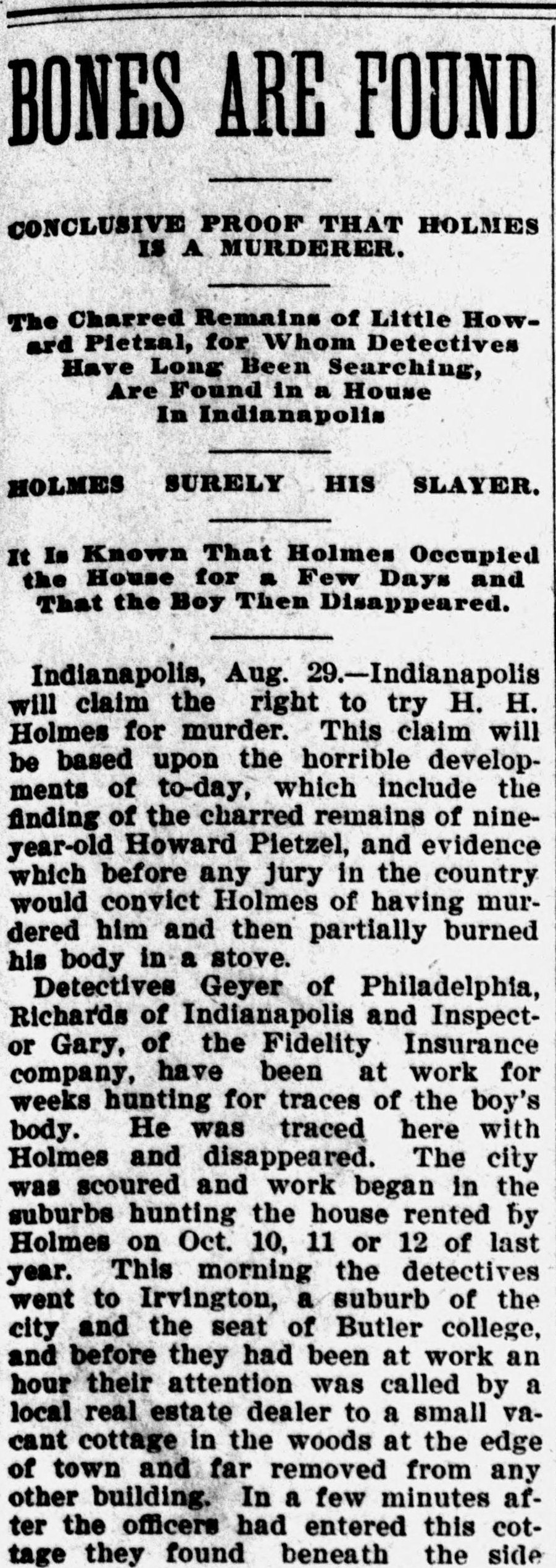
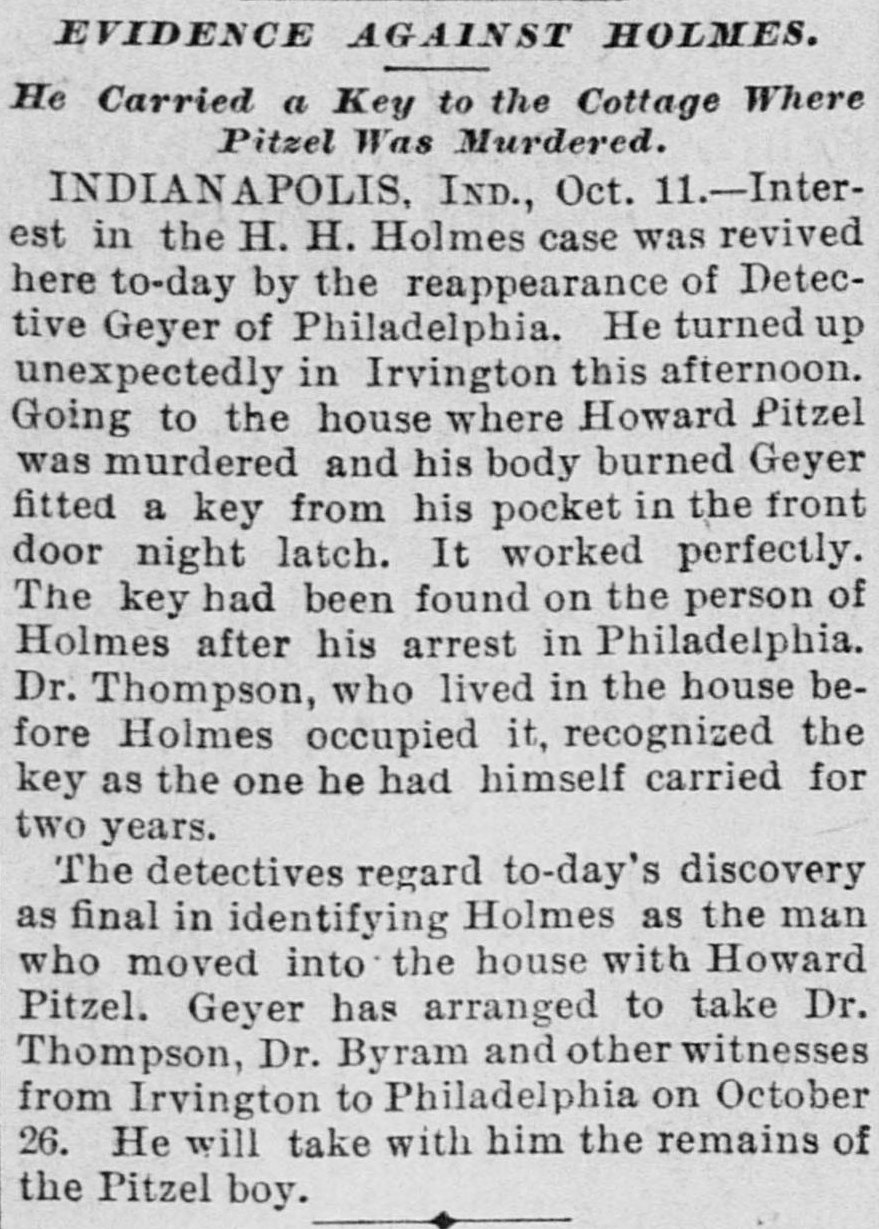
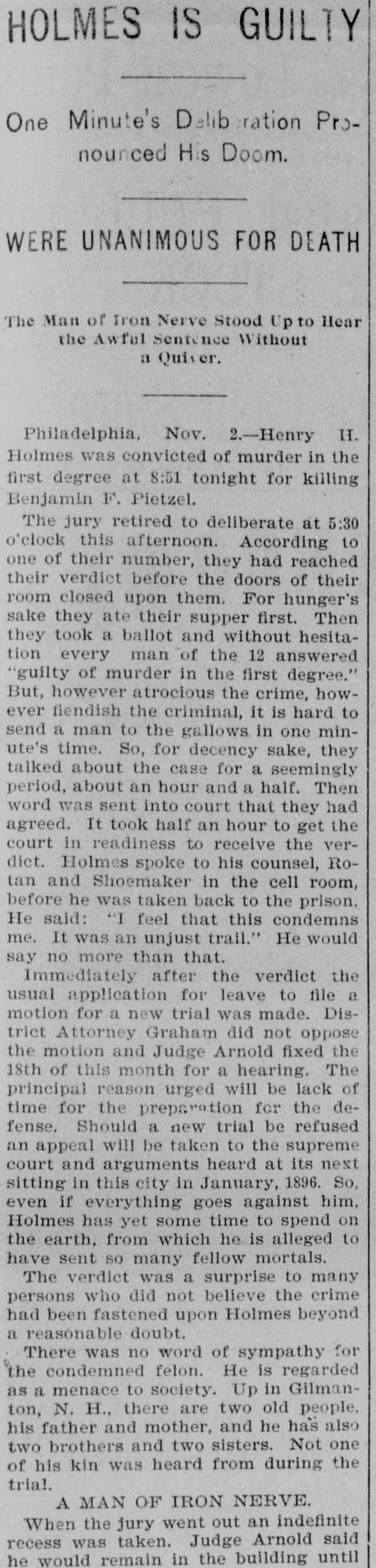
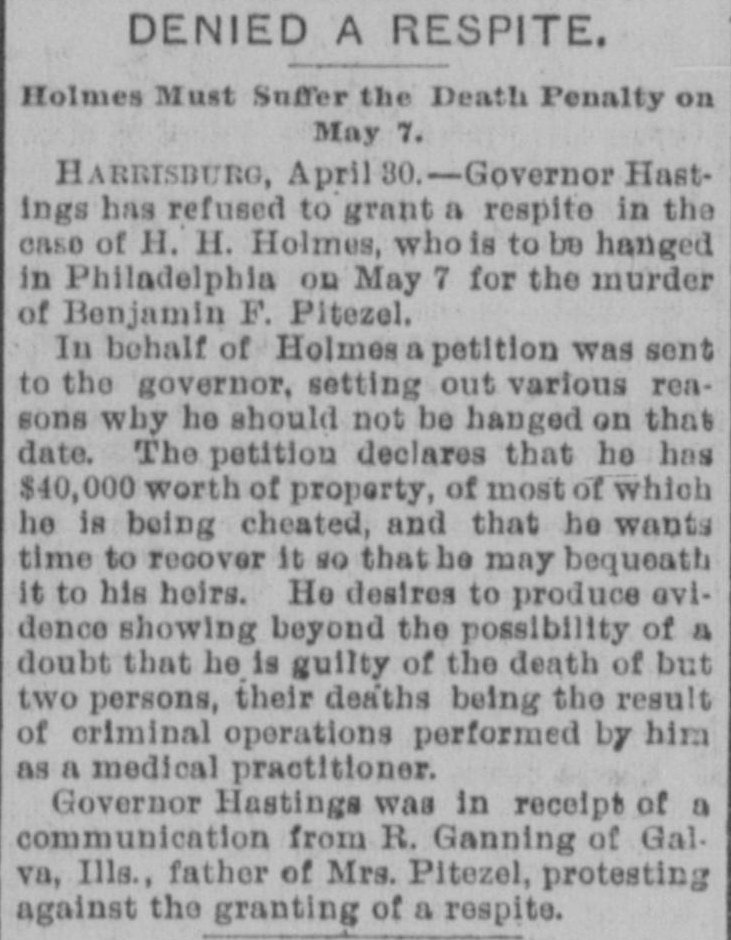
The Bottineau Courant, 31 August 1895The San Francisco Call, 12 October 1895The Weiser Signal, 7 November 1895Evening Journal, 30 April 1896

Original newspaper accounts, 1894–1896

November 1894 – June 189647 newspaper articles in the story, 2,967 in the full archive

From November 1894 to May 1896, Americans followed the case of H. H. Holmes, as a Philadelphia insurance fraud involving Benjamin Pitezel unraveled into charges of murder. The papers printed conflicting names and theories, false sightings of the supposedly dead, a trial, an unsuccessful appeal, a written confession claiming twenty-seven killings, and reports that several of the named victims were later found alive. On the scaffold Holmes denied killing Pitezel or his children, the crime for which he was hanged. Here is how it unfolded in the press.

Draft introduction, for review

The numbers

2,967newspaper articles
3,396printings
346newspapers
49states and territories
20months in the papers

Each article is counted once, however many papers ran it. Printings counts every paper that ran it, so an article reprinted in five papers is one article and five printings.

How much the papers printed

Week of 12 November 1894: 1 printingWeek of 19 November 1894: 132 printingsWeek of 26 November 1894: 23 printingsWeek of 3 December 1894: 6 printingsWeek of 10 December 1894: 5 printingsWeek of 31 December 1894: 3 printingsWeek of 7 January 1895: 1 printingWeek of 28 January 1895: 2 printingsWeek of 13 May 1895: 3 printingsWeek of 20 May 1895: 1 printingWeek of 27 May 1895: 12 printingsWeek of 3 June 1895: 2 printingsWeek of 10 June 1895: 2 printingsWeek of 17 June 1895: 4 printingsWeek of 24 June 1895: 1 printingWeek of 1 July 1895: 1 printingWeek of 8 July 1895: 2 printingsWeek of 15 July 1895: 132 printingsWeek of 22 July 1895: 354 printingsWeek of 29 July 1895: 368 printingsWeek of 5 August 1895: 121 printingsWeek of 12 August 1895: 57 printingsWeek of 19 August 1895: 117 printingsWeek of 26 August 1895: 150 printingsWeek of 2 September 1895: 113 printingsWeek of 9 September 1895: 87 printingsWeek of 16 September 1895: 43 printingsWeek of 23 September 1895: 52 printingsWeek of 30 September 1895: 6 printingsWeek of 7 October 1895: 18 printingsWeek of 14 October 1895: 9 printingsWeek of 21 October 1895: 5 printingsWeek of 28 October 1895: 376 printingsWeek of 4 November 1895: 154 printingsWeek of 11 November 1895: 23 printingsWeek of 18 November 1895: 69 printingsWeek of 25 November 1895: 31 printingsWeek of 2 December 1895: 54 printingsWeek of 9 December 1895: 2 printingsWeek of 16 December 1895: 6 printingsWeek of 23 December 1895: 4 printingsWeek of 30 December 1895: 16 printingsWeek of 6 January 1896: 16 printingsWeek of 13 January 1896: 2 printingsWeek of 20 January 1896: 12 printingsWeek of 27 January 1896: 5 printingsWeek of 3 February 1896: 24 printingsWeek of 10 February 1896: 5 printingsWeek of 17 February 1896: 2 printingsWeek of 24 February 1896: 1 printingWeek of 2 March 1896: 49 printingsWeek of 9 March 1896: 89 printingsWeek of 16 March 1896: 26 printingsWeek of 23 March 1896: 17 printingsWeek of 30 March 1896: 13 printingsWeek of 6 April 1896: 41 printingsWeek of 13 April 1896: 75 printingsWeek of 20 April 1896: 62 printingsWeek of 27 April 1896: 56 printingsWeek of 4 May 1896: 195 printingsWeek of 11 May 1896: 109 printingsWeek of 18 May 1896: 9 printingsWeek of 25 May 1896: 7 printingsWeek of 1 June 1896: 1 printingWeek of 8 June 1896: 3 printingsWeek of 15 June 1896: 3 printingsWeek of 22 June 1896: 5 printingsWeek of 29 June 1896: 1 printing18 November 189419 November 189419 November 189422 November 18943 December 18945 December 18941 February 189517 May 189529 May 189525 June 189518 July 189521 July 189529 July 189530 July 189531 July 18951 August 18958 August 189522 August 189531 August 18956 September 189512 September 189517 September 189523 September 189512 October 189528 October 189528 October 189529 October 189530 October 189531 October 18957 November 189521 November 189522 November 189522 November 18951 December 189531 December 189522 January 18963 February 18965 March 189610 March 189611 March 18963 April 189611 April 189615 April 189630 April 18967 May 18968 May 189613 May 1896189418951896376 printings in the week of 28 October 1895

Every printing of every article, by the week it ran. The marks under the line are the articles in the story below; red ones were wrong.

Where it was printed

FewerMore

Printings in 49 states. Most: Minnesota (247), Kansas (202), District of Columbia (173). 21 printings could not be placed in a state.

How it unfolded

47 newspaper articles in 6 acts

Act One

First Hints of Suspicion

November 1894 – June 1895

In November 1894 the papers had an insurance swindle: a man found dead in a Philadelphia house, a $10,000 policy, and a smooth-talking Chicago man named H. H. Holmes under arrest in Boston. Murder was only a whisper.

The first article: an insurance swindle

The story breaks in Washington the day after Holmes’s arrest in Boston. The Fidelity Mutual Life Association has paid $10,000 on a man who died in Philadelphia as ‘B. F. Perry,’ really Benjamin Pitezel, and the trail leads to H. H. Holmes, who had a desk in the same Chicago building. The headline says the corpse was a fake. It wasn’t: it was Pitezel, and Holmes had killed him.

The Washington Times · Washington, D.C.

The Washington Times · 18 November 1894 · page 1 · transcribed from the page image

$10,000 FOR A BOGUS BODY

That Price Was Paid by the Fidelity Mutual Life Association.

See moreSee less

BUT THE CORPSE WAS A FAKE

The Slick Methods by Which Mr. Holmes Secured a Fortune Upon the Alleged Death of B. F. Pitzel—Is Finally Arrested in Boston—The Deed Done in Philadelphia.

PHILADELPHIA, Nov. 17.—An elaborate life insurance swindle has come to light in this city.

On September 3 last, the corpse of a man was found at 1316 Callowhill street, this city, and was buried by the coroner under the name of B. F. Pitzel. Now it appears that the corpse was a bogus one substituted for the purpose of defrauding the insurance company of $10,000.

B. F. Pitzel rented the house on Callowhill street during the summer under the name of B. F. Perry, and while there conducted a patent medicine business. The last week in August he disappeared and on September 3 a man with whom he had had business relations, went to the house and found Perry dead on the floor. Death was attributed to the explosion of a jar of cleaning fluid.

After the body had been buried in the potters' field a communication was received by the Fidelity Mutual Life Association, dated St. Louis, and signed by an attorney of that city, J. D. Howe. It stated that he had seen the death notice in a Philadelphia newspaper and that he represented the dead man's widow.

The letter further stated that the real name of the deceased was B. F. Pitzel, a beneficiary of the company, the name of Perry having been assumed on account of financial difficulties in Tennessee.

The policy had been issued through the agency of a reputable business man, but when he was questioned he referred the inquirer to H. H. Holmes, who had had a desk in the same building with the deceased in Chicago during the World's Fair.

The general manager could not locate Holmes at first, but found his wife, and by her was told that her husband was a traveling man and she would communicate with him.

The manager left with her a clipping, referring to a body found in Chicago, and a few days later the office received a letter from Holmes, offering to come to Chicago if his expenses were paid.

The next day, however, Holmes wrote to the Philadelphia office stating that he had learned that the death was in Philadelphia, and that as he expected to be in Baltimore soon he would stop in Philadelphia.

Meanwhile Attorney Howe appeared in Philadelphia, accompanied by a young girl whom he represented as the daughter of the dead man. He also produced a letter of introduction to Superintendent of Police Linden from a former assistant district attorney of St. Louis, and Supt. Linden sent him to President House, of the insurance company.

Holmes came to hand about the same time, and, though examined separately and denying acquaintance with each other, both men gave a corresponding description of the dead man.

It was then decided to exhume the body, which was done by officials of the coroner. The officials of the company were satisfied and the body was reburied, and Attorney Howe received the $10,000, representing the sum due Mrs. Pitzel.

The insurance company never doubted the truth of the identification, although they had a belief that the case was one of murder, rather than accident. A month ago, however, one of the company's agents, while in St. Louis, became cognizant of some of the facts, and he formulated the theory of conspiracy.

Additional detectives were put on the case and Holmes was chased all over the country. The mother of the supposed dead man was found and from minute descriptions of her son it at once appeared that the corpse found was not his. In the meantime it was discovered that Holmes' real name was Herman Mudget and his home New Hampshire. His aliases were legion. He is known in New York, Chicago, Fort Worth, St. Louis, and almost [e]very other big city.

Then it was learned that Pitzel and Holmes obtained, by some means or other, a corpse from the New York Hospital, brought it here, surrounded it by the evidences of a violent death in the Callowhill street house, and obtained the $10,000 as above described.

Holmes was arrested in a west end boarding-house in Boston by Pinkerton detectives, who are now after the other conspirator, Pitzel.

See the clipping

The first whisper of murder

One day in, the New-York Tribune is already asking whether this was murder. The coroner’s physician says the body was too stiff to have arrived folded in a trunk, as Holmes claims, and reporters float two theories: Pitezel was killed by his own partners, or a lookalike was killed in his place. The first guess was the right one.

New-York Tribune · New York, N.Y.

New-York Tribune · 19 November 1894 · page 1 · transcribed from the page image

HOLMES MAY BE TRIED FOR MURDER. Philadelphia, Nov. 18.—H. H. Holmes, alias H. H. Howard, the man arrested in Boston charged with swindling the Fidelity Mutual Life Insurance Association, of this city, out of $10,000, by palming off a bogus corpse as the body of B. F. Pitzel, a policy-holder of the company, will be brought here to-morrow and arraigned on the charge. The charge of swindling may not be the only one Holmes will have to answer, for the more serious crime of murder may be laid to him. When the body of the supposed Pitzel was found in the room at No.

See moreSee less

1,316 Callowhill-st., on September 3 last, it was stretched flat upon the floor and was perfectly rigid. The Coroner's physician holds that the body could not have been brought here in a trunk from another city, as confessed by Holmes, for the reason that it was stiff, and a body once bent does not again become rigid. Furthermore, if it had been in the trunk it would have shown marks of where it had been doubled up, and no such marks were upon the body. A theory is advanced that the body found was really that of Pitzel and not of any one else. As a basis for this theory it is argued that Pitzel and the other conspirators plotted to disfigure the former by burning his face with some chemical and then calling in a physician to prescribe for his injuries. A body was then to be procured and similarly disfigured as Pitzel's was, and then it was to be given out that the man had died of his injuries, and it was trusted that the attending physician would not discover the fraud and would give a certificate of death in accordance with the facts told by the conspirators. It is supposed that Pitzel had his fellow conspirators administer chloroform to him so that he would not feel the pain of the burns when they were inflicted, and that he either was given an overdose and died from the effects or was killed while unconscious by his treacherous friends. Another theory in support of the belief of murder is that a man resembling Pitzel was decoyed to the room, chloroformed and killed and his face disfigured so as to render identification more difficult.

See the clipping

Holmes says Pitezel is alive

Chicago’s German-language Abendblatt prints Holmes’s first story: the dead man was a substitute, and his partner Pitezel is alive and has had his share of the money. Pitezel had been dead for eleven weeks. The same day, Philadelphia police said they thought Holmes was lying.

Abendblatt · Chicago, Ill.

UnconfirmedNo later report in this collection bears it out.

Abendblatt · 19 November 1894 · page 2 · transcribed from the page image

Boston, Mass., 18. Nov.

In hiesiger Stadt wurde H. H. Holmes auf die Anklage, im September an einem Versicherungsschwindel in Philadelphia betheiligt gewesen zu sein, verhaftet. Holmes hatte einen Freund, Namens B. F. Pitzel, der angeblich ein Grundeigenthumsgeschäft in Philadelphia betrieb. Das Leben dieses Pitzel war durch eine Chicagoer Agentur in der Fidelity Mutual Life Association zum Betrage von $10,000 versichert. Eines schönen Tages wurde eine in New York erlangte Leiche in Pitzel's Bureau gebracht und Holmes identificirte sie als die seines Freundes Pitzel, der an Brandwunden gestorben sein sollte, die er bei einer Benzin-Explosion davongetragen hatte. Die Versicherungsgesellschaft zahlte zwar das Geld aus, machte sich aber an eine Untersuchung. Sie verfolgte Holmes' Spur nach Chicago und Denver und von dort nach dem Osten. Der Verhaftete legte ein volles Geständniß ab. Er bekannte, daß Pitzel noch am Leben sei und daß er (Holmes) seinen Antheil an den $10,000 Versicherungsgeldern erhalten habe. Die Bostoner Polizei glaubt, Holmes sei ein Mann, der in Chicago als des Mordes beschuldigt gesucht werde. Sicher ist, daß er in Fort Worth, Texas, wegen Pferdediebstahls gewünscht wird.

See moreSee less

Philadelphia, Pa., 18. Nov.

Am 3. September d. J. wurde in No. 1316 Callowhill Straße die Leiche eines Mannes gefunden und vom Coroner als die von B. F. Pitzel begraben. Ein Mann dieses Namens miethete das Haus an der Callowhill Straße im Laufe des Sommers unter dem Namen B. F. Perry und betrieb darin ein Patent-Medizingeschäft. In der letzten Woche des August verschwand er und am 3. September ging ein Mann, mit dem er in Geschäftsverbindung stand, in das Haus und fand Perry todt auf dem Fußboden liegend. Der Tod wurde angeblich durch die Explosion eines Kruges Benzin herbeigeführt. An der Leiche wurden eine kleine Summe Geldes und zwei in St. Louis zur Post gegebene Briefe gefunden, die von der Frau des Todten zu sein schienen und worin dieselbe ihre Absicht mittheilte, nach Philadelphia zu kommen. Die Leiche lag elf Tage in der Morgue, ohne identificirt zu werden. Die Leichenschau-Geschworenen gaben einen auf zufälligen Tod durch Brandwunden lautenden Wahrspruch ab. Nachdem die Leiche auf dem Armenfriedhofe beerdigt worden war, erhielt die Fidelity Mutual Life Association einen in St. Louis geschriebenen und von einem Anwalt jener Stadt, J. D. Howe unterzeichneten Brief, worin er schrieb, daß er die Todesanzeige in einer Philadelphiaer Zeitung gelesen habe und die Wittwe des Todten vertrete. Weiter hieß es, der richtige Name des Todten sei B. F. Pitzel, eines in der Gesellschaft Versicherten, und er habe den Namen Perry nur angenommen wegen finanzieller Schwierigkeiten, die er in Tennessee gehabt habe. Die Versicherungsgesellschaft weigerte sich, dem Anwalt die zur Ausfüllung bestimmten Papiere zu schicken, und ersuchte den General-Director in Chicago, wo die Police ausgefertigt worden war, um eine Beschreibung des Mannes, der sie erlangt hatte. Die Police war im Bureau eines angesehenen Geschäftsmannes ausgestellt worden, als er aber seine Aussagen machte, verwies er auf H. H. Holmes, der während der Weltausstellung in demselben Gebäude wie der Todte sein Bureau gehabt hatte. Der General-Director konnte zuerst den Aufenthaltsort Holmes' nicht ermitteln, fand jedoch seine Frau und erfuhr von dieser, daß ihr Mann ein Geschäftsreisender sei. Sie versprach, sich mit ihm in Verbindung setzen zu wollen. Der Director ließ einen auf eine in Chicago gefundene Leiche bezüglichen Zeitungsausschnitt zurück, und ein paar Tage später traf ein Brief im Bureau der Gesellschaft ein, worin Holmes sich erbot, nach Chicago zu kommen, falls die Auslagen bezahlt würden. Am folgenden Tage schrieb Holmes aber an das Bureau der Lebensversicherungsgesellschaft in Philadelphia und sagte, er habe gehört, der Todesfall habe sich in Philadelphia zugetragen, und da er bald in Baltimore zu sein gedenke, würde er nach Philadelphia kommen. Inzwischen traf Anwalt Howe in Gesellschaft eines jungen Mädchens in Philadelphia ein, das er für die Tochter des Todten ausgab. Er legte auch einen Empfehlungsbrief an den Polizeidirektor Linden von einem früheren Bezirksanwalt in St. Louis vor und der Polizeidirektor schickte ihn zu dem Präsidenten der Versicherungsgesellschaft. Es wurde dann beschlossen, die Leiche auszugraben, was die Beamten des Coroners thaten. Die Beamten der Gesellschaft erklärten sich jetzt zufrieden, die Leiche wurde wieder begraben und Anwalt Howe erhielt die Frau Pitzel schuldige Summe von $10,000.

Die Versicherungsgesellschaft zweifelte nicht an der Glaubwürdigkeit der Identifikation, doch glaubte sie, daß es eher ein Fall von Mord als von einem Unglück sei. Vor etwa vier Wochen nun hörte einer der Agenten der Gesellschaft, während er sich in St. Louis aufhielt, etwas von den Thatsachen und kam auf die Vermuthung, daß eine Verschwörung dahinter stecke. Nun kam es an's Licht, daß Pitzel und Holmes auf irgend eine Weise eine Leiche aus dem New York Hospital erlangt und den oben beschriebenen Betrug ausgeführt hatten. Geheimpolizisten fahnden jetzt auf Pitzel.

New York, 18. Nov.

Holmes war in Chicago unter dem Namen Howe bekannt. Er war Arzt gewesen und hatte einmal eine Apotheke. Er hatte Glück im Geschäft und als die Weltausstellung kam, baute er mit anderen ein großes Hotel, das Weltausstellungsgäste aufnehmen sollte. Er war als Contraktor und Kapitalist bekannt und als er sich in der Philadelphiaer Gesellschaft versichern ließ, nahm ihn der Chicagoer Agent, Fay, ohne Bedenken an. Einen Monat später stellte er seinen Freund, Benjamin F. Pitzel, dem Beamten vor, der sein Leben für $10,000 versichern lassen wollte. Auf die Empfehlung seines Arbeitgebers, Holmes, wurde Pitzel angenommen. Nach Auffindung der Leiche Perry's in Philadelphia, suchte man Holmes in Chicago. Der Chicagoer Agent ging nach dem Hotel, das Holmes gebaut hatte, und erfuhr, daß Holmes seinen Antheil verkauft und Chicago verlassen habe. Holmes hatte auf einem westlichen College Medizin studirt und im Westen praktizirt. Nach Auszahlung des Geldes traf Holmes mit Pitzel zusammen, das Geld wurde getheilt und Holmes ging nach Chicago zurück. Dann verließ er Chicago, bereiste New Hampshire und ging nach Boston. Wie es heißt, wird er auch in Chicago gewünscht.

See the clipping

The papers start counting victims

Five days after the arrest, a San Francisco paper has women vanishing wherever Holmes went: the Williams sisters, and now Kate Durkee, whose property passed to him before she disappeared. Late that night a reporter found Miss Durkee alive and well in Omaha. The Williams sisters were another matter: Holmes’s own confession, seventeen months later, would name them both.

The Morning Call · San Francisco, Calif.

The Morning Call · 22 November 1894 · page 1 · transcribed from the page image

ONE MORE MURDER. Victims Found Wherever Holmes Was Known.

CHICAGO, Nov. 21.—Following close on the story of the mysterious disappearance of the Williams sisters at the hands of Holmes, the life insurance swindler, comes a third woman victim, namely, Miss Kate Durkee. Miss Durkee had property, and documents representing the property came into the hands of H. H. Holmes by theft. Then the woman mysteriously disappeared and Holmes showed title to the property.

See moreSee less

Miss Durkee was not Miss Williams. She had dark eyes and hair, while Miss Williams was blonde. Just one year ago to-day twenty-five creditors of H. H. Holmes met at the office of George B. Chamberlain and made a desperate effort to find out who and where Miss Durkee was. It was supposed she was an accomplice of Holmes and that the property illegally obtained was being transferred to her name. The creditors therefore wished to reach it, when suddenly Kate Durkee dropped entirely from sight, and, like the Williams sisters, has left no trace behind.

"I believe she was murdered," said Chamberlain to-day. "I believe also that both the Williams girls were murdered."

Mr. Chamberlain is the proprietor of the Lafayette Mercantile Agency and he began an investigation of Holmes' career over a year ago.

Late to-night it is stated that Miss Durkee has not been murdered. She has been found by a reporter of the Inter Ocean in Omaha.

A dispatch from that city to-night says: Miss Kate Durkee lives here with her brother, who is assistant auditor of the Burlington Railroad Company. She expressed surprise when the correspondent called on her and asked concerning her connection with the Holmes family in Chicago, where she visits yearly. She never heard of but one wife. She recently visited Mrs. Holmes in Chicago and made Holmes transfer a piece of property for her. She refused to explain what property this was or give any of the details, but declared that Holmes' Chicago lawyer was familiar with the deal.

Attorney D. Duncombe of Chicago, who was at one time the attorney for Holmes, and who in the course of his business for him had occasion to meet the Miss Kate Durkee who figured in a real-estate transaction in this city in 1892 said to-night:

"Holmes employed me to attend to some business for him, and in the course of the action for which I was retained it became necessary to take the deposition of Miss Kate Durkee. In her evidence she said she was related to the wife of Holmes. It was to this woman that I transferred certain Chicago property."

Mr. Duncombe said he had frequently seen Pitzel in company with Holmes, and that he would know whether the corpse in question was the body of Pitzel, if he saw it.

See the clipping

Holmes won’t name his ‘doctor’

In his cell in Moyamensing prison, Holmes is pressed by the insurance company’s man to name the New York doctor who supplied the corpse. He won’t. There was no doctor and no substitute: the body was Pitezel’s own.

The Wilmington Daily Republican · Wilmington, Del.

CorrectionThis set right an article from 4 days earlier.

The Wilmington Daily Republican · 3 December 1894 · page 1 · transcribed from the page image

Swindler Holmes Remains Stubborn.

PHILADELPHIA, Dec. 3.—H. H. Holmes, the insurance swindler, is now, it is claimed, resting in his cell in Moyamensing prison under the charge of murder. Supervisor Perry, of the insurance company, visited Holmes in his cell and charged Holmes with murdering Pitezel, and demanded the name of the New York doctor who, according to Holmes' statement, furnished the cadaver on which the insurance was collected for Pitezel's death. Holmes refused to mention the name of his New York doctor.

See the clipping

How the swindle worked

A Kentucky weekly catches its readers up. In September Holmes himself helped identify the Philadelphia body as Pitezel’s, the insurance company paid, and Holmes slipped away. Now, under arrest, he swears it was a substitute corpse.

The Hartford Herald · Hartford, Ky.

CorrectionThis set right 2 earlier articles: The Monmouth Inquirer, 29 November 1894, The Jasper Weekly Courier, 30 November 1894.

The Hartford Herald · 5 December 1894 · page 1 · transcribed from the page image

$10,000 FOR A CORPSE THIS AMOUNT PAID FOR A SUPPOSED DEAD MAN. A "Stiff" was Obtained from a Medical College and Palmed Off on the Unsuspecting Company. A LAWYER'S FEE OF $2,500 [Louisville Star.]

An attempt to defraud a life insurance company out of $10,000 by substituting a dead body for the man who carried the policy, and who is still alive, has excited a great deal of attention throughout the United States, and has a local flavor which the Louisville people will now learn for the first time. The story is one of thrilling interest. The scheme to defraud the insurance company was daring in its conception, and required a good deal of pluck and nerve to carry it out. It takes shrewd, wily men to sell an insurance company a corpse for $10,000. The plan worked out, but soon afterward the insurance company got wind of the fraud and put the detectives on the track of the swindlers. They are now in jail, have confessed, and the doors of the penitentiary are yawning for them.

See moreSee less

The most interesting phase of the story is the implication of Jeptha D. Howe, of St. Louis, the lawyer who received $2,500 for collecting the money from the insurance company. Howe is only twenty-two years of age, and a brother of Ben Howe, the manager of the real estate department of the Germania Trust Company, at First and Market streets, in this city. He passed through Louisville with the little daughter of the supposed dead man to identify the corpse in Philadelphia. They spent the night with his brother here, and Mr. Ben Howe has since had some correspondence with his brother in St. Louis and his law partner, Marshall DeMonald.

H. H. Holmes, of Chicago, with the aliases of Dr. Howe, Howard and Howell, is the man who received and engineered the scheme. He was a builder and capitalist in Chicago, and when he introduced his friend, Mr. Benjamin F. Pitezel, to the agent of the Philadelphia company in Chicago, he was accepted for the policy of $10,000.

The New York World tells the rest of the story as follows:

"In Philadelphia, during the latter part of August of the present year, a man about forty years old, who called himself B. F. Perry, rented an office and began a real estate business. After he had been in the place about two weeks it was noticed one morning that his street door was open. The next morning it was in the same condition, and on a third morning there was no change. Then the police were notified and found Mr. Perry lying dead on the floor of his chamber, apparently from the effects of the explosion of a bottle of benzine. He was partly dressed at the time, and the supposition which was at first accepted was that he was examining the naptha bottle while smoking and that the explosion was caused by a spark from his pipe. The broken bottle and the corncob pipe were found on the floor beside him, and his face and the upper part of his body were burned from the ignited fluid in a manner which made this the first natural deduction. An autopsy placed a different face on the matter. The Coroner found that the interior of the mouth had not been burned from inhaling the flames, nor were the intestines injured in this way, as would have been the case had the man been alive at the time of the explosion. A quantity of chloroform was also found in the stomach.

"The man had no known friends or relatives, and all the evidence the police could obtain was that his name was B. F. Perry. Under that name he was finally buried in Potter's field and the accident theory changed to the one of murder. About a week after the finding of the body the insurance company received a letter from Mrs. Pitezel, of St. Louis, who stated that she had seen the accounts of the mysterious corpse in the papers, and added that she believed the victim to have been her husband, as he had been doing business in Philadelphia under the name of Perry. She explained that he had changed it from Pitezel on account of business troubles, which forced him to move to another city and assume an alias. She incidentally added that her husband had been insured in the company and that she had the policy.

"The reply from the company came in the form of a request for her to come to Philadelphia and identify the body. The company had also learned through its Chicago agent that Mr. Holmes had recommended Mr. Pitezel for insurance, and at the request of the company Mr. Holmes also came to Philadelphia.

Mr. Holmes stated that if the dead man was his old friend Pitezel he could readily identify him by his peculiar teeth, a scar on his leg, a wart on the back of his neck and by a discolored thumb nail caused by a blow. When the body of the victim was disinterred every one of these peculiar marks were found. Mr. Holmes pronounced it without hesitation the body of Pitezel, and Mrs. Pitezel and her daughter, judging from the teeth, pronounced it the body of her husband and father.

"On the next day the insurance money was paid over to a representative of the family, and the body was delivered to Mrs. Pitezel. The insurance men were satisfied as to the identity of the dead man, but the question of the cause of the accident continued to puzzle them. As Holmes was in Chicago at the time it must have occurred, and as Mrs. Pitezel and her daughter were undoubtedly in St. Louis, they did not suspect them in connection with the affair and concluded to let the matter drop.

"Later the insurance company grew suspicious and began a search for Holmes. He had fled from Chicago, but was finally run in New Hampshire. He was arrested, and for fear of being accused of Pitezel's murder, confessed. Holmes said that he and Pitezel planned the matter last summer. He helped Pitezel pick out the place, and then he went to New York for the purpose of procuring a corpse. He packed the body in a trunk and carried it to Philadelphia. At Philadelphia he met Pitezel, and the latter must have had a "creepy" feeling - that is, if he had any at all - when he received the check for his own body, and after obtaining it, carted it to his house. The rest of the work was done by Pitezel, who had been instructed by Holmes how to treat the body to make it appear as if it had been burned. The benzine was poured on the corpse and lighted, then the bottle was broken, the corncob pipe placed in position, and Pitezel fled."

A special from Philadelphia to the St. Louis Star-Sayings says:

"According to the story told by Holmes, Howe was cognizant of the plot almost from the time of its inception. In his story Holmes says that when first he and Pitezel determined upon the conspiracy, he (Holmes) was told by Hedgepeth, the St. Louis train robber, who is now in jail, that Howe was a cool and nervy man, and one that could be trusted. Holmes visited Howe and outlined the plot to him.

"Howe inquired closely into the details of the affair, and was unwilling to appear as the principal in it. He advised that if it was successful that some friend of the family identify the corpse first, as insurance companies are liable to be suspicious of attorneys who appear in cases where there is no evident need of their services. Howe's advice was followed, and he and Holmes and Alice Pitezel came East to identify the body. Holmes left Alice and Howe in Washington, and came on here first.

"The identification of the body followed, as has been told, and then Howe put in the claim for $10,000. It was paid and they returned to St. Louis. Of the $10,000 Howe retained $2,500 for counsel fees and $490 for expenses.

"Pitezel got $2,000; Holmes sent $1,000 to a broker named Blackman at 69 Dearborn street, Chicago; deposited $1,000 in the Merchants' National Bank, at Indianapolis, in his wife's name; gave Mrs. Pitezel $500 and retained the balance as his share."

See the clipping

Who is H. H. Holmes?

With Holmes in jail and the news gone quiet, a syndicated Chicago letter tells his life story. He was born Herman W. Mudgett in New Hampshire, taught school at sixteen and studied medicine, and at Ann Arbor, the paper says, he and a fellow student planted a corpse to collect $12,500 in insurance. If that is true, Philadelphia was a trick he had pulled before.

The Clarksburg Telegram · Clarksburg, W. Va.

The Clarksburg Telegram · 1 February 1895 · page 6 · transcribed from the page image

KING OF CRIMINALS.

The Startling Career of H. W. Mudgett, Alias H. H. Holmes.

See moreSee less

In Some Respects the Most Interesting Lawbreaker of Our Times—An Account of a Few of His More Sensational Crimes.

[Special Chicago Letter.]

Of course you have heard of H. H. Holmes, all-around swindler and expert crook? You have also read about other frauds. Perchance you have even spent an hour or two with Sherlock Holmes, the wonderful creature brought forth by Dr. A. Conan Doyle's genius—Sherlock Holmes, the man who disentangled more mysterious knots than all the Scotland Yards force put together. But Sherlock, creature of imagination, is not as profoundly interesting as is H. H., his opposite, at present an inmate of the jail at Philadelphia. H. H. Holmes, swindler, ghoul, incendiary, perchance murderer, is unquestionably the most daring and most eccentric criminal of our time—in some respects the most unique violator of law known in American police history.

H. W. MUDGETT, ALIAS HOLMES.

The Beginning of His Career.

Herman W. Mudgett, subsequently known as H. H. Howard and H. H. Holmes, was born a short distance from London, N. H. When but sixteen years of age he taught a country school at Gilmartin, and began to save money to study medicine at Burlington, Vt. Just about this time he met a handsome young woman, named Clara Lovering, fell into love and was married. Soon afterward the couple left Burlington, where Mudgett had started his career as a medical student, and removed to Ann Arbor, Mich., where he intended to take a degree. After living for a time at his wife's expense, Mudgett formed an intimate acquaintance with a fellow-student who seemed to take considerable interest in insurance frauds. When the collegiate term was over, the two men went to Chicago, where Mudgett's friend was insured for $12,500. Some time later the couple procured a corpse and sent it to Connecticut where it was "planted" in a secluded spot near the seashore, and in due time identified by Mudgett as that of his friend. The insurance company paid the face value of the policy to the conspirat[ors an]d the two young [m]e[n] went back to the university with $6,000 apiece. The successful issue of this swindle made Mudgett known from that time on as Holmes, a confirmed criminal. His accomplice later on turned over a new leaf, and is now practicing medicine in New York city.

First Appearance in Chicago.

After graduating from the university Holmes had charge of a department in the Norristown (Pa.) insane asylum for six months. Later he was clerk in a Philadelphia drug store. But he could not forget the success of his first venture in crime. One day he resigned his position and went back to Chicago. His first wife and her boy had long since returned to New Hampshire. He assumed the name of H. H. Howard, hunted up his medical friend, who was then located in Chicago, and before a year had passed the two conspirators had swindled another insurance company out of $10,000. With the money secured by this operation he purchased a drug store and entered into various swindling schemes, out of which he

HOUSE AT NO. 1316 CALLOWHILL STREET, PHILADELPHIA.

claims to have made $30,000. When creditors began to crowd him he left for California, leaving behind him nothing but debts and his second wife. The trip to the Pacific coast proved quite profitable, and when he returned to Chicago, after things had quieted down, he organized a concern known as the Yates-Campbell Company. In the preliminaries necessary for the formation of this concern, Holmes made the acquaintance of a pretty girl stenographer named Minnie R. Williams. He learned that she and her sister had inherited $50,000 from an uncle in Fort Worth, Tex. In the course of a few weeks he won the young woman's heart and the two went to housekeeping at 701 Sixty-third street without the usual formalities. The Yates-Campbell company did not prosper, and so Holmes burned the flat in which he was living and which was insured for $60,000. But the insurance companies refused to pay, and Holmes had to think of some other way to raise money.

Mystery of the Williams Girls.

About this time Minnie Williams' sister Anna came to Chicago in response to an invitation evidently dictated by Holmes. The girl suddenly disappeared about a month after her arrival and nothing has been heard or seen of her since. Holmes is probably the only man who can tell what became of her; and his explanation is characteristic of the man. "Minnie got jealous of her," he said, a few days after his capture; "and picked up a stool and hit Annie on the head with it. The blow killed her. I got a trunk, put the body in it, and sunk it in the lake." Shortly afterward Minnie Williams and Holmes rented apartments at the Plaza hotel, at Chicago, under assumed names, and from that time on the existence of Minnie Williams has been shrouded in mystery. Holmes says the woman is in Europe, but no one in the wide world is ready to corroborate his statement.

The Williams Estate in Texas.

A few weeks after Annie Williams disappeared Holmes visited the city jail at Terre Haute, Ind., where he formed the acquaintance of B. F. Pitzel, who had been arrested on a charge of forgery. Holmes gave straw bail for Pitzel to the amount of $1,800, and the two worthies proceeded to Chicago, where they developed a scheme to secure possession of the Williams property. In February, 1893, one Benton F. Lyman (Pitzel) appeared in Fort Worth and recorded a deed from a man named Bond (Holmes) for a valuable piece of property. Holmes had doubtless secured the deed from Minnie Williams. Lyman began to build a three-story house on the property. Just as operations were beginning one O. C. Pratt (Holmes) appeared on the scene and was introduced by Lyman as superintendent of the work. A few weeks later Pratt left town with dozens of creditors searching for him. Next Lyman sold a number of lots and disappeared with the proceeds, leaving nothing but the unfinished building and unpaid laborers' and contractors' bills. Holmes and Pitzel also bought a great many horses and gave mortgages on the Fort Worth property in payment. The animals they shipped to St. Louis, where they remained for a time with Pitzel's family. From St. Louis Holmes went to Franklin, Ind., where he met and married Miss Yoke last January.

The Beginning of the End.

In Novem[ber, 18]94, Holmes, with whom the swindling of insurance companies was an incurable fad, had B. F. Pitzel take out a policy for $10,000 in a Philadelphia company. On August 18 of this year, an ordinary-looking man, who gave his name as B. F. Perry, appeared in Philadelphia and rented the old and ramshackle house known as No. 1316 Callowhill street. Perry was no other than Pitzel. He advertised himself as a dealer in agents' specialties. A man called at Perry's establishment on the 3d of September and made an engagement to call again on the following Monday. He could get no reply to his repeated raps. On the next day he came again. He noticed that everything was just as he left it the preceding day. He tried the door and found it open, and lying on the floor was the body of "B. F. Perry." The corpse was found in the position of a man who had been lying down and smoking. A pipe partly filled with half-smoked tobacco was found on the floor just where it might have fallen from the smoker's lips. Everything seemed so natural that the insurance company had no suspicions and was ready to pay over $10,000 to the beneficiaries. The body of Perry was identified as that of Pitzel by his wife, one of his daughters, and by Holmes. Three other children of the Pitzel family have mysteriously disappeared since their father's death, and Mrs. Pitzel and two of her children are in jail charged with being accomplices in the insurance swindle.

A Surprise and Holmes' Arrest.

On October 18, Chief of Police Harrigan, of St. Louis, received a note from Marion C. Hedgspeth, the Glendale train robber, in which was given an outline of the plan hatched by Holmes and Pitzel to rob the Philadelphia company. During one of his eccentric visits to jails and prisons Holmes had met Hedgspeth and explained to him his manner of swindling insurance companies. The train robber gave Holmes the name of an attorney who, he thought, might be willing to manage a crooked piece of work, and in return was promised a reward of $500. This reward Holmes never paid, and to secure revenge the train robber "squealed." Holmes was arrested on a charge of conspiracy, but may be tried for murder, for there is some reason to suppose that Pitzel was killed by his accomplice, although Holmes claims that the body found in the Callowhill street house was a corpse shipped to Philadelphia from New York. Much that is horrible will, no doubt, be brought out at his trial. The crimes confessed by himself are swindling schemes to the amount of $150,000 or $200,000. The crimes of which he is suspected are the murders of Annie Williams, B. F. Pitzel, and Alice, Nellie and Howard Pitzel. Holmes is a nervy man, but he will need all his nerve to clear himself of these terrible suspicions.

See the clipping

Back in the news: indicted for fraud

For three and a half months the papers in this collection print nothing about Holmes. Then a Philadelphia grand jury indicts him, as Herman Mudgett, with the lawyer Jeptha Howe and Marion Hedgepeth, for cheating the Fidelity Mutual out of $10,000. Fraud is still the only charge.

Evening Journal · Wilmington, Del.

Evening Journal · 17 May 1895 · page 1 · transcribed from the page image

Indicted For Insurance Frauds.

PHILADELPHIA, May 17.—The grand jury found an indictment against Jeptha D. Howe, Marion Hedgepeth and Herman Mudgett, alias H. H. Holmes, charging them with conspiring to cheat and defraud the Fidelity Mutual Life association out of $10,000. This is the case which created great excitement a few months since by reason of the alleged fraud perpetrated by the defendants in palming off a dead body found in a house on Caldow Hill street as that of Benjamin Pitzel.

See the clipping

Guilty, of fraud

In the middle of his fraud trial, Holmes suddenly changes his plea to guilty, and sentencing is put off. As far as the courts are concerned, this is still a swindle. He will not be charged with murder until September.

New-York Tribune · New York, N.Y. · and 2 other papers

New-York Tribune · 29 May 1895 · page 2 · transcribed from the page image

MUDGETTS PLEADS GUILTY AT LAST.

Philadelphia, May 28.—Herman Mudgetts, alias H. H. Holmes, who was on trial charged with conspiring to defraud the Fidelity Mutual Life Association of $10,000 by producing a dead body and representing it to be the corpse of Benjamin F. Pietzel, to-day withdrew his plea of not guilty and pleaded guilty. At the request of District-Attorney Graham and the prisoner's counsel, Judge Hare deferred sentence.

See the clipping

A mother looks for her children

Released from prison, Carrie Pitezel goes home to her father in Galva, Illinois, to search for Alice, Nellie and Howard. Holmes says they are in Europe with a woman named Minnie Williams, and the authorities try to reach them with a coded newspaper notice. All three children were already dead.

The Progressive Farmer · Winston, N.C.

This article was wrong. The papers corrected it 21 days later.

Wrong

The Progressive Farmer · 25 June 1895 · page 3 · transcribed from the page image

SEARCH FOR HER CHILDREN.

Mrs. B. F. Pitzen's Two Girls and Boy Believed to be in Europe.

See moreSee less

PHILADELPHIA, Pa, June 20 -- Mrs. B. F. Pitzen, wife or widow of the man who is thought to have been murdered by H. H. Holmes, in the conspiracy to secure $10,000 from the Fidelity Mutual Life Association, of this city, was yesterday released from Moyamensing Prison, where she had been confined as a witness since the first disclosure. She left for her father's home in Galva, Ill., and will devote her time to searching for her three missing children--Alice, aged fourteen; Howard, eleven, and Nellie, aged thirteen, who were first supposed to have been murdered by Holmes, who is now in prison here awaiting sentence for conspiracy to defraud.

It has been learned that the children were in Detroit in October, 1894, but there all trace of them is lost. Holmes has told District Attorney Graham that the children are abroad with Minnie Williams, his one time sweetheart, and the District Attorney has advertised in a New York paper by a cipher, which reads: "Minnie Williams, Adele Covele, Geraldine Wanda: Important to hear before 10th; cable. Return children at once; also write. Cassie Holmes."

Detective Geyes, will leave this city in a few days, and while the officials at police headquarters decline to discuss the case, it is believed that he is going abroad to investigate Holmes statement.

See the clipping

About these pages

Every clipping here was printed in an American newspaper at the time. The text on each card was read from the page by machine and lightly repaired; where it disagrees with the clipping, the clipping is right. Where the scan of an old page was too damaged to read, the text was transcribed again from the page image and is marked so; letters in [square brackets] were supplied where the printing itself is damaged, and the paper’s own misspellings are kept. The dates, papers, headlines and text are the papers’. The notes on why each article matters, and the one-line summaries, are ours.