As the Papers Told It

Belle Gunness

As the Papers Told It

The Ocala Evening Star, 1 May 1908The Washington Herald, 23 August 1908The Washington Times, 5 November 1908The Daily Gate City, 19 December 1908

Original newspaper accounts, 1908–1909

April 1908 – December 190946 newspaper articles in the story, 5,008 in the full archive

Late in April 1908 fire destroyed the farmhouse of Mrs. Belle Gunness near La Porte, Indiana, and she and her three children were reported dead in the ruins. A man named Ray Lamphere was arrested. Days later the brother of Andrew Helgelein, a South Dakota man who had come to marry her after meeting her through a matrimonial agency, came looking for him, and the digging in her yard began. By mid-May the papers’ count of the dead had reached eighteen.

The question that followed her through the rest of the story was whether she had died in the fire. Her dentist identified her teeth in the ashes and the coroner said she had, but she went on being discovered in city after city. At Lamphere’s trial in November the jury convicted him of arson only, and he died in prison at the end of 1909 without a statement on the Gunness cases.

The numbers

5,008newspaper articles
5,386printings
424newspapers
50states and territories
21months in the papers

Each article is counted once, however many papers ran it. Printings counts every paper that ran it, so an article reprinted in five papers is one article and five printings.

How much the papers printed

Week of 27 April 1908: 24 printingsWeek of 4 May 1908: 705 printingsWeek of 11 May 1908: 1,048 printingsWeek of 18 May 1908: 733 printingsWeek of 25 May 1908: 342 printingsWeek of 1 June 1908: 276 printingsWeek of 8 June 1908: 108 printingsWeek of 15 June 1908: 86 printingsWeek of 22 June 1908: 53 printingsWeek of 29 June 1908: 28 printingsWeek of 6 July 1908: 23 printingsWeek of 13 July 1908: 60 printingsWeek of 20 July 1908: 20 printingsWeek of 27 July 1908: 41 printingsWeek of 3 August 1908: 31 printingsWeek of 10 August 1908: 7 printingsWeek of 17 August 1908: 13 printingsWeek of 24 August 1908: 8 printingsWeek of 31 August 1908: 9 printingsWeek of 7 September 1908: 4 printingsWeek of 14 September 1908: 2 printingsWeek of 21 September 1908: 5 printingsWeek of 28 September 1908: 5 printingsWeek of 5 October 1908: 10 printingsWeek of 12 October 1908: 5 printingsWeek of 19 October 1908: 3 printingsWeek of 26 October 1908: 11 printingsWeek of 2 November 1908: 40 printingsWeek of 9 November 1908: 298 printingsWeek of 16 November 1908: 389 printingsWeek of 23 November 1908: 269 printingsWeek of 30 November 1908: 128 printingsWeek of 7 December 1908: 13 printingsWeek of 14 December 1908: 5 printingsWeek of 21 December 1908: 3 printingsWeek of 28 December 1908: 13 printingsWeek of 4 January 1909: 30 printingsWeek of 11 January 1909: 8 printingsWeek of 18 January 1909: 3 printingsWeek of 25 January 1909: 1 printingWeek of 1 February 1909: 2 printingsWeek of 8 February 1909: 7 printingsWeek of 15 February 1909: 5 printingsWeek of 22 February 1909: 5 printingsWeek of 1 March 1909: 17 printingsWeek of 8 March 1909: 1 printingWeek of 15 March 1909: 1 printingWeek of 29 March 1909: 15 printingsWeek of 5 April 1909: 17 printingsWeek of 12 April 1909: 3 printingsWeek of 19 April 1909: 11 printingsWeek of 26 April 1909: 3 printingsWeek of 3 May 1909: 2 printingsWeek of 10 May 1909: 15 printingsWeek of 17 May 1909: 2 printingsWeek of 24 May 1909: 37 printingsWeek of 31 May 1909: 28 printingsWeek of 7 June 1909: 4 printingsWeek of 14 June 1909: 20 printingsWeek of 21 June 1909: 9 printingsWeek of 28 June 1909: 30 printingsWeek of 5 July 1909: 21 printingsWeek of 12 July 1909: 12 printingsWeek of 19 July 1909: 6 printingsWeek of 26 July 1909: 2 printingsWeek of 23 August 1909: 29 printingsWeek of 30 August 1909: 19 printingsWeek of 6 September 1909: 1 printingWeek of 20 September 1909: 2 printingsWeek of 27 September 1909: 3 printingsWeek of 4 October 1909: 51 printingsWeek of 11 October 1909: 25 printingsWeek of 1 November 1909: 15 printingsWeek of 8 November 1909: 9 printingsWeek of 15 November 1909: 17 printingsWeek of 22 November 1909: 20 printingsWeek of 29 November 1909: 14 printingsWeek of 6 December 1909: 5 printingsWeek of 13 December 1909: 1 printingWeek of 20 December 1909: 8 printingsWeek of 27 December 1909: 32 printings1 May 19085 May 19085 May 19087 May 19087 May 19088 May 19089 May 190810 May 190810 May 190812 May 190813 May 190813 May 190815 May 190816 May 190817 May 190818 May 190819 May 190823 May 190825 May 190826 May 190829 May 190830 May 19081 June 190810 June 190825 June 190831 July 19081 August 190821 August 190823 August 19085 November 190813 November 190817 November 190817 November 190819 November 190822 November 190826 November 190827 November 190828 November 190819 December 19083 April 190926 May 19093 July 190927 August 19098 October 190915 October 190931 December 1909190819091,048 printings in the week of 11 May 1908

Every printing of every article, by the week it ran. The marks under the line are the articles in the story below; red ones were wrong.

Where it was printed

FewerMore

Printings in 50 states. Most: District of Columbia (432), Indiana (356), Iowa (254). 348 printings could not be placed in a state.

How it unfolded

46 newspaper articles in 5 acts

Act One

A Modern Borgia

1–15 May 1908

The fire was first reported as the death of Mrs. Gunness and her three children, Myrtle, Lucy and Philip, and Ray Lamphere was arrested. Then Helgelein’s brother came from South Dakota looking for Andrew, who had been told to bring all the money he could get, and the digging in the yard turned up his body. The count of the dead rose day by day. Within days there were doubts: the woman’s body found in the ruins had no head, and a physician was reported to say it was too small to be hers.

A fire, four bodies and an arrest

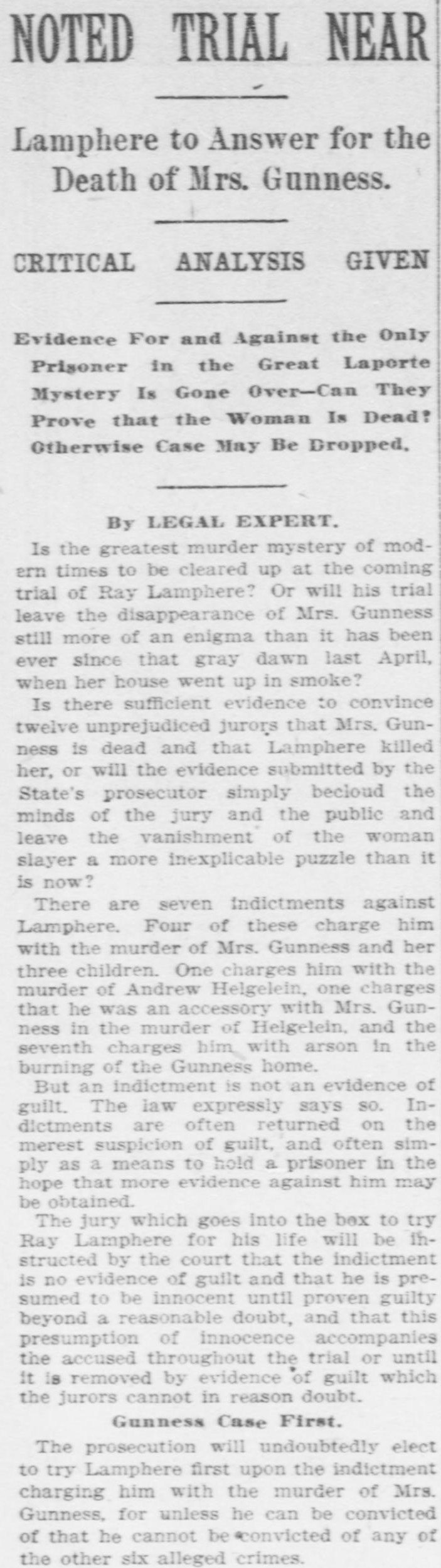
The first dispatch from La Porte treats Mrs. Gunness as a victim: four bodies, hers and her three children’s, taken from her burned farmhouse, and her former hired man, Ray Lamphere, under arrest. He was ‘infatuated with Mrs. Gunness’, it says, and she had tried to have him declared insane. The farmhand it calls Joseph Maxwell is Joseph Maxson in later reports.

The Ocala Evening Star · Ocala, Fla.

The Ocala Evening Star · 1 May 1908 · page 1 · transcribed from the page image

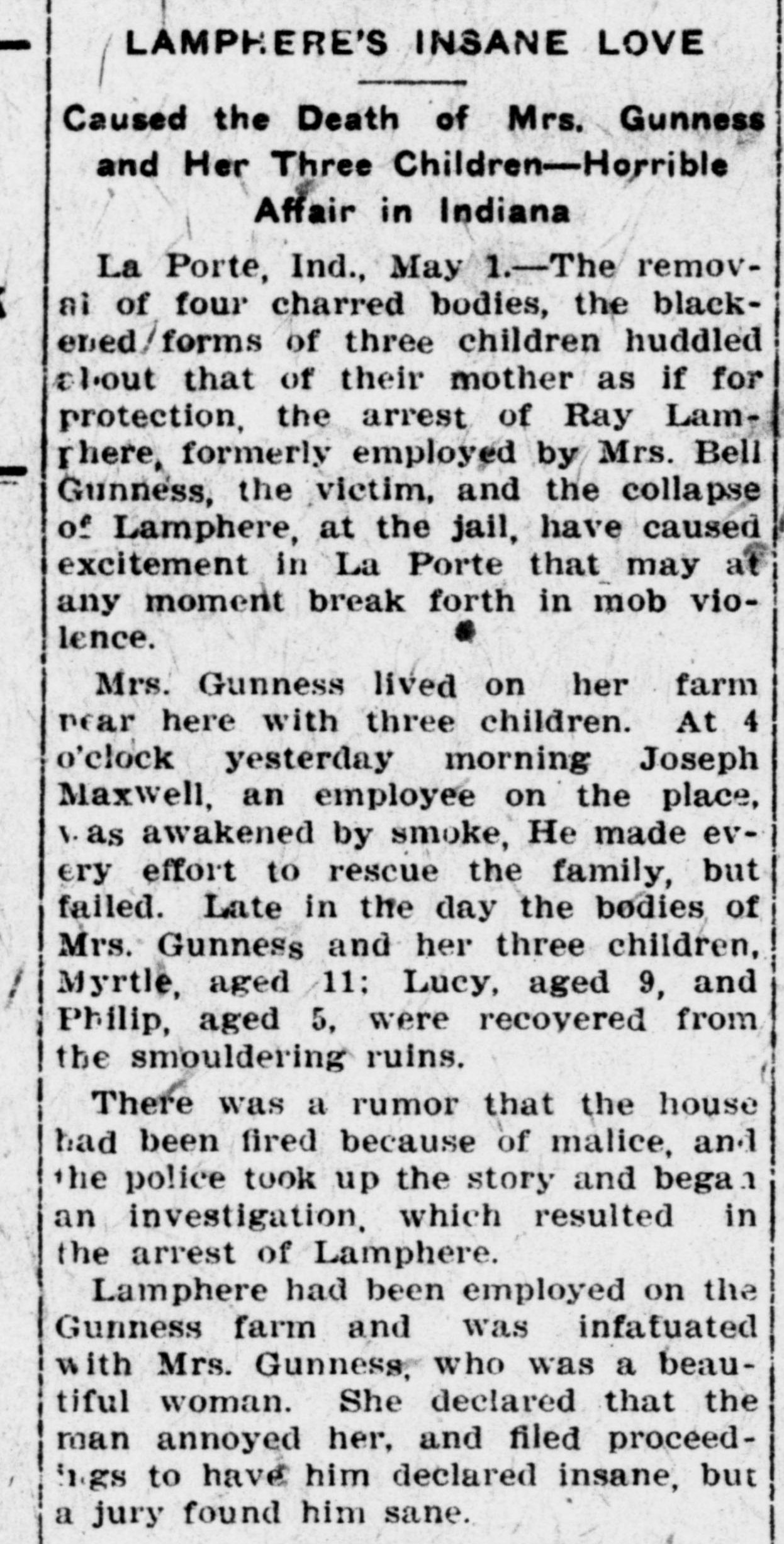
LAMPHERE'S INSANE LOVE

Caused the Death of Mrs. Gunness and Her Three Children—Horrible Affair in Indiana

See moreSee less

La Porte, Ind., May 1.—The removal of four charred bodies, the blackened forms of three children huddled about that of their mother as if for protection, the arrest of Ray Lamphere, formerly employed by Mrs. Bell Gunness, the victim, and the collapse of Lamphere, at the jail, have caused excitement in La Porte that may at any moment break forth in mob violence.

Mrs. Gunness lived on her farm near here with three children. At 4 o'clock yesterday morning Joseph Maxwell, an employee on the place, was awakened by smoke. He made every effort to rescue the family, but failed. Late in the day the bodies of Mrs. Gunness and her three children, Myrtle, aged 11; Lucy, aged 9, and Philip, aged 5, were recovered from the smouldering ruins.

There was a rumor that the house had been fired because of malice, and the police took up the story and began an investigation, which resulted in the arrest of Lamphere.

Lamphere had been employed on the Gunness farm and was infatuated with Mrs. Gunness, who was a beautiful woman. She declared that the man annoyed her, and filed proceedings to have him declared insane, but a jury found him sane.

See the clipping

Bodies buried in the backyard

A brief Topeka item records the turn in the case: four bodies dug up in the backyard of the burned Gunness home. The finding ‘is held to prove that there was murder committed in each case’. The item still counts Mrs. Gunness and her children among those who perished in the fire.

The Topeka State Journal · Topeka, Kansas

The Topeka State Journal · 5 May 1908 · page 7 · transcribed from the page image

Evidences of Murder Found. LaPorte, Ind., May 5.—Four mutilated bodies were found today buried in the backyard of the Gunness home, which was burned recently and in which Mrs. Gunness and her children perished. Finding the buried bodies is held to prove that there was murder committed in each case.

See the clipping

The suitor who came to marry her

A Salem paper names the first identified victim: a South Dakota man who had come to La Porte to marry Mrs. Gunness, whom he met through a matrimonial agency, and whose remains were found in a sack near the ruins. It calls him Andrew Heldergreen and his brother John; most later reports give Andrew and Asle K. Helgelein. With three more bodies found, it counts nine.

Daily Capital Journal · Salem, Oregon

Daily Capital Journal · 5 May 1908 · page 1 · transcribed from the page image

amily Brutally Murdered in La Porte, Indiana

HORRIBLE MURDER IN INDIANA

See moreSee less

FIND BODIES OF NINE

WHOLE FAMILY BURNED IN HOUSE AFTER BEING MURDERED — SEARCHERS FIND BODY HACKED TO PIECES.

La Porte, Ind., May 5.—A crime involving the burning to death of a woman and her three children and the decapitation of a man and woman, their heads being found in sacks, has developed one of the greatest mysteries that the police officials of this or, perhaps, any other city in the state, have ever been confronted with.

A week ago the home of Mrs. Belle Gunness was burned to the ground and Mrs. Gunness and her three children perished in the flame. In searching for the man who committed this crime, the police arrested Ray Lamphere. This sensation was followed by the discovery of a sack containing the head, arms, legs and the hacked bodies of Andrew Heldergreen, near the fence surrounding the ruins of the Gunness home. The mystery of the death of the Gunness' and Heldergreen was further increased by the finding of the skeleton of a woman near the sack.

The mutilated remains in the sack were not identified until today, when John Heldergreen of Aberdeen, S. D., arrived here and declared they were those of his brother Andrew, who had come to La Porte to wed Mrs. Gunness, whom he had met through a matrimonial agency. The skeleton of the woman has not been identified. It evidently had been placed where it was found long before Andrew Heldergreen's body was hacked to pieces and put in the sack.

John Heldergreen said today that his brother had left Aberdeen last January to marry Mrs. Gunness, but he was not informed when the ceremony was to take place.

Andrew Heldergreen was last seen alive here about Feb. 3.

Judging from the way his body is mutilated it is the opinion of the police that a saw was used by the fiend. The police have no clew to follow.

Shortly after the Gunness home was burned they arrested Ray Lamphere. He has undergone a severe examination, but insists that he knows nothing about the crime. He says he saw the home burning while he was on his way to work.

Lamphere says he knew Andrew Heldergreen and told the police that the latter had gone to Sweden. This was before the remains of the body were found in the sack.

Three more bodies were found today in the ruins of the Gunness home, making nine that figure in the great mystery so far. They have not been identified.

One of the bodies was that of a woman and the other two were men. The bodies had evidently been mangled by a saw. It is thought that the two men, like Heldergreen, met Mrs. Gunness through a matrimonial agency. The coroner is certain from other evidence, principally talks with neighbors, that at least six more bodies will be found buried somewhere near the Gunness home.

See the clipping

Love letters that asked for money

With six bodies found, an Iowa paper gathers the week’s discoveries. Helgelein’s brother hands the prosecutor her letters, written in Norwegian, telling Andrew to ‘bring all the money he could get’ and to ‘sew the money in his clothes’; a woman living nearby recalls other men who came to the house and vanished. Lamphere, held for the fire, is now suspected as her accomplice.

The Oskaloosa Herald · Oskaloosa, Iowa

UnconfirmedNo later report in this collection bears it out.

The Oskaloosa Herald · 7 May 1908 · page 2 · transcribed from the page image

Part of this page is damaged, so some words could not be read with certainty. Letters and words in [brackets] are our reading of what survives.

CORPSES DUG UP AT GUNNESS HOME

SIX BODIES ALREADY FOUND AND SEARCH GOES ON.

See moreSee less

MURDERS ARE REVEALED.

Laporte Woman Believed to Have Slain Many, Including Wealthy Suitor—Lamphere Suspected As Accomplice.

Laporte, Ind., May 6.—The sensational findings at the Gunness farm, where five murdered bodies were revealed yesterday, continue, and evidence of additional victims confronts the officers on all sides.

The sixth body was unearthed on the farm this morning, but cannot be positively identified.

Mrs. Christoferson, a neighbor, residing quite near the Gunness house, has given account of the disappearance of a number of other men who may possibly have fallen before the ruthless hand of the murderers. The woman told the sheriff that a year ago she saw a strange man wearing a fur overcoat appear at the Gunness home. Mrs. Gunness told that he was a new hired man. Later he disappeared and Mrs. Gunness explained that he presented her with his overcoat which she wore about the place. Mrs. Christoferson also stated that shortly after the overcoat incident another stranger came to the house. He was a large man with a red mustache. After about three weeks at the place he, too, disappeared. Mrs. Gunness said that this man had replied in person to a matrimonial ad which she had placed in a paper, but that he did not suit her, so he left. Two weeks later a third man reported to have been a lumberman from Wisconsin was seen at the house, but he, too, disappeared after a few days, Mrs. Gunness saying she had dismissed him upon learning that he had two children. Officers suspect that all of these men were made victims of the fiend and that their bodies will be found somewhere on the premises. Anton Olson and [dau]ghter, fath[er and sister of the] missing Jennie Olson, today identified one of the half decomposed bodies found yesterday as that of the missing girl.

The body discovered this morning was so badly mutilated that the determination of sex was impossible. A human rib and several other human bones were found near by. The sheriff beleves that several more bodies or remains will be found later. Aslie Helgaline, the brother of the murdered Andrew, whose body was found yesterday, today delivered into the keeping of State's Attorney Smith a package of love letters written by Mrs. Gunness. The letters were written in Norwegian and are filled with expressions of affection and endearment. The letters to Andrew told [writ]ten Andrew told him to come and bring all the money he could get and they would beautify her home. She requested him to sew the money in his clothes.

When Andrew disappeared, Aslie says Mrs. Gunness wrote love letters to him. She asked him to sell Andrew's property and to bring the money to her. Sheriff Smutzer believes that the woman planned to kill him also. Last summer, so the sheriff says, he accused the woman of murdering and making away with the men who, one after another, had disappeared after visiting her home. Mrs. Gunness, he states, some time afterwards asked him to visit her at her house. She promised if he would do so that she would entertain him. The sheriff says he was suspicious and did not go. Chicago, May 6.—Coroner Hoffman today declared that he would exnume the body of Max Sorenson, the first husband of Mrs. Gunness, to ascertain if there were evidences of murder in this case. Sorenson died mysteriously at Austin, a suburb of Laporte.

List of Known Victims.

Eleven victims so far known to figure in the tragedy were:

Helgelein, Andrew, 40 years old, bachelor, Aberdeen, S. D.; suitor for Mrs. Gunness' hand, who came to Laporte in January and disappeared one month later after loaning the woman $1,500; body dug up today.

Gunness, Jennie Olson, 16 years old, adopted daughter of Mrs. Gunness; disappeared in September, 1906, ostensibly to attend school at Los Angeles; appeared body dug up today.

Unidentified man, believed by Sheriff Smulzer to have been an admirer of the woman; body found today.

Unidentified boy, apparently 8 years old; mutilated body in gunnysack, found today.

Unidentified girl, about 7 years old; mutilated body in gunnysack, found today.

Gunness, Joseph, husband of Mrs. Gunness, whose death at Laporte four years ago had always remained a mystery.

Sorenson, Albert, woman's first husband, who died under mysterious circumstances in Chicago eight years ago.

Gunness, Mrs. Belle, believed to have been burned to death in fire which destroyed her home one week ago.

Sorenson, Myrtle, 11 years old, eldest daughter of Mrs. Gunness; thought to have pershed in the fire.

Sorenson, Lucy, 9 years old, another daughter; also believed to have been a victim of the fire.

Gunness, Philip, 5 years old, youngest child; said to have been killed in the fire.

Laporte, Ind., May 6.—With five bodies already unearthed, Sheriff Smutzer and Coroner Mack continued their search Wednesday for other alleged victims of Mrs. Belle Gunness, who, from all indications, was one of the most fiendish murderesses of the century, and who was recently killed with her three children through the burning of her country home, one mile northeast of Laporte.

Of the bodies so far unearthed, two have been identified. They are those of Andrew Heldgren, a wealthy bachelor of Aberdeen, S. D., and Jennie Olson, 11-year-old stepdaughter of Mrs. Gunness. The other three bodies are so badly decomposed as to make identification impossible.

How the Bodies Were Discovered.

The discovery of the bodies was brought about by the appearance of John Heldgren of Aberdeen, S. D., brother of Andrew Heldgren, in Laporte in search for the missing man. With information that his brother Andrew had come to Laporte to wed Mrs. Gunness and that he had turned over his property to her, he became convinced that he had been made the victim of foul play. While questioning Joseph Maxson, a hired hand on the Gunness farm, he learned of the mysterious digging of holes by him, all of them being filled at a later date by Mrs. Gunness. He led Heldgren and the officers to the place where the holes had been dug, about 150 feet from the house, and there, after digging a few minutes, was uncovered the body of Heldgren. The remains were only four feet under ground and were inclosed in a gunny sack. The legs and arms had been dismembered, but were with the trunk.

About 35 feet further on the four other bodies were wound. Lying on top of a mattress were the skeletons of two men and a woman. Underneath the mattress was the body of an 11-year-old girl, said to be Jennie Olson. All the bodies were taken in charge by the coroner and are now locked in a box on the farm.

Clearinghouse for Murderers?

The discovery of the bodies led expressmen to tell of the delivery of five trunks to the Gunness farm during the last six months, and this fact has caused the authorities to work on the theory that the place was a clearinghouse for murderers. They [illegible] w[ealthy] persons, after being lured to Chicago and killed, were packed in these trunks and sent to Laporte and disposed of.

The developments of Tuesday also caused the authorities to recall that the two husbands of Mrs. Gunness died under suspicious circumstances, both meeting violent deaths. The first, Edward Sorenson, was insured for $8,500, and the second, Gunness, for $3,500. This insurance was paid over to Mrs. Gunness by the companies.

Ray Lamphere, the former hired man of Mrs. Gunness, who was arrested after the woman's home had been destroyed by fire and the bodies of Mrs. Gunness and her three children had been found in the ruins, was charged with murdering the family. He now will be accused of being an accomplice of Mrs. Gunness in the murdering of the alleged victims of the Laporte woman. It is believed that Lamphere, angered because Mrs. Gunness refused to keep him supplied with money, killed her and the children out of revenge and then fired the house to cover the crime.

Looks Bad for Lamphere.

It developed Tuesday night that Lamphere had been seen wearing a fur overcoat answering the description of one belonging to Andrew Heldgren, several times during the month of February. Mrs. Gunness also wore the coat on several occasions, and when asked concerning it stated that it had been given to her by an admirer. Lamphere is also said to have entered a barber shop in Laporte during the South Dakota man's visit in Laporte with a revolver in his possession with which he said he could not part as "he might have use for it before long." The revolver, it is declared, was afterward identified as belonging to Heldgren.

That Lamphere knew Heldgren had been slain is now believed a certainty. During the time he was prosecuted by Mrs. Gunness for trespass he told the police he knew something that Mrs. Gunness wanted him to forget. He would not divulge what he knew, stating that justice would be done at last.

The theory regarding the murder of the girl, Jennie Olson, is that she, nearing an age when she could know too much of the life of Mrs. Gunness and her commission of crimes, was murdered that her lips might be sealed forever.

See the clipping

Nine bodies, and the first doubts

A Maryland paper counts nine bodies and reports a growing belief in La Porte that Mrs. Gunness did not die in the fire: the head of the body taken for hers is missing, and many think she is on her way to Norway. A doctor doubts the largest body is Helgelein’s, though measurement experts later confirmed it. Her sister in Chicago says she was ‘crazy for money’.

The Daily Banner · Cambridge, Md.

The Daily Banner · 7 May 1908 · page 4 · transcribed from the page image

MORE BODIES FOUND

Remains ol Four Other Persons Found In Mrs. Gunness' Yard.

See moreSee less

THE SEARCH IS CONTINUED

Evidence Tends to Show That the Nine Bodies Were Shipped to La Porte From Chicago—Mrs. Gunness' Sister Says She Was Crazy For Money.

La Porte, Ind., May 7.—A possible solution of the Gunness farm mystery, which was deepened when four additional bodies were found in the barnyard, has developed. Evidence tending to show that the nine dismembered corpses had been shipped to La Porte, probably from Chicago, came to light. Testimony of draymen, who had carted trunks and boxes to the Gunness home, lent color to this supposition. La Porte police also received information that two trunks, consigned to "Mrs. Belle Gunness, La Porte, Ind." are held in an express office in Chicago. Assistance of the Chicago police in unravelling the puzzle was sought at once.

Two of the nine mutilated bodies were identified with reasonable certainty. Antone Olson, of Chicago, viewed the body supposed to be that of Jennie Olson, sixteen years old, foster daughter of Mrs. Gunness, and pronounced it to be that of his daughter. A sister of the girl, Mrs. Leo Olander, of Chicago, confirmed the father's identification.

Ask K. Helgelein, whose inquiries regarding his missing brother Andrew led to the first discoveries on the death-haunted farm, became sure that the largest and best-preserved of the corpses is that of his brother. Against this identification, however, is the result of the autopsy performed on this body by Dr. J. H. Meyer. He found conditions which to his mind proved that the man perished long after Andrew Helgelein disappeared last January. Dr. Meyer said that the corpse showed evidences of having been in the ground less than two weeks.

Roy Lamphere, who is held on a charge of first degree murder as a result of the fire that destroyed the Gunness home and caused the deaths of Mrs. Belle Gunness and her three children, gave no new evidence, despite repeated questionings. Ralph W. Smith, prosecuting officer, asserted that a confession is not necessary so far as Lamphere is concerned. "We have evidence in the shape of letters connecting Lamphere with alleged murders at the farm," he said. The exact nature of these letters was carefully guarded by Mr. Smith.

The belief is growing in La Porte that Mrs. Gunness was not burned to death in the fire at her house, but that the body supposed to be hers is really that of another woman. The basis for this belief is that the head of the body supposed to be Mrs. Gunness is missing. The autopsy held immediately after the fire revealed that, while the head was apparently burned off, the rest of the body was scarcely scorched. Many persons think that Mrs. Gunness is now on her way to Norway.

Stirred by the horror experienced by citizens as each additional bundle of decaying bones and flesh was discovered, the commissioners of La Porte county resolved to use every resource at their command toward finding an answer to the puzzles that confront the police. The board decided to offer a reward of $1000 for the solution of the enigma.

The Gunness farm was thronged with curious sightseers. When Sheriff Smutzer and his assistants reached the place they resumed the task of delving for bodies. Carriages, wagons, bicycles and automobiles were lined along the ornamental wire fence which separates the wooded knoll on which the residence stood from the macadam highway leading from La Porte. Many persons also trudged to the place on foot, and by the time the first of the discoveries had been made the spectators numbered hundreds.

Of the nine cadavers, seven are those of males. All were adults, the two smaller bodies found Monday and first thought to be those of children proving otherwise when the bones were examined by the coroner.

The best clew which has yet been found came to light immediately following the discovery of the last three bodies. John A. Welker, a liveryman, and Leo Wade, his employe, told of having carted heavy trunks to the Gunness farm in the summer and autumn of 1906. Clyde Sturgis, employed by Foster & Degarmo, another livery concern, remembered that he took two smaller trunks to the place about a year ago. In addition, several heavy boxes, marked variously "potatoes' and "wall paper," were carted to the house at different times.

If these trunks contained dismembered corpses, disposal of the bodies at the farm would have been comparatively simple. Joseph Maxson, man of all work at the Gunness place since last February; Roy Lamphere, the prisoner in the case, and Fred Brickman, a neighbor, have told of digging trenches in the barnyard at Mrs. Gunness' directions.

Mrs. Gunness Was Crazy For Money.

Chicago, May 7.—Mrs. Nellie Larson, 992 Francisco avenue, sister of Mrs. Gunness, said:

"My sister was crazy for money. When she was a girl she never seemed to care for a man for his own sake only for the luxuries he could give her. She frequently told me that she never would have lived with Max Sorenson, her first husband, if he had not made such a fine home for her. At the time Sorenson died the neighbors charged that he was poisoned, but I never thought so. He became ill one evening and died the next day. He had a good physician to attend him.

"I have not seen my sister for over twenty years. She was angry with me because I would not allow her to have my little daughter to bring up.

"My sister at one time had a candy store in Chicago, but it burned down. The first house she had in the suburb of Austin also burned down."

See the clipping

Eighteen dead, and party politics

A Richmond, Indiana, paper puts the toll at eighteen, counting the two husbands, the three children and the body taken for Mrs. Gunness; the sheriff speaks of thirty-three. It also finds politics in the question of her death: Democratic papers say she is alive, the Republican paper that ‘she lies in the morgue’, and the Democratic mayor is law partner of Lamphere’s attorney.

The Richmond Palladium and Sun-Telegram · Richmond, Ind.

The Richmond Palladium and Sun-Telegram · 8 May 1908 · page 1 · transcribed from the page image

Part of this page is damaged, so some words could not be read with certainty. Letters and words in [brackets] are our reading of what survives.

THREE MORE BODIES ARE FOUND TODAY

At Dawn Sheriff and His Deputies Began Digging "Soft Spots" on Gunness Farm And Later Found Remains.

See moreSee less

POLITICS HAS ENTERED THE HORRIBLE MYSTERY.

Republicans and Democrats Entering Counter Claims as To Whereabouts of Arch Murderess. THIRTY-THREE ARE DEAD. 80 THINKS SHERIFF SMUTZER WHO IS WORKING DILIGENTLY ON THE CASE—PINKERTONS ARE ACTIVE.

Laporte, Ind., May 8.— Sheriff Smutzer and his deputies began digging in the "soft spots" at dawn and at nine o'clock had unearthed a skeleton. This soon was followed by the discovery of the second adult skeleton, believed to be a male, several feet deeper.

Several bones of another body were found at noon, making three today. They were dug up several feet from the former discoveries. Total now eighteen.

Household debris and rubbish covered the spot. The total of eighteen, including the two husbands of the woman, her three children and the corpse supposed to be Mrs. Gunness. The Pinkertons' engaged to work on the mystery are impressed with evidence that Mrs. Gunness is still alive and they will work on this theory. They will also work toward the connection of a Chicago gang with the Laporte farm.

Chief of Police Cochrane is receiving many letters from all parts of the country concerning men who left their homes, taking all their money and mysteriously disappearing. Scores will come here to endeavor to make identifications.

A secret conference between Prosecutor Smith and Coroner Mack is said to have resulted in an agreement that the body of the headless woman in the fire ruins was Mrs. Gunness. Smith claims he has found an important witness in Loius Roule, saloonkeeper, who claims that Lamphere told him he would get even with the widow if he had to burn her house with her and her children inside. This was a few days prior to the fire.

Politics in Investigation.

Politics begins to figure in investigation. Democratic papers claim that Mrs. Gunness is alive and the republican paper says she lies in the morgue. City officials of respective political faith, agree with the theory their political papers advance. Democratic Mayor Darrow, is the law partner of Herman Worden, attorney for Lamphere. Affidavits in the case formerly read "In case of death of Mrs. Gunness" etc., have been changed so that they now read, "case of death unknown woman" etc. Attorney Worder cross-examined Mrs. Gunness during her second prosecution of Lamphere for trespass. Worden now declares her testimony was such as to indicate that the woman believed Lamphere suspected her of being a murderess, and he believes she was then in fear of arrest and exposure. At that time Worden asked her direct, accusing questions regarding the death of her two husbands and their insurance.

"I noticed she turned pale," said Worden.

Lamphere declares that while Helgelein was visiting her, Mrs. Gunness wanted him to procure some chloroform "to kill a hog," but he refused to do so.

Sheriff Smutzer declares he now has evidence to justify the belief that thirty-three persons suffered death on the Gunness farm. Many reasons were deducted today to convince the authorities that the widow is still alive and fled to Norway after murdering her three children and substituting a corpse to represent herself.

The identification of another of the bodies dug upon the Gunness farm, near here, as that of Ole B. Budsberg, of Iola, Wis., and evidence that he, like

Andrew Helgelein, of Mansfield, S. D., had been brought into Mrs. Bella Gunness's net through "matrimonial" advertisements, was one of the clarifying features of the latest developments in the complications of the case. The identification of the bundle of bones and flesh as the remains of Budsberg, was made by the man's sons, Mat Budsberg, aged twenty-nine years, and Oscar H., two years his junior. The young men arrived here Thursday afternoon. A soaking rain, which fell continuously for twenty-four hours, prevented further excavation about the farm, and Sheriff Smulzer devoted his day to unearthing possible evidence which may be used in the trial of Ray Lamphere on the charge of having caused the deaths of Mrs. Gunness and her three children. The result of his investigations were such that Ralph N. Smith, prosecuting attorney for the district, announced that he will seek the immediate indictment of Lamphere and will endeavor to have the case called at the next term of court, which is scheduled to start May 11.

"Lamphere will be on trial within three weeks," said Mr. Smith. "So far as the state is concerned the case is complete and I am ready to present the evidence to the court and jury. I am satisffed that we have collected testimony of such a character that Lamphere's responsibility for the deaths in the fire will be established beyond doubt."

During the sheriff's absence Thursday afternoon two men, thought to be from Michigan City, caused some apprehension by breaking into the carriage house on the Gunness farm, where the nine cadavers have been kept since their exhumation. The men raised a window of the building and one of them already had made his way into the barn when discovered by a watchman. The latter ordered the men away and sent a message to summon a deputy sheriff from Laporte. The intruders disappeared before the officers arrived and efforts to discover their identity failed. It is thought, however, that the men were merely led by curiosity to desire a close view of the grewsome skeletons.

Coroner Mack has taken lengthy dep-

ositions from the father, sister and brother of Jennie Olsen and also from Asle K. Helgelein, of Mansfield, S. D. These documents detail at considerable length the known relations between Mrs. Gunness and these two of her victims. Helgelein's proved of special interest in that it confirmed many of the previous reports regarding the metods by which Mrs. Gunness drew the South Dakota farmer into her web.

The Olsen testimony details the early life of Mrs. Gunness and revealed that the woman had refused at one time to return the girl to her father.

Religious Fanatic.

Chicago, May 8.—Mrs. Belle Gunness is a religious fanatic, self-hypnotised into crime. This was the solution of the Laporte horror, so far as motive is concerned, offered by Dr. Charles E. Jones, of Austin, Ill. This sensational sidelight was strengthened by assertions made by Anton Olson father of Jennie Olson, one of the supposed victims. He declared that he was convinced that his daughter had been strangely fascinated by the woman, and he was strongly inclined to the belief that she possessed a peculiar hypnotic power over all children.

Sudden affluence, following the receipt of insurance money on the death of her first husband, is also supposed by the physician to have had its effect on her mind already unhinged by religious eccentricities.

Dr. Jones and Dr. J. B. Miller were called to attend Mads Sorenson, the woman's first husband, on the day he died—July 30, 1900. He made some remarkable observations at the time.

"If Mrs. Sorenson, or Gunness, as she later became, is guilty of the hor-

(Continued on Page Seven.)

THREE MORE BODIES

ARE FOUND TODAY

(Continued From Page One.)

rible murders," said Dr. Jones at his office, 118 Pine avenue, Austin, "I can explain psychologically to my own satisfaction the causes that started her on her terrible work. I remember her well as a religious fanatic.

Deranged by Wealth.

"The sudden wealth, comparatively speaking, that came to her at her husband's death, I believe may have had for her an irresistable suggestion of the ease with which money might be obtained. In the incident of her husband's death her temptation to commit the alleged atrocities may have had its birth.

"For 15 years I have been a conscientious student of the psychology of crime and never in that time have I found a more interesting case. I believed at the time that Sorenson met a natural death, and if so my theory holds equally good. The ease with which suspicion was quieted had its effect upon the woman. I was called to the house on the morning of the man's religious frenzy.

"She was of the weeping, wailing type. And while one might expect her to be hysterical she showed an unusual fanaticism. In just such a state of mind as this I, as a phychologist, would say suggestion would find fertile ground. I remembered the woman was active in the Norwegian Lutheran church and was especially interested in religious work for children.

"The fact that she willed her money to a children's charity I regard as strengthening my theory that fanaticism may have been at the bottom of the unparalleled murders. It is something of the same spirit you might say as prompted tortures and burning at the stake in the name of religion in the middle ages.

A Strange Religion.

"In my psychological studies," continued the physician, "I have observed that religion is not restraining in a moral sense. Religion is not ethics. The two are quite separate. Religion and morality are often found developed together, but there is no essential union between them. Religion in its fanatic state may be a passion devoid of morality that will take any means to attain its end. Such, I consider, Mrs. Gunness' religion may have been. There is a big difference between insanity and fanaticism.

"Mrs. Gunness struck me as a fanatic, just as Billik and Hoch did. To commit crime easily requires a powerful suggestion. This suggestion is gained usually either through having committed a similar crime before or some peculiar circumstance, of which Sorenson's death is an example."

When called to Sorenson's deathbed Dr. Jones says he was told by the widow her husband had taken a headache capsule which he had brought home himself. The doctors asked to see the rest of the capsules.

"When I saw they made him sick I threw them away," the woman is said to have explained.

"We could detect no sign of poisoning," adder Dr. Jones, "and Dr. Miller, who was in charge of the case, and I agreed on cerebral hemorrhage as a superficial opinion. There really were no symptoms of enlargement of the heart." Coroner Looking Over the Several Dismembered Bodies

MODERN WOMAN BLUEBEARD AND HER THREE CHILDREN MRS BELLA GUNNESS.

See the clipping

The wrong woman, arrested on a train

Syracuse detectives arrest a woman in mourning in her berth on the Atlantic Express after two traveling men think she resembles the newspaper pictures of Mrs. Gunness. A report the next day names her Mrs. Cora Belle Herron, a Chicago widow who proved who she was and went on to New York. In La Porte, meanwhile, the ashes are to be sifted for Mrs. Gunness’s gold teeth.

The Washington Herald · Washington, D.C.

The Washington Herald · 9 May 1908 · page 1 · transcribed from the page image

SUSPECT HELD

Woman Believed to Be Mrs. Gunness Arrested.

See moreSee less

ON WAY TO NEW YORK

Denies She Is Harpy, and Tells Plausible Story.

ACCOMPANIED BY MOTHER

Was Undressed in Berth When Placed Under Arrest by Detectives. Fellow-travelers Observed Resemblance to Pictures in Newspapers. Declares She Is Widow of Chicago Merchant and Left Cooperstown, Pa., to Visit Sister in Metropolis. Three More Bodies Found.

Utica, May 9.—A woman, dressed in mourning, was arrested on the Atlantic Express just as it left Syracuse at 1 o'clock this morning, who is suspected of being Mrs. Belle Gunness, the Laporte murderess.

She was taken from the train when it reached Utica, and with her a woman, said to be her mother, who accompanied her. She started back to Syracuse at 2:05 a. m., after being in the city about half an hour.

The woman was in such a state of collapse when she left the train here that she could not talk for a few moments. Then she became more composed and said she was Mrs. L. A. Hearon, of Chicago. She said her husband, a dealer in essential oils in that city, died on January 1, and that she came East a few weeks ago to stay with a brother at Cooperstown, Pa., near Franklin.

The woman said she started yesterday afternoon, with her mother, to visit her sister in New York. She wouldn't tell the sister's name, under instructions from the detectives. She has a receipt for lodge dues made out to Mrs. L. A. Hearon and another receipt made out to her in Franklin, Pa.

She made a good impression. Her mother had nothing to say.

Suspected by Fellow-travelers.

The woman was arrested on a tip given to the Syracuse police by trainmen on the Atlantic Express, on which she was a passenger. Traveling men on the train told the conductor they were positive the woman was Mrs. Gunness.

Telegraphic advices were sent to the Syracuse police. Detectives Donovan and Neis, of that place, boarded the train when it arrived at 12:55 a. m.

The woman was in her berth. The train would not wait for her to dress. The detectives went aboard and arrived here on the way.

The Pullman conductor told the detectives the two women got on the train at Ashtabula, Ohio, which might be a junction point for persons traveling to New York from Franklin, Pa.

Both women were nicely dressed. The woman arrested asked the detectives to let her sister in New York know that her train had been delayed. She pleaded with them not to tell that she had been arrested.

Rochester, N. Y., May 9.—The information which led to the arrest of Mrs. Gunness at Syracuse was given to Police Lieut. Henry F. McAlester, of this city, by two traveling men who were on their way here from Cleveland.

They had copies of newspapers containing pictures of the woman. They thought one of the women passengers bore a most striking resemblance to that in the newspapers. This belief was strengthened by the peculiar actions of the woman herself.

As soon as they got to Rochester, they went to the Powers Hotel, where they told the house detective, who, in turn, notified the detective.

The lieutenant called Capt. Quigley, at Syracuse, on the 'phone, and informed him of the traveling men's suspicions, giving the number of the car in which they had been passengers.

Resembled Pictures in Print.

The traveling men who furnished the information were E. R. Duell and H. E. Hunt, both of Detroit.

They say the woman was between thirty-five and forty years of age, and weighed about 200 pounds. She was heavily veiled, and seemed eager to avoid attention on the car.

Syracuse. May 8.—Mrs. Belle Gunness, accused of a dozen or more murders in her home outside of Laporte, Ind., was arrested here to-night.

The arrest was made on a train. Mrs. Gunness was undressed, in a sleeper, when Syracuse detectives took her into custody. They did not take her off the train, but went along with her to Utica, where the train will make the next stop.

The understanding is that she was on her way to New York, and the Syracuse detectives got word from the authorities at Laporte to arrest her.

The train should arrive at Utica at 1:40 a. m.

Three More Bodies Found.

Indianapolis, Ind., May 8.—To-day's excavations in the private cemetery of Mrs. Belle Gunness brought three additional skeletons to light.

Hardly one-fifth of suspected ground has yet been investigated by the sheriff and his assistants.

The skeletons were the remains of men, one of them large. In every instance

Continued on Page 3, Column 4.

SUSPECT HELD.

Continued from Page One.

quick-lime had been used to hasten the destruction of the flesh.

In all the graves remnants of gunny sacks were found, though one of the bodies was buried in a pine box. The other two were placed in the ground in a nude condition.

In one grave was found evidence of the bones having been partially burned before being placed in the ground, as though an effort had been made to destroy the body with fire. In two graves all the bones or complete skeletons were not found. When the parts were placed together, it was demonstrated beyond a doubt they were the remnants of two persons and not one body.

Fourteen Victims Discovered.

The finds to-day increase the number of known victims to twelve or to fourteen, if the two husbands of Mrs. Gunness were really murdered, as is now believed. Counting four persons who lost their lives in the burning of the Gunness home, the tragedy to date includes eighteen persons, and the investigation has only begun.

In a search of the debris in the cellar of the burned residence to-day several bones were discovered. It could not be determined exactly to what they belonged, whether to a human being or an animal. It is believed that bodies of Mrs. Gunness' victims were placed in the cellar until they could be buried at night.

That the woman used the cellar for some peculiar purpose was confirmed to-day, when Miss Jennie Garwood, a school teacher, told the officers that the two Gunness children came to school one morning in tears, and told her they had been severely whipped by their mother for trying to get into the cellar through a window.

Ole Budsborg Identified.

The arrival of Matthew and Oscar Budsborg, sons of Ole Budsborg, of Iola, Wis., has resulted in the identification of the body of their father. The young men went to the Gunness farm and saw the body thought to be that of Ole Budsborg. The younger Budsborg wept piteously.

He identified the body by the mustache and shape of the head. They say they will take the skeleton back to Iola with them if the authorities will permit. Both sons recalled that their father drew $2,000 from the bank in March, 1907, and came to Laporte to work for Mrs. Gunness.

There is no doubt that Budsborg had been murdered. The body was wrapped in a gunny sack and buried in a pit filled with quicklime.

It was learned to-day that Olaf Limbo, who came all the way from Norway to marry Mrs. Gunness, is probably another of her victims. If he died on the Gunness farm he was one of the early victims, as he came here shortly after Mrs. Gunness' second husband died.

Before he came here he had been in Chicago for some time. It is believed he is "the man from Chicago" referred to in Ray Lamphere's statement.

Believe Corpse Is Mrs. Gunness.

Pinkerton detectives who were brought into the case to-day went carefully over all the circumstances attending the burning of the Gunness home. In addition to declaring that the evidence against Ray Lamphere is all that the State needs, they expressed the opinion that the headless body found in the cellar of the burned house is that of Mrs. Gunness.

The prosecutor and sheriff are of the same opinion. All the ashes in the cellar will be sifted, in the hope of finding the woman's gold teeth, and thus making sure of her death.

In the meantime, however, detective agencies throughout the country will be asked to keep a lookout for the woman. Police departments at seaport cities especially will be urged to keep on the alert, on the theory that if she escaped death she has gone back to Norway.

Late this afternoon the sheriff began an investigation to determine if a number of the bodies found are not those of stock men who passed through this county from time to time. Several of them disappeared mysteriously.

At the Gunness barn there are now several horses and buggies which the widow said she had traded. One horse and buggy belonged to a Montana man who stopped at a resort near by and had said he was going to Mrs. Gunness to sell her the rig.

See the clipping

A doctor says the body is too small

The Tribune prints a statement credited to Dr. Harry H. Long, who helped examine the body: it is fifty pounds lighter and five inches shorter than Mrs. Gunness, and he says ‘Mrs. Gunness is still alive’. A report the same day calls him a former coroner and says he denied issuing it. A carpenter who had worked on her farm also recalls the men she called ‘cousins’, whose trunks stayed behind.

New-York Tribune · New York, N.Y.

This article was wrong. The papers corrected it the next day.

Wrong

New-York Tribune · 10 May 1908 · page 8 · transcribed from the page image

MRS. GUNNESS ALIVE

DECLARED BY CORONER.

See moreSee less

Bones Found in Burned House Those of Much Smaller Woman.

La Porte, Ind., May 9.—Dr. Harry H. Long, coroner of La Porte County, who assisted in the post-mortem examination of the body supposed to be that of Mrs. Gunness, declares positively that the body in the morgue is that of a woman who weighed fully fifty pounds less than did Mrs. Gunness; also that it is five inches shorter than Mrs. Gunness. He says Mrs. Gunness is still alive.

Dr. Long's statement follows:

A strange coincidence is that the foreheads of all the children were burned at the same place. This is extraordinary. A skull crushed by a blow at any point and then subjected to fire would be more likely to burn away at that point than at a sound place, as the heat and fire would reach the bony structure and thus attack the cartilages from both sides. The theory that the head of Mrs. Gunness had been entirely burned away is disproved by the fact that, being subject to the same intensity of heat and flame, and being harder, it could not have been burned away as easily as the skulls of the children.

The body at the morgue is not that of Mrs. Gunness, because it is not correctly proportioned. It is that of a rather plump woman of the general contour of Mrs. Gunness, but weighing between 150 and 160 pounds. Mrs. Gunness weighed fully 225 pounds.

The arm that was burned off was found beside the body and is well formed. The fingers show evidence of careful manicuring, and that was something that Mrs. Gunness knew nothing about.

Basing my statements on the statistics and figures of eminent physicians of this country and Great Britain, I find that the body at the morgue is almost five inches shorter than the body of Mrs. Gunness would be under similar circumstances. The fire would, of course, cause the body to lose weight, but the general physical outline of the woman would remain.

Mrs. Gunness was a woman of unusual appearance. She was large, bony, powerful looking, with square jaws and black eyes. She was a woman who would attract attention anywhere from her lack of womanly characteristics. She wore a large fur coat during the winter and her long strides, together with her remarkable countenance and her generally vicious appearance, gave her an aspect that was almost terrifying.

Only one man was occupied in digging at the Gunness farm to-day, and his work was without result.

The authorities are endeavoring to trace a young man named Canary, who it is believed may have been one of the victims of Mrs. Gunness. A letter was received this morning from his mother at Pink Lake, Ind., saying that her son, who was about twenty years old, disappeared almost two years ago. It is known that young Canary worked for Henry Bizge, who lived about a quarter of a mile from the Gunness farm. He disappeared from La Porte in June, 1906. Mrs. Canary declares in her letter that the boy was not bright and that he once burned an empty cottage for the pleasure of seeing it destroyed.

A great crowd of sightseers is expected to-morrow to view the Gunness farm. An extra force of deputies and guards will be on duty to see that the fences and other appurtenances of the place are not dismantled and carried off by relic hunters.

Oklahoma City, Okla., May 9.—Emil Greening, a carpenter, and his brother, Fred, a painter, both of whom worked last summer on Mrs. Gunness's Indiana farm, told to-day of the mysterious visits of a dozen men to the home of Mrs. Bella Gunness and of their more mysterious disappearance. Jennie Olsen, seventeen years of age, the adopted daughter of Mrs. Gunness, was Emil Greening's sweetheart. Emil said to-day:

Jennie and I were good friends, and when her mother announced one night that she had decided to send Jennie to California with a professor, who, she said, had come after Jennie, but whom I never saw, Jennie came to me and declared that she would never go.

In the morning I did not see Jennie. Her mother told me that Jennie was still asleep, and, when I returned from an errand late that afternoon, I was told that Jennie had gone. I wrote to her, but I gave the two letters to Mrs. Gunness, and I never received any answer. I don't believe there ever was a professor, for I did not hear any man's voice or see any strange man about the house at that time.

Mrs. Gunness received men visitors all the time. A different man came nearly every week to stay at the house. She introduced them as cousins from Kansas, South Dakota, Wisconsin and from Chicago. Most of the men that came brought trunks with them; but they rarely took the trunks away. Mrs. Gunness kept the "cousins" with her all the time in the parlors and her bedroom. She was always careful to make the children stay away from her "cousins," who rarely tried to show them any affection.

I never knew of Mrs. Gunness bestowing her affections on any of her hired men, except Ray Lamphere.

So many men came and I saw so little of them that I cannot remember many of them, but I distinctly remember a Mr. Moo, who came from Chicago the day before Christmas, 1906. He was with Mrs. Gunness almost constantly.

When he left, his trunk stayed behind, and no one saw him go. It was several days before Mrs. Gunness announced that he was gone.

Shortly afterward, Mrs. Gunness sent me to Michigan City to get a horse that she said Moo had promised to give her. I took a day to make the trip. When I got to Michigan City something was wrong, and I was told to come back for the horse later. When I returned to the farm another "cousin" who was there when I left was gone.

In about two weeks I was again sent to Michigan City, and still there was no horse, but when I got back another cousin was missing, and no one around the place had seen him leave.

Moo's trunk was in the Gunness home on July 11, 1907, when I left the place. His was not the only one. There were about fifteen other trunks, and one room was packed full of all kinds of men's clothing, which Mrs. Gunness said her "cousins" had left, and she was not certain that they would be back for them.

In the light of what has transpired, I believe that many murders were done right under my nose.

Mrs. Gunness had a little place fenced off just south of the kitchen. She never allowed any of the hands to go near it, and she would fly in a rage if a man looked that way when he was passing. Two sides of it were barricaded with barrels and boxes, shutting off the view, but from the other two sides you could see that it looked like a garden in spots.

See the clipping

Officials answer: the body is hers

A Salt Lake paper carries the officials’ reply to the doubters, whose reports it traces to the defense camp and to local politics. Dr. Long now calls his view a personal opinion, and Dr. Meyer says the heat would account for the body’s small size. Remains of her ring, a money-belt buckle and a key to her safety deposit box have been found in the ashes.

The Salt Lake Herald · Salt Lake City, Utah

This article was wrong. The papers corrected it the next day.

Wrong

The Salt Lake Herald · 10 May 1908 · page 1 · transcribed from the page image

BODY IN RUINS MRS. GUNNESS BEYOND DOUBT

Rumors to the Contrary Started by Enemies of County Officials.

See moreSee less

WOMAN ARRESTED AT SYRACUSE RELEASED

LA PORTE MURDERESS SAID TO BE DESCENDANT OF SAME MAN AS KATE BENDER.

Syracuse, N. Y., May 9.—Mrs. Cora Belle Herron, widow of Frederick B. Herron, former president of the Sethness Chemical company of Chicago, who was arrested by Syracuse detectives in a Pullman sleeper this morning on suspicion of being Mrs. Belle Gunness, the Laporte alleged murderess, was quickly able to prove her identity and went on to New York this afternoon.

An effort was made to have her sign papers releasing the city of Syracuse from liability for her arrest, which she characterized as "an outrage without the shadow of an excuse."

Louisville, Ky., May 9.—The editor of a Louisville afternoon paper today received the following unsigned communication in the mails:

Louisville, Ky., May 9.—"Dear Mr. Editor: I do not like my name to be known, hence I will not give it, but will tell you that the notorious Mrs. Gunness is descended from the same man as was Kate Bender of Kansas notoriety. Kate's father was also a brother to Mrs. Gunness' grandfather. I know this through my marriage ties.

"In my opinion Ray Lamphere is kin to Mrs. Gunness."

Laporte, Ind., May 9.—The dissensions which have been brewing among the officials of the city and county of Laporte interested in the solving of the mysteries of the Gunness farm, broke out today. It is openly charged that the political affiliations of some of the men concerned has much to do with their attitude towards the labors of the sheriff and the prosecuting attorney and a factional fight in the party to which the latter belongs is blamed also.

The widespread reports that evidence had been found tending to prove that the corpse supposed to be that of Mrs. Belle Gunness is in reality the body of another woman are said to have had their origin in the camp of the defense, the members of which are of opposite political faith to the sheriff and of the faction opposing the prosecutor.

Denied Issuing Statement.

These reports had their origin in a statement said to have been given out by Dr. H. P. Long, a former coroner, and one of the four physicians who performed the autopsies on the bodies found in the ruins of the Gunness home. Dr. Long, however, said today that he had not issued such a statement, but had merely expressed a personal opinion that he was not satisfied as to the identity of the corpse in question.

Two other members of the board refused to be drawn into the controversy, but Dr. J. H. William Meyer, the fourth member, said that he had no doubt but what the corpse was that of Mrs. Gunness. He, too, however, declined to reveal the findings of the physicians.

Report Changed by Coroner.

The attitude of the coroner as between the two factions, has not become manifest. At the prosecuting attorney's office, however, it was asserted that Dr. Mack, the coroner, had changed the first report as to the identity of the Gunness body and an inspection of the documents showed this to be the case.

All four doctors were unanimous as to the facts and conditions surrounding the bodies taken from the Gunness home.

Agreed as to the Facts.

"There was absolutely no difference among us," said one of the doctors, and this was confirmed by other members of the board. There is absolutely no indication that the skull of any of the bodies of the three children bore penetrating wounds. It has been asserted that fractures caused by some blunt instrument had been found on these sku[l]ls. Neither was there any kind of brain hemorrhages and the heart and lungs of at least two of the children revealed the same conditions found in these organs in the body of their mother. The hearts were all dilated and full of clots and the lungs had collapsed. This condition is found in the cases of persons who have died from suffocation and the circumstances is taken as another evidence that the theory regarding Mrs. Gunness having killed her children, substituted another woman's body for her own and then escaped after setting fire to the house is not tenable.

Heat Would Shrink the Body.

One of the alleged circumstances upon which that theory is based, is the fact that the body of the woman is much smaller than Mrs. Gunness was. The intense heat to which the corpses were subjected, according to Dr. Meyer, would, however, fully account for this circumstance.

Mrs. Gunness was an abnormally large woman in every particular. When the corpse was cut open a layer of fat two inches thick still existed over the abdomen.

Still further evidence that the body was that of Mrs. Gunness was found in the fact that the remains of a finger ring which she is known to have worn, were found in the ashes several days later. The buckle of a money belt, such as the woman is known to have used, was also picked up and later still a key which corresponds to the lock on her safety deposit box was discovered in the basement.

For the first time since Sheriff Smutzer began work on the farm he failed today to discover at least one additional body. Excavations were made at several points in the barnyard, but in none of them was there indications of human bones or flesh.

The search for bodies is to be abandoned, for a few days at least, the sheriff announcing that he will endeavor to secure additional evidence regarding the identity of the corpses found in the basement. With this object in view, he has employed Louis Schultz, who was formerly a miner, to sluice the ashes in the cellar, in the hope that additional metallic relics of Mrs. Gunness will be found. The gold filling which she is said to have had in several of her teeth, is to be an especial object of this search.

Search Not Abandoned.

The sheriff is not convinced that he has found all of the bodies which have been buried on the farm, but he has not fully determined the method by which he will conduct further explorations.

The crowds of visitors to the farm and the city were augmented today. In the city there was a constant stream of morbid sightseers visiting the morgues, where ten of the fourteen bodies are lying.

The sheriff received today several inquiries from outside points regarding missing persons who may have been among the victims of Mrs. Gunness. None of these was connected directly with the farm, the fears of their relatives being based upon circumstantial evidence.

New evidence regarding Lamphere's alleged connection with the deaths at the farm were also discovered. The more important of these were William Slatter and John Rye. The latter asserts that on the day when Helgelein is supposed to have been killed, he and Lamphere drove to Michigan City. They returned at night, and Lamphere alighted when they reached a point opposite the Gunness farm and cut across the fields toward it, remarking that there would be "something doing" there that night.

Slatter and Lamphere occupied the same bed on many occasions following the prisoner's dismissal from the Gunness establishment. He says that Lamphere told him that he had run Helgelein out of Mrs. Gunness' house at the point of a revolver on one occasion, but that the South Dakotan returned later and remained.

Insisted Upon Currency.

A deposition was made here today by Frank J. Pitner, cashier of the First National bank of Laporte, who handled the transactions by which Helgelein collected $2,890 from the bank in Mansfield, S. D. Pitner asserts that Mrs. Gunness accompanied Helgelein on his visits to the bank and when the money was withdrawn, refused to let her visitor take a cashier's check in part payment. Mrs. Gunness insisted that currency only should figure in the transaction.

Search was instituted today for traces of E. J. Tiefland, a resident of Minneapolis, who is said to have come here about a year ago. An advertisement in a Minneapolis newspaper is said to have been the lure by which Tiefland was led to open correspondence with Mrs. Gunness.

Asle K. Helgelein, whose insistence that his brother had been murdered, caused the first excavating to be done on the death farm, departed for his home in Mansfield, S. D., this evening, after he had made arrangements to have the body of his brother given a Christian burial.

See the clipping

The prosecutor’s case, and Lamphere’s story

A Richmond paper reports three rings found in a charred hand near the body, and the prosecutor’s word that there is ‘not the shadow of a doubt that Mrs. Gunness is dead’. It also carries Lamphere’s account, gathered through a minister, of overhearing her plan to give him chloral. The state admits its case is entirely circumstantial; in November the jury would convict Lamphere of arson only.

The Richmond Palladium and Sun-Telegram · Richmond, Ind.

The Richmond Palladium and Sun-Telegram · 12 May 1908 · page 1 · transcribed from the page image

CORPSE FOUND IN RUINS IS THAT OF THE BORGIA

Rings Found in a Hunk of Flesh Identified as Those of Mrs. Gunness and All Say Wom- an Is Dead.

See moreSee less

LAMPHERE'S FATHER WILL ASSIST HIM.

Has Arrived at Laporte and Will Do Everything He Can For Son Who It Is Said, Will Be Convicted.

Laporte, Ind., May 12.—Identification of Mrs. Gunness' corpse is about finished, due to the finding of three rings. Close to the remains in the morgue, a chunk of badly charred flesh which was broken into pieces disclosed the fact that it was a portion of a human hand. The fingers tightly clutched contained rings, one of which appeared to be a wedding ring, and another a plain gold band, and the third a diamond ring. They are now in the possession of Coroner Mack who claims that persons familiar with them have identified them as those worn by Mrs. Gunness. It appears to be the belief of the majority of people in Laporte that the woman died in the fire which ruined her home.

Laporte, Ind., May 12.—A complete solution of the mysteries of the Gunness farm is expetced within 48 hours. A final step will be taken either today or tomorrow by the men who have brought the investigation of the horror to its culmination, and with it is promised an answer to all the questions which have arrayed themselves before the public during the past week.

The exact nature of the action is not disclosed, but from an authoritative source it has been learned that the climax of the great case is at hand.

The inquiry, which has been carried on almost entirely in secret, has been pronounced successful, and men who have directed it wear smiles of elation as the end appears in sight.

Each of them is discreet in his utterances, but there is not one to whom the secret has been disclosed who does not admit that the clouds of doubt are to be dispelled. There is satisfaction expressed in the attitude of every man upon whose shoulders rested the responsibility for placing the culpability behind at least 14 deaths.

Four of these are crossed from the list by absolute certainty that Ray Lamphere, the prisoner in the county jail, set fire to the home of Mrs. Belle Gunness on the morning of April 28 and thereby caused the death of the widow and the four children.

Indictments to be Sought.

For this he is liable, under the peculiar provisions of the Indiana state laws, to conviction for murder in the first degree as well as for arson. Indictments against him upon both these charges will be asked of the grand jury, which met in its first session yesterday, but will not reach his case before Wednesday.

As to the crucial movement which in itself will reveal the manner of death of the 10 murdered persons whose bodies were guarded by closely woven wire netting, the silence of the officers of the law in response to queries as to the arrest of one or more accomplices provides the only answer.

It is certain that they came to their death through the use of poison. The administration of a deadly amount of chrloral has been proved. The places at which the drug was purchased in the past eight years have been found. The inanimate corpses were dismembered either in a "chamber of horrors" on the second floor of the Gunness home or in the basement. Two knives, one a six-inch dagger, and the other a needlepointed double razor-edged surgeons knife, are in their possession.

That the big, stolid Norwegian woman enticed some of the men into her lair by the bait of matrimonial advertisements and there had an active hand in killing them and disposing of their bodies is established without question by those expected to answer the riddle.

Remaining Question.

The one remaining question, "Whether or not she had assistance in her crimes?" is to be met by the action that is expected almost hourly.

The arrival at this point has been preceded by a hunt for details, only rumors of which have been given to the public. Here and there bits of evidence have leaked out, but the great array of facts, it is said, was secured from statements made by Ray Lamphere, the former hired man who blackmailed the Gunness woman through the possession of knowledge concerning her dark secrets.

He has not been "sweated" at any time. No attempt at the "third degree" has been made, but it is from his utterance that the chain of testimony has been forged.

The chief agent in securing the confidence of the prisoner has been a minister, Rev. E. A. Schell, pastor of

(Continued on Page Seven.)

CORPSE FOUND IN RUINS IS THAT OF THE BORGIA

(Continued From Page One.)

the first Methodist church. Ever since the first day of the prisoner's incarceration the clergyman has been a visitor at his cell. For hours at a time he has been locked in with the man who might carry the secret with him to the gallows.

The man has been cautioned by his legal counsel to avoid giving any information concerning his knowledge of his actions upon the night of the disappearance of Andrew Helgelein, the last victim of the arch murderess, his observations upon that and later occasions and his actions upon the night of the fire which cost the lives of the woman and her children.

Damaging Admissions.

In spite of these warnings, the accused man has made admissions that, in addition to the earlier proof that he fired the building, have led to the conviction that he either was a witness or an active participant in the putting away of Andrew Helgelein.

According to Lamphere's statements shortly before June 27, 1907, Mrs. Gunness stopped him on the street and asked him if he could go to her farm and do some carpentering and other general work. He accepted her offer and on that date began his work repairing a floor in the house.

On the first night their relations passed to a stage of intimacy and it was not long before his room was changed from the lean-to, at the rear the house, to a chamber opposite to that of the widow, and she made to him a proposal of marriage.

She urged that this step be taken as soon as possible, but that it must be preceded by his having his life insured. She pointed out that under the state law none but a relative could be the beneficiary of an insurance policy and that, if issue should result from their close association, there would be no provision for the future in case of his death.

This aroused no suspicion in his mind but his delay in acting upon her suggestion caused Mrs. Gunness to order him to his former bed chamber in the rear of the house. It was about this time, somewhere near January 4, that he discovered that Helgelein had come to the house. One afternoon, when he had been ordred by Mrs. Gunness to build a fire in the sitting room stove, he was startled by the appearance of a stranger, who came down the stairs.

Ordered Him to the Barn.

This was Helgelein, he learned later, for at that time Mrs. Gunness returned to find the two men engaged in questioning each other as to his identity. In a rage she ordered Lamphere to go to the barn, "where he belonged."

The jealousy which sprang up in the heart of Lamphere led him to watch the woman and her new lover closely. He listened at windows and doors and on one of these instances heard Mrs. Gunness tell Helgelein that she was "sick of having Lamphere around."

"I am going to give him a dose of chloral," she said. "How much will I give him to kill him?"

"I can't tell," replied Helgelein. "He's got a dog. Why don't you try it on the dog?"

Thoroughly frightened, Lamphere went to a friend in Laporte and told him what he had heard. He was advised to "pack his kit and clear out," but returned to the farm. A few days later his dog disappeared and he revisited his confidant, whom he advised that, in case of his sudden death an autopsy should be held.

Louis Kelting, shoestore proprietor, declared that he had been selling shoes to Mrs. Gunness for years and that he knew she had a large foot and wore a No. 9 shoe. This conflicts with the statement of Prosecutor Smith that the woman's foot was small.

Discovery was made that there was a quilt between the body of Mrs. Gunness and those of the three children. Pieces of the burnt quilt, which were found upon the body of the woman, by a close inspection brought the announcement from the prosecuting attorney that he believes the woman was covered with it when the fire was burning.

Sheriff Smutzer has decided that he would have the barn moved and the ground under it dug up.

A conference of the officials working on the case was held today. The common council of Laporte county has been called to take action of the Gunness farm mystery. A vote of the common council is needed to expend public funds to carry on the investigation.

Pinkerton detectives working under Superintendent C. J. Smith report that they are securing valuable information. They believe that Mrs. Gunness is dead and that Lamphere can clear up the entire mystery.

Expects to Convict Lamphere.

"I expect to have Ray Lamphere tried and convicted of the murder of Mrs. Belle Gunness," said Prosecutor Smith. "There is not the shadow of a doubt that Mrs. Gunness is dead. The gold ring on the finger of the corpse lying in the basement of the burned building is one that Mrs. Gunness constantly wore during her lifetime.

"That ring, now in the possession of the authorities, has been positively identified by several persons. The ring was found on the dead woman's finger.

"The sheriff and his men, assisted by the Pinkerton detectives, who have been getting evidence for the state, have gathered proof, in addition to that of the gold ring, which demonstrates conclusively that Mrs. Gunness is dead."

Hitherto unpublished evidence regarding the movements of Ray Lamphere on the day of the fire in the Gunness house have strengthened the case for the state. County Prosecutor Smith is responsible for the statement that Lamphere's comings and goings have been so closely followed that not half an hour is unaccounted for.

Neighbors who were first awakened at the time of the Gunness fire agree that it started about 4 o'clock in the morning. Lamphere's own statement has been that he left "Negro Liz's" house at 4:30 o'clock in the morning. This contention by Lamphere was the one stumbling block that has been in the prosecutor's way.

"More likely he left at 3 o'clock; it fits our corroborative evidence better," remarked the prosecutor.

This corroborative evidence is an important result of the work of the Pinkerton detectives and the local sheriff's officers. Five witnesses have been found who saw Lamphere that morning.

"In all Lamphere traveled on foot more than 16 miles the day of the fire," said the prosecutor. "I believe that he left the graveled road at the railroad crossing, went half a mile to Mrs. Gunness's house and set it on fire, hid in the woods to watch the blaze and was running away when Ira Hoover saw him."

Entirely Circumstantial.

In main this is the state's case against Lamphere; it is admitted that it is entirely circumstantial. But the prosecutor insists that he has corroborative witnesses of importance who are not named.

While not willing to discuss the important evidence in detail, County Prosecutor Smith says that he, in person, found the letters in a trunk in one of the outbuildings of the Gunness place.

More than a hundred letters were in the trunk, but only four or five were from Mrs. Gunness to Lamphere.

Prosecutor Smith says the statement of the defense that Mrs. Gunness could not write English is not true. The letters are in her handwriting, but the spelling is crude.

Refused Admission to Son.

W. W. Lamphere, father of Ray Lamphere and a justice of the peace at Springfield, Ind., arrived here to assist in the defense of his son. The father was refused permission for an interview with the son by Sheriff Smutzer. H. W. Worden, attorney for Ray Lamphere, declares he will bring about an interview with father and son if he is compelled to bring Ray to court.

The father is strong in protestations of the innocence of his son and asserts that he believes Ray incapable of the murders with which he stands charged.

Lamphere, senior, says that at one time Mrs. Gunness bought nearly 50 fence posts of him, and that while he was at the place he was strangely prejudiced against her. He questioned his son Ray about the latter's possible marriage with Mrs. Gunness and advising against it, and Ray told him that he never would marry the woman.

MURDER FARM OF THE WIDOW GUNNESS

RUINS OF THE BURNED HOME, PLAT OF THE GARDEN AND THE OUTBUILDINGS.
See the clipping

A gold crown settles it for officials

The Washington Herald calls her death ‘apparently settled beyond cavil’: a workman in the cellar debris has found a gold-crowned molar that a dentist says he made for Mrs. Gunness, and the authorities accept it as proof. The clipping breaks off while describing the rings. The coroner would rule the body hers later that month, though Lamphere’s defense still disputed it at his trial.

The Washington Herald · Washington, D.C.

This article was wrong. The papers corrected it the next day.

Wrong

The Washington Herald · 13 May 1908 · page 1 · transcribed from the page image

HARPY PERISHED IN BURNED HOUSE

Rings on Hand Identify the Body of the Murderess.

See moreSee less

GOLD TEETH ARE ALSO FOUND

Dentist Identifies Crown on Hollow Molar as Work Done by Him for Mrs. Belle Gunness—Mystery Yet in Meaning of Inscriptions in Circlets Worn by the Monster.

Laporte, Ind., May 12.—Mrs. Belle Gunness, the multi-murderess, died in the fire that destroyed her home on the morning of April 28.

. That fact was apparently settled beyond cavil to-day, when one of the workmen in the debris in the cellar brought to light a gold-crowned tooth, which a dentist identified as his workmanship, and said that he did it for Mrs. Gunness. The tooth is a hollow molar, and the crown is to some extent indented and partially incrusted with cinders. It bears every evidence of having come from the incinerated skull of Mrs. Gunness, and the find has been accepted by the authorities as conclusive of the death of the woman in the incendiary fire that destroyed her home.

Close to the torso on the slab in the morgue was a chunk of what was taken to be charcoal. It was so badly burned that it did not seem to resemble flesh. The cinder was broken open, and was found to be what was left of a human hand, the fleshless fingers tightly clutched. On the skeleton fingers were three rings that had withstood the heat of the flames. Two of them were plain gold bands, and a microscopic examination showed one to be the wedding ring given

Continued on Page 3, Column 5.

See the clipping

Lamphere denies confessing to a minister

Two dispatches disagree: from La Porte, Lamphere denies that he confessed, or promised to confess, to the Rev. E. A. Schell; from Baltimore, Schell says Lamphere told him things ‘as though in the confessional’, but nothing about setting the fire. Schell adds that he has no doubt Mrs. Gunness is alive. Lamphere died in prison in December 1909 having made no statement about the case.

Lewiston Evening Teller · Lewiston, Idaho

Lewiston Evening Teller · 13 May 1908 · page 1 · transcribed from the page image

Part of this page is damaged, so some words could not be read with certainty. Letters and words in [brackets] are our reading of what survives.

REPORT FALSE SAYS LAMPHERE DID NOT CONFESS TO REV. SCHELL, NOR HAS HE ANY SUCH INTENTION— DETAILS YET LACKING. LA PORTE, Ind., May 13.—Ray Lamphere, under arrest charged with complicity in the wholesale murders at the Gunness farm, denies vigorously that he made a confession or any promise of one to Rev. E. A. Schell.

SAYS LAMPHERE CONFESSED.

See moreSee less

Dr. Schell of La Porte Has a Statement From Him. BALTIMORE, May 13.—That Ray Lamphere, charged with the burning of the Gunness home and the death of its occupants, near La Porte was admitted by Mr. Schell. The latter, who is a pastor of the Methodist Episcopal church at La Porte and a delegate to the Methodist Episcopal general conference here, refused to divulge anything as to its nature.

"My lips are sealed," said Mr. Shell. "I got these things as though in the confessional. I found that the prosecuting officers were sweating Lamphere, and I appealed for fair play in his behalf. I said that he should be allowed to have a lawyer and I told them so.

"But I advised Lamphere to tell the prosecutor exactly what he told me, and I think he will do so. He seems to be a thoroughly penitent man."

Mr. Schell says that he has no doubt that Mrs. Gunness is alive. Pressed as to the details of the statement made to h[i]m by Lamphere he said that the statement did not include a confession that Lamphere set fire to the Gunness house, but related exclusively to matters that had transpired a month or more before.

See the clipping

A weekly’s version, behind the news

An Idaho weekly retells the case with errors: it counts three bodies in the ruins, Mrs. Gunness and two adopted children, where other reports give her and three children. Days after officials accepted the gold tooth as proof of her death, it still says she may have escaped to Chicago, and it repeats a story that she was a cousin of Kate Bender of Kansas.

The Idaho Republican · Blackfoot, Idaho

This article was wrong. The papers corrected it the next day.

Wrong

The Idaho Republican · 15 May 1908 · page 1 · transcribed from the page image

Part of this page is damaged, so some words could not be read with certainty. Letters and words in [brackets] are our reading of what survives.

A MATCH FOR KATE BENDER. A woman nemed Belle Guuness who has a farm at LaPorte, Indiana, has been running a polite kind of killing pen at her home for some time and has just been discovered.

Her house burned down last week, and three corpses were found in the ruins. They were supposed to be Mrs. Gunness and two adopted children, but on investigation there is some reason to believe that it was some of her victims that burned, and that she escaped to Chicago, and is now in hiding there among friends for whom she has put troublesome people out of the way.

See moreSee less

A story is circulated to the effect that Mrs. Guuness is a cousin of Kate Bender, one of the family that had a stage station in Kansas many years ago, and killed and robbed so many people while at lunch, and buried the bodies in the garden.

Mrs. Gunness worked on the matrimonial plan, and lured men to her home as suitors, and then disposed of them during their visit, retaining their money and valuables. Many bodies were disinterred on her premises, and there is reason to believe that she had a man partner who helped her in the work. He is now in custody, and the police are on the lookout for Mrs. Gunness all over the country. She was a big muscular woman, and it is thought that she dispatched many of her victims with a dirk of a cleaver. There are indications also, that she was in league with robbers and murderers in Chi- tions Chicago who killed and robbed people in the city and shipped the dismembered bodies in trunks to the Gunness farm for burial in the night.

See the clipping

About these pages

Every clipping here was printed in an American newspaper at the time. The text on each card was read from the page by machine and lightly repaired; where it disagrees with the clipping, the clipping is right. Where the scan of an old page was too damaged to read, the text was transcribed again from the page image and is marked so; letters in [square brackets] were supplied where the printing itself is damaged, and the paper’s own misspellings are kept. The dates, papers, headlines and text are the papers’. The notes on why each article matters, and the one-line summaries, are ours.