As the Papers Told It

Billy the Kid

As the Papers Told It

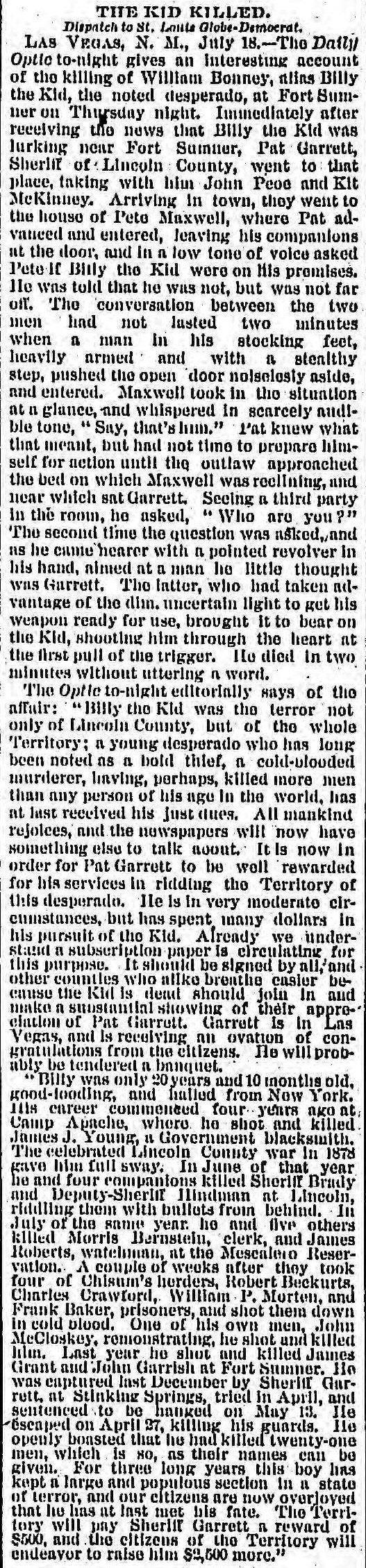
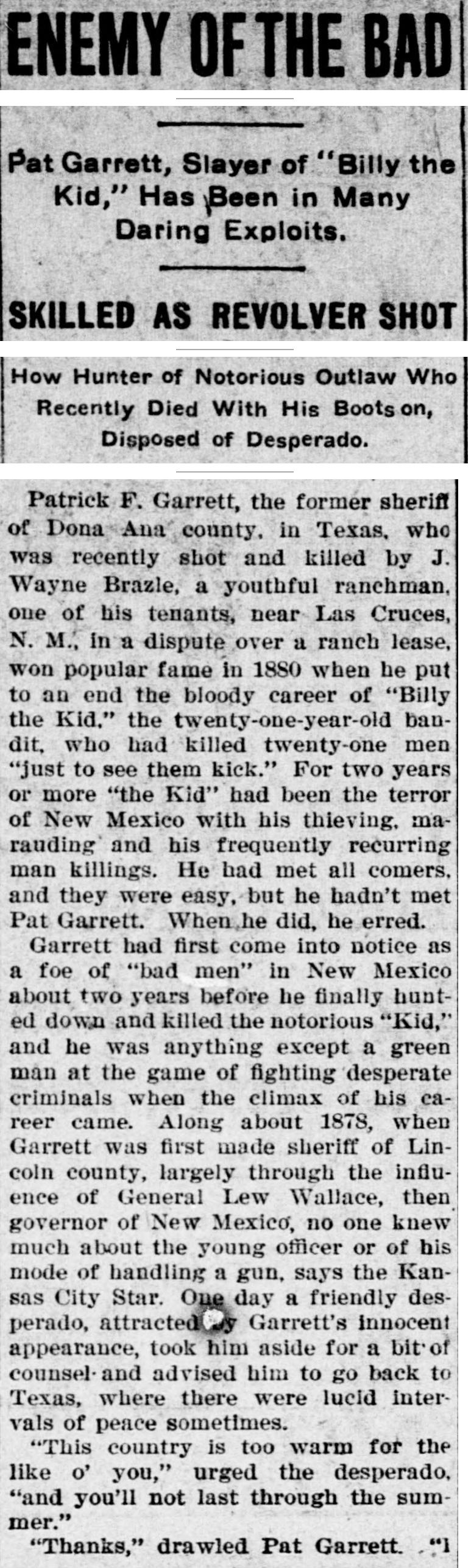
Daily Globe, 31 July 1878Las Vegas Gazette, 17 August 1878Chicago Daily Tribune, 20 July 1881Rock Island Argus, 8 April 1908

Original newspaper accounts, 1877–1930

October 1877 – December 193048 newspaper articles in the story, 1,644 in the full archive

Billy the Kid began as a name in a county war. When Lincoln County, New Mexico, split in 1878, he rode with the side that lost; two years later he led a gang on the Pecos, and Pat Garrett was elected sheriff to stop him. Garrett caught him in December 1880. He was tried and sentenced to hang, killed his two guards and got away, and in July 1881 Garrett killed him at Fort Sumner.

The papers had barely begun. They argued over who he had been, gave him twenty-one killings, a sweetheart in buckskin and a birthplace in Rhode Island, killed him again in Montana and, forty-five years on, wondered whether he had ever died at all. Garrett wrote his life, a governor and an old-timer of Lincoln told their own, and by 1930 Hollywood had cast him.

Here is how the papers told it, from the Lincoln County War to the movies.

The numbers

1,644newspaper articles
1,832printings
588newspapers
50states and territories
639months in the papers

Each article is counted once, however many papers ran it. Printings counts every paper that ran it, so an article reprinted in five papers is one article and five printings.

How much the papers printed

Month of 1 October 1877: 1 printingMonth of 1 April 1878: 1 printingMonth of 1 June 1878: 1 printingMonth of 1 July 1878: 2 printingsMonth of 1 August 1878: 2 printingsMonth of 1 November 1878: 1 printingMonth of 1 December 1880: 5 printingsMonth of 1 April 1881: 2 printingsMonth of 1 May 1881: 17 printingsMonth of 1 June 1881: 3 printingsMonth of 1 July 1881: 83 printingsMonth of 1 August 1881: 29 printingsMonth of 1 September 1881: 12 printingsMonth of 1 October 1881: 9 printingsMonth of 1 November 1881: 3 printingsMonth of 1 December 1881: 11 printingsMonth of 1 January 1882: 4 printingsMonth of 1 February 1882: 4 printingsMonth of 1 March 1882: 6 printingsMonth of 1 April 1882: 4 printingsMonth of 1 May 1882: 3 printingsMonth of 1 June 1882: 10 printingsMonth of 1 July 1882: 3 printingsMonth of 1 August 1882: 4 printingsMonth of 1 September 1882: 2 printingsMonth of 1 October 1882: 2 printingsMonth of 1 November 1882: 4 printingsMonth of 1 December 1882: 2 printingsMonth of 1 January 1883: 17 printingsMonth of 1 February 1883: 3 printingsMonth of 1 March 1883: 4 printingsMonth of 1 April 1883: 1 printingMonth of 1 May 1883: 1 printingMonth of 1 June 1883: 1 printingMonth of 1 July 1883: 2 printingsMonth of 1 August 1883: 3 printingsMonth of 1 September 1883: 3 printingsMonth of 1 October 1883: 3 printingsMonth of 1 November 1883: 1 printingMonth of 1 January 1884: 4 printingsMonth of 1 February 1884: 1 printingMonth of 1 March 1884: 4 printingsMonth of 1 April 1884: 7 printingsMonth of 1 May 1884: 2 printingsMonth of 1 June 1884: 1 printingMonth of 1 July 1884: 1 printingMonth of 1 September 1884: 3 printingsMonth of 1 November 1884: 4 printingsMonth of 1 January 1885: 5 printingsMonth of 1 February 1885: 11 printingsMonth of 1 May 1885: 4 printingsMonth of 1 June 1885: 1 printingMonth of 1 July 1885: 1 printingMonth of 1 September 1885: 1 printingMonth of 1 October 1885: 1 printingMonth of 1 December 1885: 1 printingMonth of 1 January 1886: 1 printingMonth of 1 May 1886: 1 printingMonth of 1 July 1886: 1 printingMonth of 1 August 1886: 1 printingMonth of 1 September 1886: 2 printingsMonth of 1 October 1886: 1 printingMonth of 1 February 1887: 1 printingMonth of 1 March 1887: 3 printingsMonth of 1 April 1887: 5 printingsMonth of 1 May 1887: 13 printingsMonth of 1 June 1887: 6 printingsMonth of 1 July 1887: 6 printingsMonth of 1 August 1887: 3 printingsMonth of 1 September 1887: 4 printingsMonth of 1 November 1887: 1 printingMonth of 1 December 1887: 1 printingMonth of 1 February 1888: 11 printingsMonth of 1 April 1888: 1 printingMonth of 1 May 1888: 1 printingMonth of 1 July 1888: 1 printingMonth of 1 August 1888: 1 printingMonth of 1 September 1888: 2 printingsMonth of 1 October 1888: 1 printingMonth of 1 November 1888: 1 printingMonth of 1 January 1889: 3 printingsMonth of 1 February 1889: 1 printingMonth of 1 March 1889: 2 printingsMonth of 1 April 1889: 18 printingsMonth of 1 May 1889: 3 printingsMonth of 1 June 1889: 7 printingsMonth of 1 July 1889: 6 printingsMonth of 1 August 1889: 4 printingsMonth of 1 September 1889: 2 printingsMonth of 1 January 1890: 2 printingsMonth of 1 February 1890: 2 printingsMonth of 1 March 1890: 4 printingsMonth of 1 May 1890: 2 printingsMonth of 1 June 1890: 1 printingMonth of 1 September 1890: 2 printingsMonth of 1 March 1891: 2 printingsMonth of 1 May 1891: 1 printingMonth of 1 August 1891: 4 printingsMonth of 1 September 1891: 2 printingsMonth of 1 October 1891: 2 printingsMonth of 1 November 1891: 6 printingsMonth of 1 January 1892: 5 printingsMonth of 1 February 1892: 1 printingMonth of 1 March 1892: 2 printingsMonth of 1 May 1892: 1 printingMonth of 1 June 1892: 1 printingMonth of 1 July 1892: 1 printingMonth of 1 September 1892: 2 printingsMonth of 1 October 1892: 5 printingsMonth of 1 December 1892: 4 printingsMonth of 1 January 1893: 2 printingsMonth of 1 March 1893: 3 printingsMonth of 1 April 1893: 1 printingMonth of 1 June 1893: 1 printingMonth of 1 August 1893: 1 printingMonth of 1 September 1893: 5 printingsMonth of 1 November 1893: 1 printingMonth of 1 December 1893: 5 printingsMonth of 1 January 1894: 5 printingsMonth of 1 February 1894: 5 printingsMonth of 1 March 1894: 6 printingsMonth of 1 April 1894: 2 printingsMonth of 1 June 1894: 1 printingMonth of 1 July 1894: 1 printingMonth of 1 August 1894: 3 printingsMonth of 1 September 1894: 1 printingMonth of 1 October 1894: 3 printingsMonth of 1 November 1894: 2 printingsMonth of 1 December 1894: 1 printingMonth of 1 January 1895: 5 printingsMonth of 1 February 1895: 1 printingMonth of 1 March 1895: 4 printingsMonth of 1 April 1895: 2 printingsMonth of 1 May 1895: 1 printingMonth of 1 June 1895: 1 printingMonth of 1 August 1895: 7 printingsMonth of 1 September 1895: 3 printingsMonth of 1 February 1896: 7 printingsMonth of 1 March 1896: 5 printingsMonth of 1 April 1896: 2 printingsMonth of 1 May 1896: 8 printingsMonth of 1 June 1896: 1 printingMonth of 1 August 1896: 2 printingsMonth of 1 September 1896: 1 printingMonth of 1 October 1896: 5 printingsMonth of 1 November 1896: 7 printingsMonth of 1 December 1896: 5 printingsMonth of 1 January 1897: 7 printingsMonth of 1 February 1897: 3 printingsMonth of 1 March 1897: 3 printingsMonth of 1 April 1897: 3 printingsMonth of 1 May 1897: 2 printingsMonth of 1 July 1897: 2 printingsMonth of 1 August 1897: 2 printingsMonth of 1 September 1897: 2 printingsMonth of 1 October 1897: 2 printingsMonth of 1 November 1897: 1 printingMonth of 1 December 1897: 7 printingsMonth of 1 January 1898: 3 printingsMonth of 1 March 1898: 2 printingsMonth of 1 April 1898: 3 printingsMonth of 1 June 1898: 1 printingMonth of 1 August 1898: 4 printingsMonth of 1 September 1898: 3 printingsMonth of 1 October 1898: 1 printingMonth of 1 January 1899: 1 printingMonth of 1 February 1899: 1 printingMonth of 1 March 1899: 7 printingsMonth of 1 April 1899: 4 printingsMonth of 1 May 1899: 12 printingsMonth of 1 June 1899: 2 printingsMonth of 1 July 1899: 2 printingsMonth of 1 August 1899: 5 printingsMonth of 1 September 1899: 1 printingMonth of 1 October 1899: 4 printingsMonth of 1 November 1899: 3 printingsMonth of 1 February 1900: 2 printingsMonth of 1 March 1900: 2 printingsMonth of 1 May 1900: 1 printingMonth of 1 June 1900: 2 printingsMonth of 1 July 1900: 2 printingsMonth of 1 August 1900: 1 printingMonth of 1 September 1900: 3 printingsMonth of 1 November 1900: 1 printingMonth of 1 December 1900: 1 printingMonth of 1 March 1901: 2 printingsMonth of 1 June 1901: 3 printingsMonth of 1 August 1901: 1 printingMonth of 1 September 1901: 11 printingsMonth of 1 October 1901: 5 printingsMonth of 1 November 1901: 3 printingsMonth of 1 December 1901: 34 printingsMonth of 1 January 1902: 2 printingsMonth of 1 February 1902: 4 printingsMonth of 1 March 1902: 1 printingMonth of 1 May 1902: 4 printingsMonth of 1 June 1902: 8 printingsMonth of 1 July 1902: 9 printingsMonth of 1 August 1902: 17 printingsMonth of 1 September 1902: 8 printingsMonth of 1 October 1902: 6 printingsMonth of 1 November 1902: 1 printingMonth of 1 January 1903: 6 printingsMonth of 1 March 1903: 3 printingsMonth of 1 April 1903: 5 printingsMonth of 1 May 1903: 6 printingsMonth of 1 July 1903: 3 printingsMonth of 1 August 1903: 1 printingMonth of 1 October 1903: 2 printingsMonth of 1 November 1903: 2 printingsMonth of 1 December 1903: 5 printingsMonth of 1 January 1904: 2 printingsMonth of 1 April 1904: 4 printingsMonth of 1 May 1904: 1 printingMonth of 1 June 1904: 2 printingsMonth of 1 July 1904: 1 printingMonth of 1 August 1904: 3 printingsMonth of 1 September 1904: 2 printingsMonth of 1 November 1904: 2 printingsMonth of 1 December 1904: 2 printingsMonth of 1 January 1905: 1 printingMonth of 1 February 1905: 3 printingsMonth of 1 March 1905: 4 printingsMonth of 1 April 1905: 7 printingsMonth of 1 May 1905: 2 printingsMonth of 1 June 1905: 3 printingsMonth of 1 July 1905: 1 printingMonth of 1 August 1905: 4 printingsMonth of 1 September 1905: 6 printingsMonth of 1 October 1905: 3 printingsMonth of 1 December 1905: 16 printingsMonth of 1 January 1906: 9 printingsMonth of 1 February 1906: 5 printingsMonth of 1 March 1906: 9 printingsMonth of 1 April 1906: 1 printingMonth of 1 May 1906: 4 printingsMonth of 1 June 1906: 2 printingsMonth of 1 August 1906: 4 printingsMonth of 1 September 1906: 36 printingsMonth of 1 October 1906: 2 printingsMonth of 1 November 1906: 3 printingsMonth of 1 December 1906: 2 printingsMonth of 1 January 1907: 2 printingsMonth of 1 February 1907: 5 printingsMonth of 1 March 1907: 2 printingsMonth of 1 May 1907: 4 printingsMonth of 1 June 1907: 2 printingsMonth of 1 July 1907: 4 printingsMonth of 1 August 1907: 8 printingsMonth of 1 September 1907: 5 printingsMonth of 1 October 1907: 26 printingsMonth of 1 November 1907: 16 printingsMonth of 1 December 1907: 3 printingsMonth of 1 January 1908: 9 printingsMonth of 1 February 1908: 1 printingMonth of 1 March 1908: 21 printingsMonth of 1 April 1908: 13 printingsMonth of 1 May 1908: 1 printingMonth of 1 June 1908: 2 printingsMonth of 1 July 1908: 4 printingsMonth of 1 August 1908: 3 printingsMonth of 1 September 1908: 7 printingsMonth of 1 October 1908: 11 printingsMonth of 1 November 1908: 8 printingsMonth of 1 December 1908: 22 printingsMonth of 1 January 1909: 3 printingsMonth of 1 February 1909: 4 printingsMonth of 1 May 1909: 2 printingsMonth of 1 August 1909: 15 printingsMonth of 1 September 1909: 8 printingsMonth of 1 October 1909: 9 printingsMonth of 1 November 1909: 8 printingsMonth of 1 December 1909: 2 printingsMonth of 1 January 1910: 1 printingMonth of 1 February 1910: 4 printingsMonth of 1 April 1910: 3 printingsMonth of 1 May 1910: 1 printingMonth of 1 June 1910: 1 printingMonth of 1 September 1910: 3 printingsMonth of 1 October 1910: 1 printingMonth of 1 November 1910: 1 printingMonth of 1 December 1910: 6 printingsMonth of 1 January 1911: 7 printingsMonth of 1 March 1911: 1 printingMonth of 1 May 1911: 3 printingsMonth of 1 June 1911: 1 printingMonth of 1 July 1911: 2 printingsMonth of 1 August 1911: 3 printingsMonth of 1 September 1911: 4 printingsMonth of 1 October 1911: 1 printingMonth of 1 December 1911: 3 printingsMonth of 1 January 1912: 6 printingsMonth of 1 March 1912: 2 printingsMonth of 1 April 1912: 3 printingsMonth of 1 May 1912: 2 printingsMonth of 1 June 1912: 1 printingMonth of 1 July 1912: 1 printingMonth of 1 August 1912: 5 printingsMonth of 1 October 1912: 3 printingsMonth of 1 November 1912: 1 printingMonth of 1 December 1912: 11 printingsMonth of 1 January 1913: 13 printingsMonth of 1 February 1913: 43 printingsMonth of 1 March 1913: 8 printingsMonth of 1 May 1913: 7 printingsMonth of 1 June 1913: 1 printingMonth of 1 July 1913: 1 printingMonth of 1 August 1913: 5 printingsMonth of 1 September 1913: 3 printingsMonth of 1 October 1913: 2 printingsMonth of 1 November 1913: 3 printingsMonth of 1 December 1913: 1 printingMonth of 1 January 1914: 21 printingsMonth of 1 April 1914: 1 printingMonth of 1 October 1914: 2 printingsMonth of 1 November 1914: 2 printingsMonth of 1 December 1914: 12 printingsMonth of 1 January 1915: 3 printingsMonth of 1 March 1915: 3 printingsMonth of 1 April 1915: 3 printingsMonth of 1 August 1915: 2 printingsMonth of 1 September 1915: 1 printingMonth of 1 February 1916: 1 printingMonth of 1 March 1916: 1 printingMonth of 1 April 1916: 2 printingsMonth of 1 May 1916: 1 printingMonth of 1 July 1916: 3 printingsMonth of 1 August 1916: 1 printingMonth of 1 September 1916: 2 printingsMonth of 1 October 1916: 6 printingsMonth of 1 November 1916: 4 printingsMonth of 1 December 1916: 5 printingsMonth of 1 January 1917: 3 printingsMonth of 1 February 1917: 1 printingMonth of 1 March 1917: 2 printingsMonth of 1 May 1917: 1 printingMonth of 1 June 1917: 2 printingsMonth of 1 October 1917: 1 printingMonth of 1 November 1917: 1 printingMonth of 1 February 1918: 2 printingsMonth of 1 March 1918: 1 printingMonth of 1 May 1918: 2 printingsMonth of 1 June 1918: 1 printingMonth of 1 July 1918: 1 printingMonth of 1 August 1918: 1 printingMonth of 1 March 1919: 1 printingMonth of 1 August 1919: 1 printingMonth of 1 October 1919: 1 printingMonth of 1 November 1919: 1 printingMonth of 1 December 1919: 3 printingsMonth of 1 January 1920: 7 printingsMonth of 1 March 1920: 1 printingMonth of 1 April 1920: 3 printingsMonth of 1 May 1920: 1 printingMonth of 1 June 1920: 1 printingMonth of 1 July 1920: 4 printingsMonth of 1 August 1920: 1 printingMonth of 1 September 1920: 1 printingMonth of 1 November 1920: 1 printingMonth of 1 December 1920: 3 printingsMonth of 1 January 1921: 2 printingsMonth of 1 February 1921: 5 printingsMonth of 1 May 1921: 3 printingsMonth of 1 June 1921: 1 printingMonth of 1 July 1921: 1 printingMonth of 1 August 1921: 3 printingsMonth of 1 September 1921: 2 printingsMonth of 1 April 1922: 1 printingMonth of 1 June 1922: 1 printingMonth of 1 September 1922: 2 printingsMonth of 1 October 1922: 2 printingsMonth of 1 November 1922: 2 printingsMonth of 1 January 1923: 1 printingMonth of 1 February 1923: 3 printingsMonth of 1 March 1923: 1 printingMonth of 1 April 1923: 1 printingMonth of 1 May 1923: 1 printingMonth of 1 June 1923: 1 printingMonth of 1 July 1923: 1 printingMonth of 1 October 1923: 9 printingsMonth of 1 February 1924: 2 printingsMonth of 1 March 1924: 2 printingsMonth of 1 April 1924: 2 printingsMonth of 1 September 1924: 2 printingsMonth of 1 November 1924: 1 printingMonth of 1 January 1925: 4 printingsMonth of 1 March 1925: 1 printingMonth of 1 April 1925: 2 printingsMonth of 1 June 1925: 1 printingMonth of 1 September 1925: 1 printingMonth of 1 January 1926: 1 printingMonth of 1 February 1926: 2 printingsMonth of 1 April 1926: 1 printingMonth of 1 May 1926: 1 printingMonth of 1 June 1926: 1 printingMonth of 1 July 1926: 6 printingsMonth of 1 September 1926: 2 printingsMonth of 1 October 1926: 3 printingsMonth of 1 November 1926: 3 printingsMonth of 1 December 1926: 1 printingMonth of 1 January 1927: 2 printingsMonth of 1 March 1927: 1 printingMonth of 1 April 1927: 3 printingsMonth of 1 May 1927: 3 printingsMonth of 1 June 1927: 9 printingsMonth of 1 July 1927: 6 printingsMonth of 1 August 1927: 1 printingMonth of 1 September 1927: 1 printingMonth of 1 October 1927: 1 printingMonth of 1 November 1927: 4 printingsMonth of 1 December 1927: 3 printingsMonth of 1 January 1928: 12 printingsMonth of 1 February 1928: 2 printingsMonth of 1 March 1928: 2 printingsMonth of 1 April 1928: 4 printingsMonth of 1 May 1928: 2 printingsMonth of 1 June 1928: 7 printingsMonth of 1 December 1928: 1 printingMonth of 1 January 1929: 6 printingsMonth of 1 February 1929: 1 printingMonth of 1 March 1929: 2 printingsMonth of 1 April 1929: 1 printingMonth of 1 August 1929: 2 printingsMonth of 1 September 1929: 2 printingsMonth of 1 October 1929: 1 printingMonth of 1 December 1929: 1 printingMonth of 1 January 1930: 1 printingMonth of 1 February 1930: 1 printingMonth of 1 March 1930: 6 printingsMonth of 1 April 1930: 2 printingsMonth of 1 May 1930: 7 printingsMonth of 1 June 1930: 4 printingsMonth of 1 July 1930: 2 printingsMonth of 1 August 1930: 3 printingsMonth of 1 September 1930: 7 printingsMonth of 1 October 1930: 26 printingsMonth of 1 November 1930: 40 printingsMonth of 1 December 1930: 38 printings13 October 187726 April 18787 June 187814 July 187831 July 18788 August 187817 August 18789 November 18783 December 188022 December 188029 December 18805 April 18815 May 18815 May 188112 May 188119 May 188117 June 18817 July 188119 July 188120 July 188122 July 188123 July 188129 July 18816 August 188118 August 188123 August 18814 October 188117 February 188226 March 188228 March 18822 April 18826 April 188216 June 188218 June 18829 July 188214 October 188225 November 188220 January 188325 January 188325 January 188329 October 18851 March 189031 July 19028 April 190811 January 191314 February 19131 July 192626 April 193018771878187918801881188218831884188518861887188818891890189118921893189418951896189718981899190019011902190319041905190619071908190919101911191219131914191519161917191819191920192119221923192419251926192719281929193083 printings in the month of 1 July 1881

Every printing of every article, by the month it ran. The marks under the line are the articles in the story below; red ones were wrong.

Where it was printed

FewerMore

Printings in 50 states. Most: New Mexico (164), District of Columbia (127), Connecticut (109). 113 printings could not be placed in a state.

How it unfolded

48 newspaper articles in 7 acts

The Setting

The Lincoln County War

October 1877 – November 1878

In 1878 Lincoln County, New Mexico, went to war with itself. On one side were the merchants Murphy, Dolan and Riley, who held the army contracts at Fort Stanton, and the county sheriff, William Brady. On the other were a lawyer, A. A. McSween, and an English rancher, J. H. Tunstall. Before the year was out Tunstall, Brady and McSween were all dead, and among the fighters on McSween’s side was a young man the papers called the Kid.

A year before the war, on the same list

In October 1877 horse thieves run off stock belonging to A. A. McSween and J. H. Tunstall near Lincoln. In the same column McSween, Lawrence G. Murphy, Jas. J. Dolan and the county sheriff all put their names to one recommendation for the legislature. Within a year Tunstall, the sheriff and McSween would all be dead.

Las Vegas Gazette · Las Vegas, N.M.

Las Vegas Gazette · 13 October 1877 · page 4 · transcribed from the page image

From the Mesilla Valley Independent we glean the following items:

A. A. McSween, of Lincoln, lost some black horses, valued at seven hundred dollars, and Tunstall some of his horses and mules, worth a thousand dollars, by a raid of the horse thieves in that vicinity. A party of citizens are in pursuit.

See moreSee less

Some of the most influential citizens of Lincoln county, among whom we notice F. G. Christie, Jas. J. Dolan, A. H. Mills, B. H. Ellis, Chas. Frietz, Lawrence G. Murphy, A. A. McSween, F. Romero y Valencia, R. H. Ewan Wm. Braly, sheriff, and others, recommend the election of Mr. Juan B. Patron, an honest, zealous and capable young man of that county, to the territorial legislature, to fill the vacancy caused by the untimely death of the late Paul Dowlin, and ask the cooperation of the good people of Doña Ana and Grant counties for that purpose.

See the clipping

Dolan’s side: blame the lawyer and the cattle king

An Arizona paper passes on the Murphy and Dolan version: Lincoln County is under ‘a reign of terror’, and the lawyer McSween and the cattle king Chisum are behind it. Dolan writes that Chisum wants the contracting business for himself and means to put Dolan and Riley ‘out of the way.’ The Lincoln County grand jury saw it the other way: it cleared McSween and indicted Dolan for Tunstall’s murder.

The Weekly Arizona Miner · Prescott, Ariz

UnconfirmedNo later report in this collection bears it out.

The Weekly Arizona Miner · 7 June 1878 · page 2 · transcribed from the page image

Lincoln County, New Mexico, seems to be undergoing a reign of terror, assassinations are the rule. A lawyer by the name of McSween is largely mixed in with sundry transactions according to the representations of Murphy & Dolan, army contractors, etc. The same parties accuse J. S. Chism, the cattle king, of being in with McSween and other bad men to defraud Murphy, Dolan, Riley and other good men. J. J. Dolan in a letter to the New Mexican, states that Chism wants to monopolize the contracting business of New Mexico and Arizona, and that as long as he and Mr.

See moreSee less

Riley live, it cannot be done in any fair way and therefore means are being taken to put them,—Riley and Dolan,—out of the way. Quite a number of people of the county have been killed upon one pretext and another, and according to accounts published in the Mesilla News, and other New Mexico papers, McSween is represented as being responsible for a large share of it.

See the clipping

McSween’s side: a county run by a ring

A New York paper prints the case against Murphy, Dolan and Riley: crooked army contracts, stolen cattle, and a sheriff’s posse that killed Tunstall ‘with his own pistol’ after he surrendered. The citizens answer by forming the regulators, who kill Sheriff Brady in the street at Lincoln. Set beside the Arizona paper’s account, the two sides could hardly be further apart.

The Sun · New York, N.Y.

The Sun · 14 July 1878 · page 6 · transcribed from the page image

RING-RIDDEN NEW MEXICO.

GOVERNOR, JUDGE, AND DISTRICT ATTORNEY ABETTING CRIME.

See moreSee less

The Reign of Terror that Three Thieving Ex-Sutlers Brought About--Tunstall's Fate--A Town Attacked by Cutthroats.

FORT STANTON, New Mexico, June 30.--The causes of the troubles in Lincoln county in this Territory, that have excited so much interest, go back four or five years. That they originated in the operations of three men, Murphy, Dolan, and Reilly, who were working in the interests of the Santa Fé Ring, may be supposed, from the fact that the citizens of Lincoln county drew up a petition setting forth that they were the cause of the disturbance, and requesting them to leave the county, which they did before the petition was presented.

Their firm was first styled L. G. Murphy & Co., of which Murphy was the principal. They were post sutlers and contractors at Fort Stanton, and contractors for the Indian Department. In these contracts there was so much suspicion of dishonesty that the sutlership was taken away from them. Murphy and Dolan were confined in the guard house, and ordered to leave the post, Murphy in three days and Dolan in fifteen minutes. They then established themselves in business in Lincoln, about nine miles from Fort Stanton, where they despotically controlled the country for miles around. The firm name was changed to J. J. Dolan & Co., as Murphy could no longer secure a contract in his own name. They put in their bids at figures which could not honestly be made to pay. Having secured the beef contract at Fort Stanton, and continuing to fill it, it was suspected that the cattle furnished were stolen. This was confirmed beyond a doubt by an account book of theirs accidentally falling into the hands of Mr. McSween and others, containing a record of the number of cattle stolen and delivered to J. J. Dolan & Co. by Jesse Evans, Frank Baker, Tom Hill, and others, at the rate of $5 a head. Such was the style of business carried on by Murphy, Dolan, and Reilly. Many murders committed in this county have been laid to them. They controlled the country, the commercial and the political powers; in fact, at one time Murphy was a little king.

In their wicked course honest men opposed them, and these men were singled out as proper objects for persecution and vengeance. Two of these were Messrs. McSween and Tunstall. The first named was at one time the attorney of Murphy & Co., and being an honest man, he quit them. From that time they sought an opportunity to remove him from their path. Mr. Tunstall was an Englishman who had considerable means invested in Lincoln county in merchandise, cattle, and other property. He was an honest, straightforward man. In such a person Murphy & Co. saw a dangerous rival, and they determined that he too should be removed.

An opportunity occurred in which they thought they could see a way to rid themselves of both McSween and Tunstall.

Murphy had at one time a partner by the name of Fritz, who had a brother named Emil Fritz. This brother died, leaving a life insurance policy amounting to $10,000 to his sister, Mrs. Scholand. Murphy & Co. pretended to have a bill against Mrs. Scholand for merchandise amounting to $7,000, which they claimed on this policy. The policy was given into the hands of McSween for collection. Murphy & Co. made a demand on him for the money, which of course he refused, as without the consent of Mrs. Scholand they had no right whatever to it. They did not then arrest McSween, but waited until he had occasion to go East, when, to make it appear that he was running away, they had him arrested on a charge of embezzlement when about two hundred miles from home. He was thrown into prison at Las Vegas, where he was approached by parties from Murphy, Dolan, and Reilly to compromise. He refused, saying that he had committed no crime, and therefore had nothing to compromise. He was then taken to Mesilla, where an examination was held before Judge W. Bristol, a partisan of Murphy's, who practically prevented McSween from giving bonds by saying that he would not accept any not approved by District Attorney W. L. Rynerson, a bitter partisan of Murphy's. Rynerson refused to approve any and all bonds brought forward by McSween, although perfectly good, and over the amount called for.

The Deputy Sheriff, seeing how matters were, said to them:

"I see that you wish to murder this man, and I will not give him up to you until court is held."

He then returned with McSween, remaining hid in Lincoln county.

Murphy & Co. then prevailed upon Judge Bristol to issue warrants of attachment against the property of McSween & Tunstall. A posse was organized by Sheriff Brady, a tool of Murphy's, and there were placed on it the notorious thieves and murderers, Jesse Evans, Frank Baker, Tom Hill, and Rivers. After attaching the cattle of Tunstall and Richard Brewer, they started in pursuit of Tunstall, who, after surrendering himself, was brutally murdered by them with his own pistol. They then shot his horse, and crushed in the head of Tunstall with a rock. One of their victims was disposed of.

This murder created the most intense excitement. Warrants were issued by J. B. Wilson, Justice of the Peace, for the arrest of the murderers and placed in the hands of Richard Brewer and others as a constable's posse. Brewer succeeded in arresting two, who upon attempting to escape were killed. The Governor, S. B. Axtell, then arrived, and going to Murphy to ascertain the cause of the trouble, was so much enlightened that he refused to listen to the representatives of the people, Messrs. Ellis and Shields. He issued a proclamation, in which he set forth that his only desire was to preserve law and order; announcing also that J. B. Wilson was no longer Justice of the Peace.

Notwithstanding Brady and posse had murdered Mr. Tunstall, the Governor still gave him authority to act as Sheriff and the privilege of procuring as many soldiers as he wished to hunt Brewer and posse, the men who were trying to arrest the murderers of Tunstall, to the mountains.

The citizens then banded themselves together as regulators with the outspoken intention of hunting down Murphy, Dolan, Reilly, Sheriff Brady and posse, the murderers of Tunstall. They succeeded in killing the Murphy tool, Brady, in the town of Lincoln. Then Capt. Purington, commanding officer at Fort Stanton, came rushing out with a large body of soldiers, and without warrant or authority, arrested and took to Fort Stanton and confined in the guard house Messrs. McSween, Widdeman, and Shields, merely on suspicion of being concerned in the death of Brady. A citizen present protesting, in the name of the Constitution of the United States, against his illegal acts, Purington damned the Constitution. He also abused others present in language too shameful for publication. He had previously expressed, in the strongest terms, his disapprobation of Messrs. Murphy, Dolan, and Reilly, pronouncing them thieves and murderers. He was removed from the command of the post (Fort Stanton), and it is expected that he will be court martialled. As nothing could be found against McSween, Widdeman, and Shields, they were discharged.

Murphy's partisans then gathered together a band of twenty-five of the worst cutthroats and cattle thieves on the Pecos and Rio Grande rivers, and made an attack on the town of Lincoln. Frank Coe, Frank McNab, and A. Saunders were waylaid by them, McNab murdered and Saunders wounded. They fired into the houses of Ellis, McSween, and others, but fortunately harming no one. The news reaching Fort Stanton, soldiers were sent down, and the fighting stopped. Sheriff Copeland made some arrests of the Murphyites, and took them to Fort Stanton.

Several days afterward Lieut. Goodwin, a Murphy partisan, made his appearance in Lincoln, and arrested Messrs. Ellis, McSween, and Widdeman. Goodwin took all the opportunities he could to vent his spleen and spite on the prisoners, who were confined in the guard house and made to sleep on the bare floor, while the Murphyites were allowed the liberties of the post, armed.

The Governor has issued a second proclamation. After the death of Sheriff Brady, the County Commissioners appointed to the vacancy John Copeland, an honest man and one respected by the honest men of Lincoln county. The Governor removed Copeland upon the pretext that he did not file bonds for the collection of taxes. Copeland had never been notified nor asked to do this, but could have done so to treble the amount required. In his place was appointed G. H. Peppin, who participated in the murder of McNab and wounding of Saunders, and for whom the officers of the law had in their hands three warrants for three several murders.

At the instigation of Axtell and Catron, Col. Hatch, the district commander, issued orders to his troops to disarm every man in Lincoln county, which, of course, meant to disarm the people who were fighting the outlaws, and leave the friends of the new Sheriff, the outlaws, to run and harry the country as they pleased. Under these orders the officers at Fort Stanton disarm travellers, ranchmen, and everybody except the retainers of Catron.

In the face of a charge by Judge W. Bristol, and the efforts of the District Attorney, W. L. Rynerson, the grand jury of Lincoln county exonerated Mr. McSween from any dishonorable intentions in regard to the collection of the insurance money, and refused to indict him. They also rebuked the Governor for the unmanly and partisan course he took while present at Lincoln to preserve law and order. Dolan and Riley were indicted for cattle stealing, and Dolan and a number of others for the murder of Tunstall, in spite of the efforts of the court officials in their behalf. But no steps have been taken to have any of these criminals arrested.

Murphy, Dolan & Co., before taking refuge in Santa Fé, transferred their property to T. B. Catron, the United States District Attorney and Elkins's partner. The outlaws who had been in charge of the firm's cattle having been scattered the cattle began to stray. At the request of Catron, the Governor calls upon the United States troops to go after these refractory beasts, round them up, and gather them in. Forthwith orders issue from district headquarters here to Fort Stanton, and a captain, lieutenant, and forty soldiers, with a camp outfit, provision train, and five wagon loads of corn belonging to the United States, sallied forth in search of Catron's beef. I suppose they are supplied with bull whips at the expense of the Government, and I see no reason why, having rounded up the cattle, they should not be retained permanently to keep them from straggling again. It would be much more economical for the United States District Attorney, and the profits of the Ring would be enhanced.

There are not troops enough in the Territory to protect the Indian agencies against outbreaks; at least there are none to spare for that purpose. It seems they are too busy in disarming the citizens of Lincoln county--who also live in an Indian country subject to frequent outbreaks--and in herding the United States District Attorney's cattle. Let the army be increased by all means.
See the clipping

The battle for Lincoln

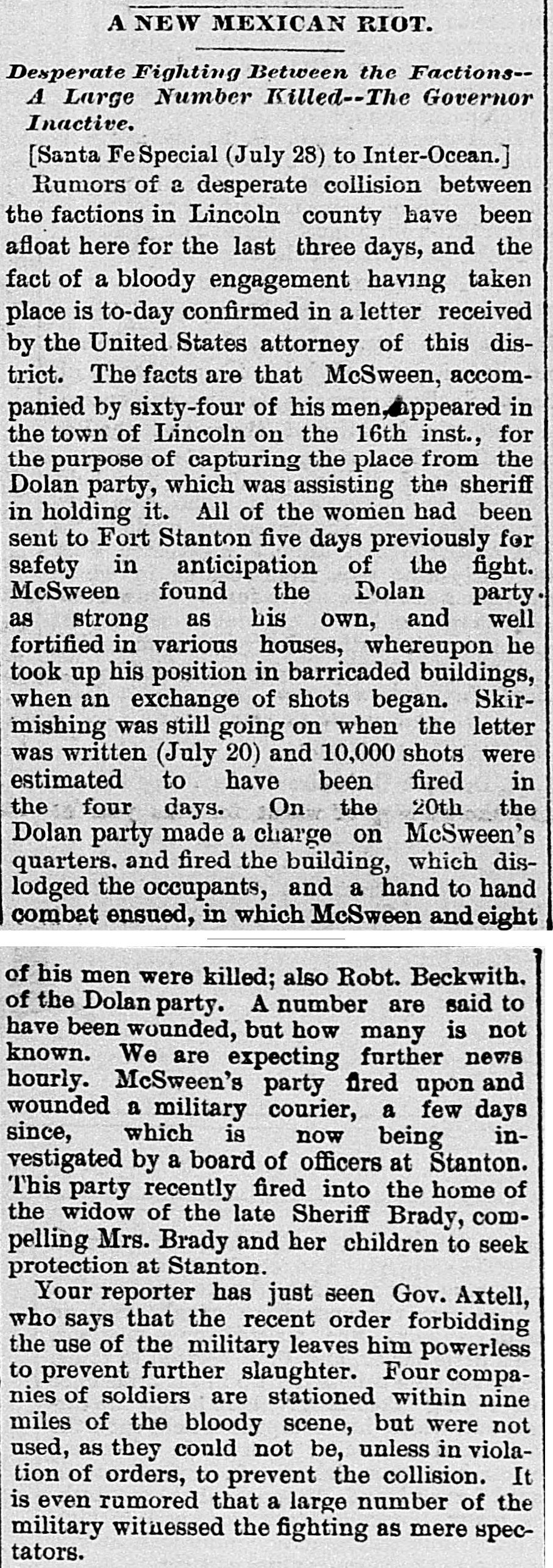
McSween rides into Lincoln with sixty-four men to take the town from the Dolan party, and for four days the two sides fire on each other from barricaded houses, an estimated 10,000 shots. On the 20th the Dolan men set McSween’s building on fire and kill him with eight of his men. Four companies of soldiers stationed nine miles away are not used, and some are said to have watched.

Daily Globe · St. Paul, Minn.

Daily Globe · 31 July 1878 · page 2 · transcribed from the page image

A NEW MEXICAN RIOT.

Desperate Fighting Between the Factions--A Large Number Killed--The Governor Inactive.

See moreSee less

[Santa Fe Special (July 28) to Inter-Ocean.]

Rumors of a desperate collision between the factions in Lincoln county have been afloat here for the last three days, and the fact of a bloody engagement having taken place is to-day confirmed in a letter received by the United States attorney of this district. The facts are that McSween, accompanied by sixty-four of his men, appeared in the town of Lincoln on the 16th inst., for the purpose of capturing the place from the Dolan party, which was assisting the sheriff in holding it. All of the women had been sent to Fort Stanton five days previously for safety in anticipation of the fight. McSween found the Dolan party as strong as his own, and well fortified in various houses, whereupon he took up his position in barricaded buildings, when an exchange of shots began. Skirmishing was still going on when the letter was written (July 20) and 10,000 shots were estimated to have been fired in the four days. On the 20th the Dolan party made a charge on McSween's quarters, and fired the building, which dislodged the occupants, and a hand to hand combat ensued, in which McSween and eight of his men were killed; also Robt. Beckwith, of the Dolan party. A number are said to have been wounded, but how many is not known. We are expecting further news hourly. McSween's party fired upon and wounded a military courier, a few days since, which is now being investigated by a board of officers at Stanton. This party recently fired into the home of the widow of the late Sheriff Brady, compelling Mrs. Brady and her children to seek protection at Stanton.

Your reporter has just seen Gov. Axtell, who says that the recent order forbidding the use of the military leaves him powerless to prevent further slaughter. Four companies of soldiers are stationed within nine miles of the bloody scene, but were not used, as they could not be, unless in violation of orders, to prevent the collision. It is even rumored that a large number of the military witnessed the fighting as mere spectators.

See the clipping

Twenty-one dead, and a name: ‘Antrim, the Kid’

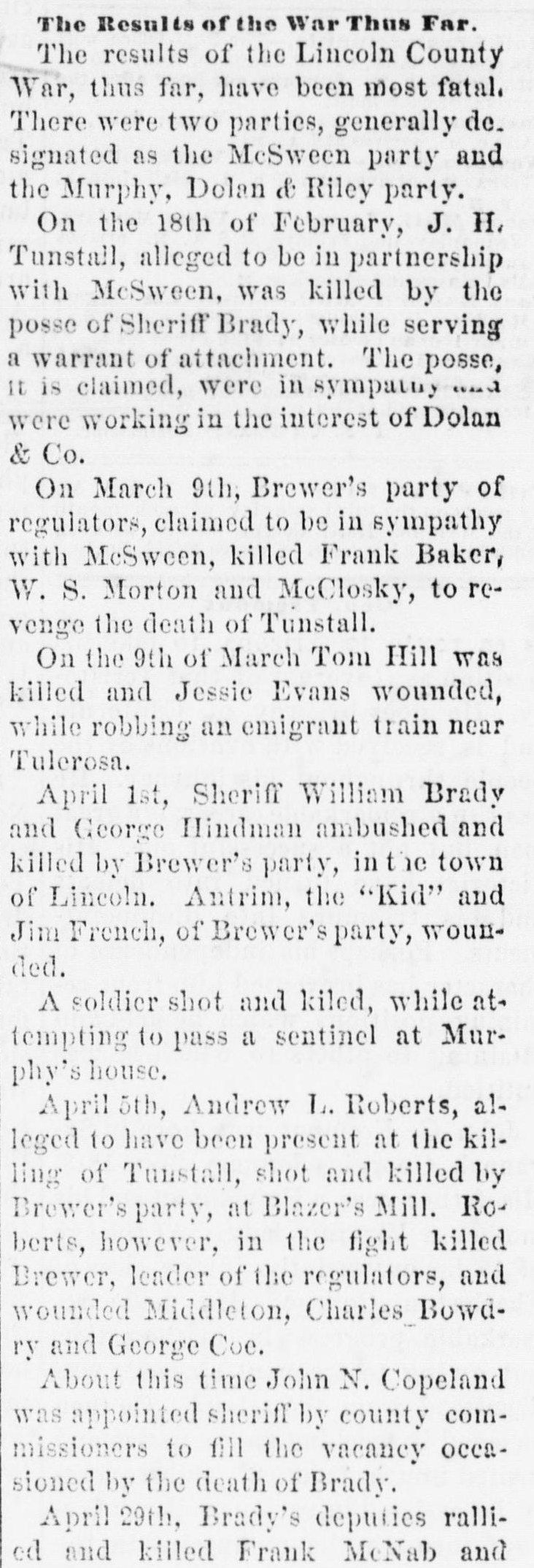
A Las Vegas paper counts up the war: ‘two parties, generally designated as the McSween party and the Murphy, Dolan & Riley party,’ and 21 men killed between them. Among the wounded on 1 April, the day Sheriff Brady was ambushed in Lincoln, it lists ‘Antrim, the "Kid"’ of the regulators. The next act begins with him.

Las Vegas Gazette · Las Vegas, N.M.

Las Vegas Gazette · 17 August 1878 · page 1 · transcribed from the page image

The Results of the War Thus Far.

The results of the Lincoln County War, thus far, have been most fatal. There were two parties, generally designated as the McSween party and the Murphy, Dolan & Riley party.

See moreSee less

On the 18th of February, J. H. Tunstall, alleged to be in partnership with McSween, was killed by the posse of Sheriff Brady, while serving a warrant of attachment. The posse, it is claimed, were in sympathy and were working in the interest of Dolan & Co.

On March 9th, Brewer's party of regulators, claimed to be in sympathy with McSween, killed Frank Baker, W. S. Morton and McClosky, to revenge the death of Tunstall.

On the 9th of March Tom Hill was killed and Jessie Evans wounded, while robbing an emigrant train near Tulerosa.

April 1st, Sheriff William Brady and George Hindman ambushed and killed by Brewer's party, in the town of Lincoln. Antrim, the "Kid" and Jim French, of Brewer's party, wounded.

A soldier shot and kiled, while attempting to pass a sentinel at Murphy's house.

April 5th, Andrew L. Roberts, alleged to have been present at the killing of Tunstall, shot and killed by Brewer's party, at Blazer's Mill. Roberts, however, in the fight killed Brewer, leader of the regulators, and wounded Middleton, Charles Bowdry and George Coe.

About this time John N. Copeland was appointed sheriff by county commissioners to fill the vacancy occasioned by the death of Brady.

April 29th, Brady's deputies rallied and killed Frank McNab and wounded James A. Saunders, of the regulators. A fight afterwards occurred in Lincoln, in which three of Brady's deputies were mortally wounded.

June 1st, John N. Copeland removed by the Governor, for failure to give bond, and George W. Peppin appointed.

During the first week in July two of Peppin's posse wounded and two horses killed in a fight with the regulators.

Several skirmishes and much manoeuvreing between both parties, from the 1st to the 20th of July, without important results, during which time slight engagements took place at Lincoln, San Patricio and on the Pecos, in one of which Charley Crawford, of Peppin's posse, was mortally wounded.

July 20th, a heavy battle between the sheriff's posse and McSween's party, in which the latter was killed and his house in Lincoln burned; also of that party Harry Morris, Vicente Romero and Francisco Samora were killed. Robert Beckwith, of the sheriff's posse killed.

On the 5th of August, the Indian Agency was attacked by some thirty men and Morris J. Bernstein, the clerk, who had no interest on either side, killed.

The above constitutes the causualties, up to the present time, as near as we can determine from data at hand. It is quite probable that several were killed, or died of wounds, whose names have not been reported in the papers.

To sum up briefly, and taking no account of the wounded, property destroyed and horses killed, the results are as follows:

Of those alleged to have belonged to the side of McSween, sheriff Copeland and the regulators, were killed: J. H. Tunstall, Richard Brewer, F. McNab, A. A. McSween, Henry Morris, Vicente Romero and Francisco Samora, or seven in all. Of those reported to belong to the side of Dolan & Co., and sheriffs Brady and Peppin, were killed: Sheriff Wm. Brady, Geo. Hindman, Andrew L. Roberts, Frank Baker, W. S. Morton, McClosky, Chas. Crawford, Robert Beckwith and three others mortally wounded; but names not given, or eleven in all. These, added to the soldier, Tom Hill and Bernstein, make 21 men slaughtered in the Lincoln County war.

The numbers killed on each side indicate that the fight has been as equal as desperate, while barbarism and lawlessness have marked the contest throughout.

See the clipping

The war is over, but the killing is not

Months after McSween’s death a correspondent at Fort Stanton tells the whole war again and sets the two sides’ accounts of Tunstall’s death side by side: he turned and fired on the posse, say the posse’s men; he was ‘assassinated, without firing a shot,’ say his friends. What is left of both parties now rides as two gangs, the ‘Modocs’ and the ‘Wrestlers,’ and the new governor, Lew Wallace, is expected at any moment.

Colored Citizen · Fort Scott, Kan.

Colored Citizen · 9 November 1878 · page 4 · transcribed from the page image

NEW MEXICAN CIVIL WAR.

The Reign of the Mexican Desperadoes---The Bloody Pranks of the "Modocs" and "Wrestlers."

See moreSee less

[Special Correspondence of the Globe-Democrat.]

Before giving an accurate and impartial account of the troubles which have existed in this country since February last, and which have assumed national importance, your correspondent desires to furnish a brief description of this place (Fort Stanton, Lincoln county, New Mexico,) and its surroundings. Fort Stanton is situated in the beautiful valley of the Rio Bonita (or Pretty Valley), a name well deserved from the magnificent scenery presented to view. The valley is wailed in by high, peaked mountains, the principal being the White and Capitan ranges. The Bonita river winds its way in close proximity to the fort, its banks covered with a fine growth of cottonwood trees. The mountains are covered with a species of timber called pinyon, which in the eastern country is known as the spruce. The Post is laid out in the form of a square; surrounded by a large growth of cottonwood trees, resembling the weeping willow, a fine stream of cool and sparkling water flowing

AROUND THE POST.

The quarters are built of stone, well plastered, and neatly finished, both inside and out. There are stationed here two companies of cavalry and one company of the 15th Infantry, the post being commanded by Col. N. A. M. Dudley, one of the oldest officers on the frontier--a strict disciplinarian and a brave and accomplished soldier. The infantry company is commanded by Captain Thos. Blair, another old and trusty soldier. There are two tribes of Indians stationed near the post, on a Government reservation, viz: the Jicarrilla Apaches and the Mescarelo Apaches, who are very friendly at present writing, but it is difficult to say how long they may remain so. Horse thieves--whether white, Mexicans or Indians, your correspondent is unable to say--ran off a number of the Jicarrillo Indians' ponies on the night of the 12th of last month, and on the morning of the 13th Lieutenant G. W. Smith, with a detachment of the 9th cavalry, started out to recapture the stock, if possible. Nothing has been heard of him up to the present time. The troubles in this county commenced in the middle of January last in the following manner:

A firm in Lincoln known as the Murphy firm, which latterly merged into the firm of Dolan, Riley & Co., claimed that they had a mortgage on a legacy bequeathed, in the shape of an insurance policy, by a man named Fritz, formerly a partner of the Murphys. The amount left on the policy was $10,000. Dolan and a Mrs. Schoeling, the legatee, employed a lawyer named McSwayne, of some notoriety in this part of the country, to collect the above amount, which he did, at the same time placing it to his own credit in a bank in East St. Louis. On being requested to transfer the money, McSwayne flatly refused to do so, alleging as a reason that if he did the Dolan firm would gobble up the money and leave Mrs. Schoeling with nothing. Threats were of no avail, and proceedings were instituted in the latter part of January. McSwayne left Lincoln at the time, and endeavored to reach St. Louis, but was overhauled at Las Vegas, and arrested on a charge of embezzlement. He was taken from Las Vegas to Messilla, before the District Court, then in session, Judge Warren Bristol presiding, where the charges against him were sustained and a writ of attachment was levied on his property, real and personal; to the amount of about $7,000. In taking an inventory of his goods, a man named Tunstall, who had sworn in court at Messilla that he was not a partner of McSwayne's, claimed a part of the above goods, and on Mr. Brady, sheriff of the county, serving the attachment writ, Tunstall met him with abuse and threats, refusing to give up the goods. The following day Sheriff Brady sent a deputy and posse to take account of the stock, or, as it is called here, to "round it up." The deputy sheriff, Billy Matthews, on attempting to take an inventory, an employe of Dolan's, was also met with.

ABUSE AND THREATS

by Tunstall, who, under some trivial excuse, departed from the place, and managed to run off some thirty horses. So far as the above is concerned, it is admitted by both parties; but mark the conflicting testimony which here follows. Mathews' testimony is to the effect that he started after the herd of horses, and he and his followers state that on nearing them, after a four-mile chase, Tunstall, seeing the party gaining on him, turned, and met them with the contents of his revolver. The fire was immediately returned by the Sheriff's posse, and Tunstall was shot dead. The remainder of Tunstall's party escaped, Mathews gaining possession of the plunder. Tunstall's friends, on the contrary, affirm that Tunstall was cut off from the rest of his party, driven into a canyon and assassinated, without firing a shot. This occurred on the 19th of February last. On the morning of the 20th Mexicans and Americans flocked into Lincoln from the surrounding country, and took up their quarters at and about McSwayne's residence. Dolan's firm summoned in all the help possible from their ranches, and this was then the beginning of the famous Lincoln county butchery. The factions were styled at this time "the McSwayne party" and "the Dolan party." Matters remained in statu quo for twenty-four hours, when Company H, 15th Infantry, at the earnest request of some of the leading citizens of the county, was dispatched to Lincoln, which is but nine miles east of Fort Stanton. On the morning of the 22d, a partly amicable settlement was arrived at, the effect of three soldiers being left at each house as a guard having a tendency to put a quietus to the matter. The company of soldiers returned here on the evening of the 22d, leaving the guard stationed at the two houses, the followers of either party dispersing for the time being. The guard remained four days, when, McSwayne decamped with a Deputy Sheriff from Las Vegas, name unknown, asserting that his life was in danger, and that he would remain away until the ensuing term of Court at Lincoln was held, when he would appear before that Court to answer to the various charges preferred against him. Matters remained comparatively quiet, with the exception of some bushwhacking, during which one American and a Mexican were killed. On the 18th of March Mr. Brady, Sheriff of Lincoln county, formerly a Major in the New Mexican Volunteers, and in command of this post soon after the late war, was assassinated, and also a man named Hindman, his deputy. Mr. Brady was walking along the main thoroughfare of Lincoln about mid-day, when he was fired upon by a party of desperadoes posted in a corrall near by, his body being actually riddled with bullets. This happened within fifteen yards of McSwayne's residence, although it must be stated that McSwayne was absent from home at the time, being somewhere on the Picos River with the Deputy Sheriff from Las Vegas.

THE GANG OF DESPERADOES

who perpetrated this dastardly act escaped to the mountains. Within three quarters of an hour after the tragedy occurred a detachment of cavalry arrived at Plaza from Fort Stanton, and at the request of Deputy Sheriff Long the inmates of McSwayne's house, consisting of McSwayne's brother-in-law, Shields, his wife, a clerk named Wiedemann and two colored men were arrested and taken to the post, where they remained nearly a week under guard. Although strongly suspected, there being no substantial proof against them they were released. In the meantime sundry scrimmages took place between the Sheriff's posse and the desperadoes, the officers alternately taking sides the different Sheriffs were appointed by the partisans and sympathizers of either faction. After the passage of the act preventing the military taking part as a posse comitatus, affairs which had been kept in check by a wholesome dread of the military, became more serious. Reports of men being shot down in cold blood throughout the country coming in daily. Houses were broken into by both parties, women insulted and ravished and Lincoln county became a perfect hell. About the beginning of July Sheriff Peppin reinforced his posse with a large number of rather questionable characters, McSwayne doing likewise. On the 18th of July the parties came in collision at a small Mexican town called San Patricia, about twenty-eight miles east of Lincoln, when a lively skirmish took place. The Sheriff's posse, or Dolan's crowd, obtained possession of the town, only two men being wounded. McSwayne fell back to the mountains, and making a flank movement, entered Lincoln early on the following morning, and fortified himself and party in his own house, situated on the west side of the town. This party numbered ten men. He then placed a second squad of about twenty, headed by one of the most notorious men in Southern New Mexico, Doc. Scurlock, in an adobe building in the center of the town. A third squad, consisting of about sixteen men, was placed in an adobe house in the eastern part of the town. Sheriff Peppin returned that afternoon to Lincoln, and with his posse occupied the hills surrounding the town, at the same time opening a lively fusillade on the houses occupied by McSwayne's followers. During

THE HEAVY FIRING WHICH ENSUED,

one of the Sheriff's posse was badly wounded, and the army surgeon, Dr. Appel, who with Capt. Blair, 15th Infantry, volunteered to go to his assistance, was fired on from the house occupied by Scurlock and his party. Nothing daunted, however, they reached the wounded man and carried him to an ambulance, bringing him to the hospital at Fort Stanton, where he died shortly afterwards. The courage displayed by these two officers, in thus assisting a wounded stranger, continuously under fire until he was brought from the field, is well worthy of mention. The engagement was kept up without intermission until the morning of the 21st, yet, strange to relate, but two men stationed in McSwayne's house were killed, and one man, Crawford, mentioned above, dangerously wounded.

About noon on the 21st of July, General Dudley, commanding at Fort Stanton, took up a position on the outskirts of the town, for the purpose of protecting innocent women and children and such non-combatants as deserved protection. The two detached sections of McSwayne's party, under Jourlock, left the town on seeing the military approach, and the sheriff's posse immediately surrounded McSwayne's residence, abandoning their position on the outskirts, and keeping up a heavy fire on the house and its approaches, contrived in the most daring manner to fire the building. During the remainder of the day an incessant fire was kept up on both sides, the houses being barricaded, and no one except the parties interested daring to show themselves. The house being of adobe, burned slowly. McSwayne and party contrived to hold possession of their position until sunset. When driven to desperation, in twos and threes they broke for the shelter of the surrounding brush. Of the ten men composing the first squad, but four escaped. McSwayne, a man named Morris, from Missouri, and four Mexicans being killed. McSwayne killed one of the posse before he met his death. The house was completely gutted. The McSwayne faction, after the death of their leader became demoralized and scattered throughout the county; the posse also becoming broken up, the respectable portion of both parties returning to their respective abodes. The remainder organized themselves into two bands, styling themselves the "Modocs" and the "Wrestlers," and still infest the county, robbing, murdering and ravishing all before them. They have been joined by some Texans. They discriminate in no manner, until it is not safe for any man to traverse the county, as these parties shoot for the fun of seeing a man fall. The Modocs are commanded by this desperado Scurlock, and the Wrestlers by a man named Gunfer. The people throughout the county are fleeing to Lincoln and the Post for protection, leaving their crops ungathered and neglected. Not a week passes but reports come in to the effect that some one has been shot down by these parties. A proclamation has just been received at this Post by General Dudley, the commanding officer, from the President of the United States, warning all persons against these outrages.]

WHERE WILL IT END?

A copy of this proclamation was received at this Post on October 12th, by Col. Dudley, commanding, and printed copies were immediately circulated throughout Lincoln county, giving a timely warning to all persons engaged in these difficulties. What the effect may be remains to be seen. The newly-appointed Governor of New Mexico, Gen. Lew. Wallace, is expected here at any moment. What action he will take in the matter your correspondent is unable to state, but will endeavor to keep you posted on anything serious that may occur in the future.

H. W. C.

See the clipping

About these pages

Every clipping here was printed in an American newspaper at the time. The text on each card was read from the page by machine and lightly repaired; where it disagrees with the clipping, the clipping is right. Where the scan of an old page was too damaged to read, the text was transcribed again from the page image and is marked so; letters in [square brackets] were supplied where the printing itself is damaged, and the paper’s own misspellings are kept. The dates, papers, headlines and text are the papers’. The notes on why each article matters, and the one-line summaries, are ours.