As the Papers Told It

The Scopes Trial

As the Papers Told It

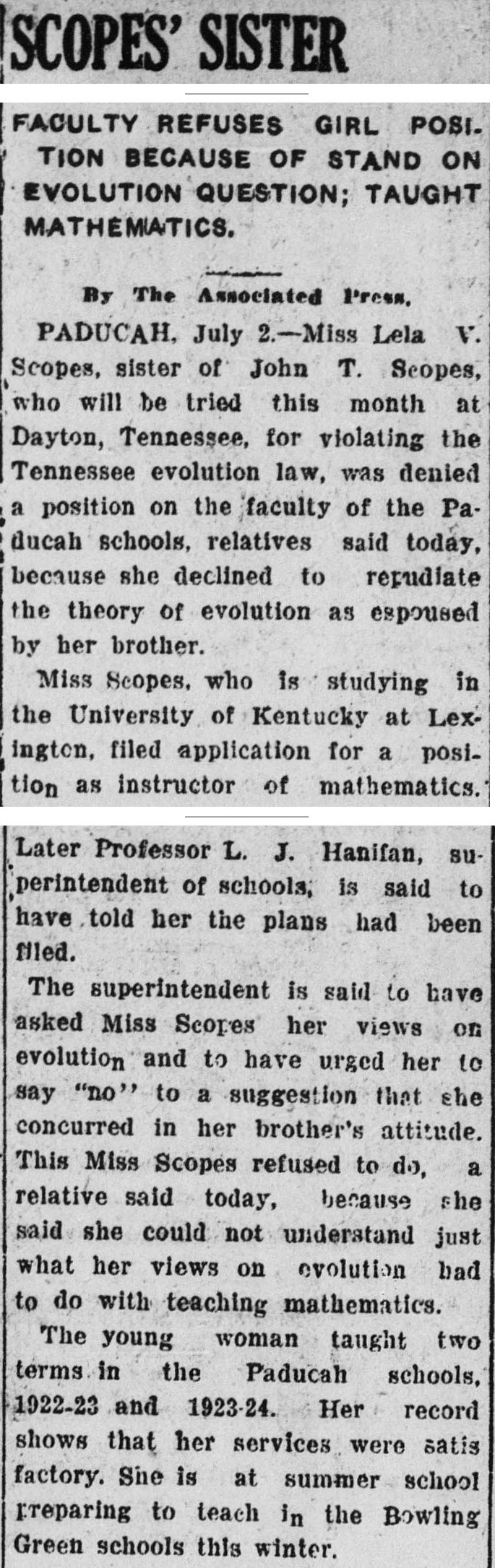
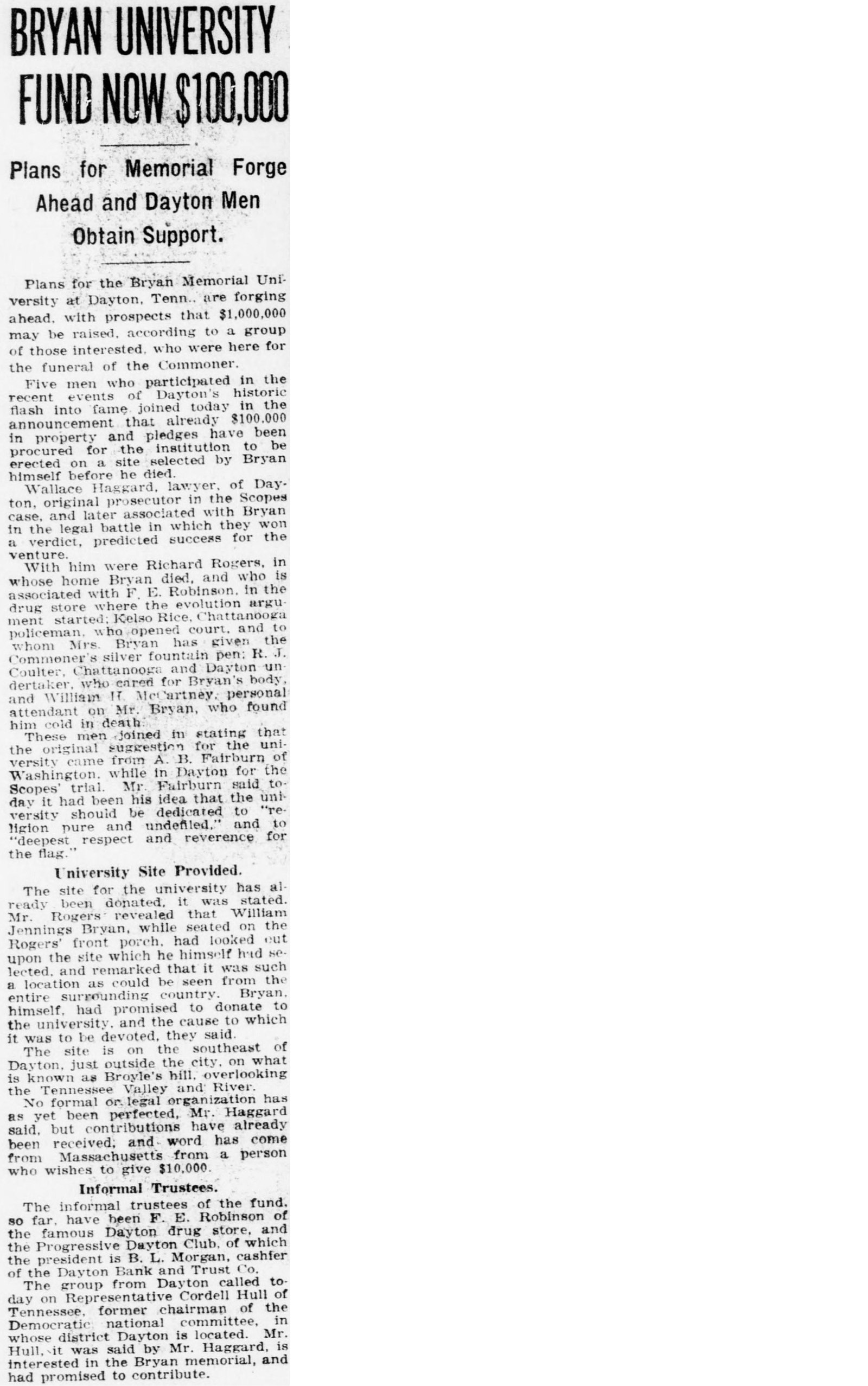
El Dorado Daily News, 7 May 1925The Washington Times, 9 June 1925The Cordele Dispatch and Daily Sentinel, 2 July 1925Evening Star, 2 August 1925

Original newspaper accounts, 1925–1926

May 1925 – March 192655 newspaper articles in the story, 5,466 in the full archive

In March 1925 a Tennessee law took effect making it a crime to teach in the public schools that man descended from a lower order of animals. Within weeks, talk in a Dayton drug store became a test case. Rappleyea, a coal company manager, swore out the warrant against John T. Scopes, the town’s 24-year-old science teacher and football coach, and the American Civil Liberties Union said it would carry the case to the Supreme Court if necessary. William Jennings Bryan joined the prosecution, and Clarence Darrow and Dudley Field Malone the defense.

In July the papers came to Dayton for the trial. The judge kept out the scientists, Darrow questioned Bryan himself on the courthouse lawn, and the jury found Scopes guilty in nine minutes, at the defense’s own request, so that the case could be appealed. Five days later Bryan died in his sleep in Dayton.

The numbers

5,466newspaper articles
5,567printings
177newspapers
34states and territories
11months in the papers

Each article is counted once, however many papers ran it. Printings counts every paper that ran it, so an article reprinted in five papers is one article and five printings.

How much the papers printed

Week of 4 May 1925: 15 printingsWeek of 11 May 1925: 59 printingsWeek of 18 May 1925: 119 printingsWeek of 25 May 1925: 159 printingsWeek of 1 June 1925: 131 printingsWeek of 8 June 1925: 235 printingsWeek of 15 June 1925: 208 printingsWeek of 22 June 1925: 207 printingsWeek of 29 June 1925: 289 printingsWeek of 6 July 1925: 755 printingsWeek of 13 July 1925: 963 printingsWeek of 20 July 1925: 764 printingsWeek of 27 July 1925: 558 printingsWeek of 3 August 1925: 242 printingsWeek of 10 August 1925: 160 printingsWeek of 17 August 1925: 85 printingsWeek of 24 August 1925: 64 printingsWeek of 31 August 1925: 23 printingsWeek of 7 September 1925: 21 printingsWeek of 14 September 1925: 32 printingsWeek of 21 September 1925: 42 printingsWeek of 28 September 1925: 41 printingsWeek of 5 October 1925: 31 printingsWeek of 12 October 1925: 21 printingsWeek of 19 October 1925: 23 printingsWeek of 26 October 1925: 15 printingsWeek of 2 November 1925: 11 printingsWeek of 9 November 1925: 11 printingsWeek of 16 November 1925: 5 printingsWeek of 23 November 1925: 9 printingsWeek of 30 November 1925: 14 printingsWeek of 7 December 1925: 9 printingsWeek of 14 December 1925: 11 printingsWeek of 21 December 1925: 17 printingsWeek of 28 December 1925: 61 printingsWeek of 4 January 1926: 25 printingsWeek of 11 January 1926: 5 printingsWeek of 18 January 1926: 15 printingsWeek of 25 January 1926: 10 printingsWeek of 1 February 1926: 17 printingsWeek of 8 February 1926: 18 printingsWeek of 15 February 1926: 30 printingsWeek of 22 February 1926: 20 printingsWeek of 1 March 1926: 3 printingsWeek of 8 March 1926: 2 printingsWeek of 15 March 1926: 5 printingsWeek of 22 March 1926: 7 printings7 May 192510 May 192513 May 192516 May 192516 May 192518 May 192519 May 192520 May 192524 May 192525 May 192528 May 19252 June 19259 June 192511 June 192512 June 192516 June 192519 June 192523 June 192527 June 19252 July 19256 July 19257 July 19259 July 192510 July 192511 July 192514 July 192515 July 192515 July 192516 July 192517 July 192518 July 192520 July 192521 July 192521 July 192521 July 192522 July 192523 July 192523 July 192527 July 192528 July 192529 July 19252 August 192510 August 192510 August 192512 August 192516 August 192519 August 192526 September 19251 October 192525 October 19257 December 192510 December 192510 February 192618 February 192622 March 1926MayJunJulAugSepOctNovDecJanFebMar963 printings in the week of 13 July 1925

Every printing of every article, by the week it ran. The marks under the line are the articles in the story below.

Where it was printed

FewerMore

Printings in 34 states. Most: District of Columbia (924), Alabama (729), Indiana (477). 499 printings could not be placed in a state.

How it unfolded

55 newspaper articles in 5 acts

Act One

Tennessee Scraps Feuds for Monkey War

7–28 May 1925

On 9 May 1925 three justices of the peace held Scopes for the grand jury under the new law, with the state’s own biology textbook in evidence. The case had begun as talk in a Dayton drug store. The American Civil Liberties Union said it expected a conviction and would go to the Supreme Court if need be. Chattanooga and Knoxville tried to take the trial away. Bryan accepted a place with the prosecution, Darrow and Malone with the defense, and a special grand jury indicted Scopes on 25 May.

Expecting conviction, the ACLU plans an appeal

Before Scopes had even been indicted, the American Civil Liberties Union in New York said it expected a conviction and was arranging to carry the case, if necessary, to the United States Supreme Court. The paper misspells the teacher as ‘J. T. Scoaps’. The conviction came in July, with a $100 fine, and the Union went on to organize and direct the defense.

El Dorado Daily News · El Dorado, Ark.

El Dorado Daily News · 7 May 1925 · page 6 · transcribed from the page image

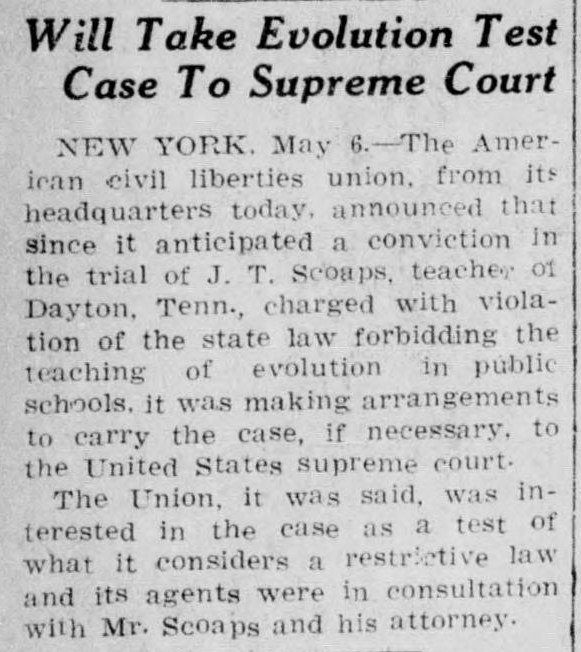
Will Take Evolution Test Case To Supreme Court

NEW YORK, May 6.—The American civil liberties union, from its headquarters today, announced that since it anticipated a conviction in the trial of J. T. Scoaps, teacher of Dayton, Tenn., charged with violation of the state law forbidding the teaching of evolution in public schools, it was making arrangements to carry the case, if necessary, to the United States supreme court.

See moreSee less

The Union, it was said, was interested in the case as a test of what it considers a restrictive law and its agents were in consultation with Mr. Scoaps and his attorney.

See the clipping

Scopes is held for the grand jury

An Associated Press account of the first hearing, on 9 May: three justices of the peace declined to rule on the law, found Scopes ‘at least technically if not intentionally guilty’ and sent him to the grand jury. The state put the Hunter textbook in evidence, and the county superintendent called Scopes ‘a good teacher.’ The act set a fine of $100 to $500; he would get the minimum.

The Montgomery Advertiser · Montgomery, Ala.

The Montgomery Advertiser · 10 May 1925 · page 2 · transcribed from the page image

TEACHER HELD TO GRAND JURY IN EVOLUTION CASE

Test Case Being Conducted in Tennessee; Defense Claims Recent Law Enacted is Unconstitutional

See moreSee less

CONSTITUTIONALITY NOT PASSED ON BY JUSTICES

Text Book Introduced Shows Man Was of Low Form of Animal

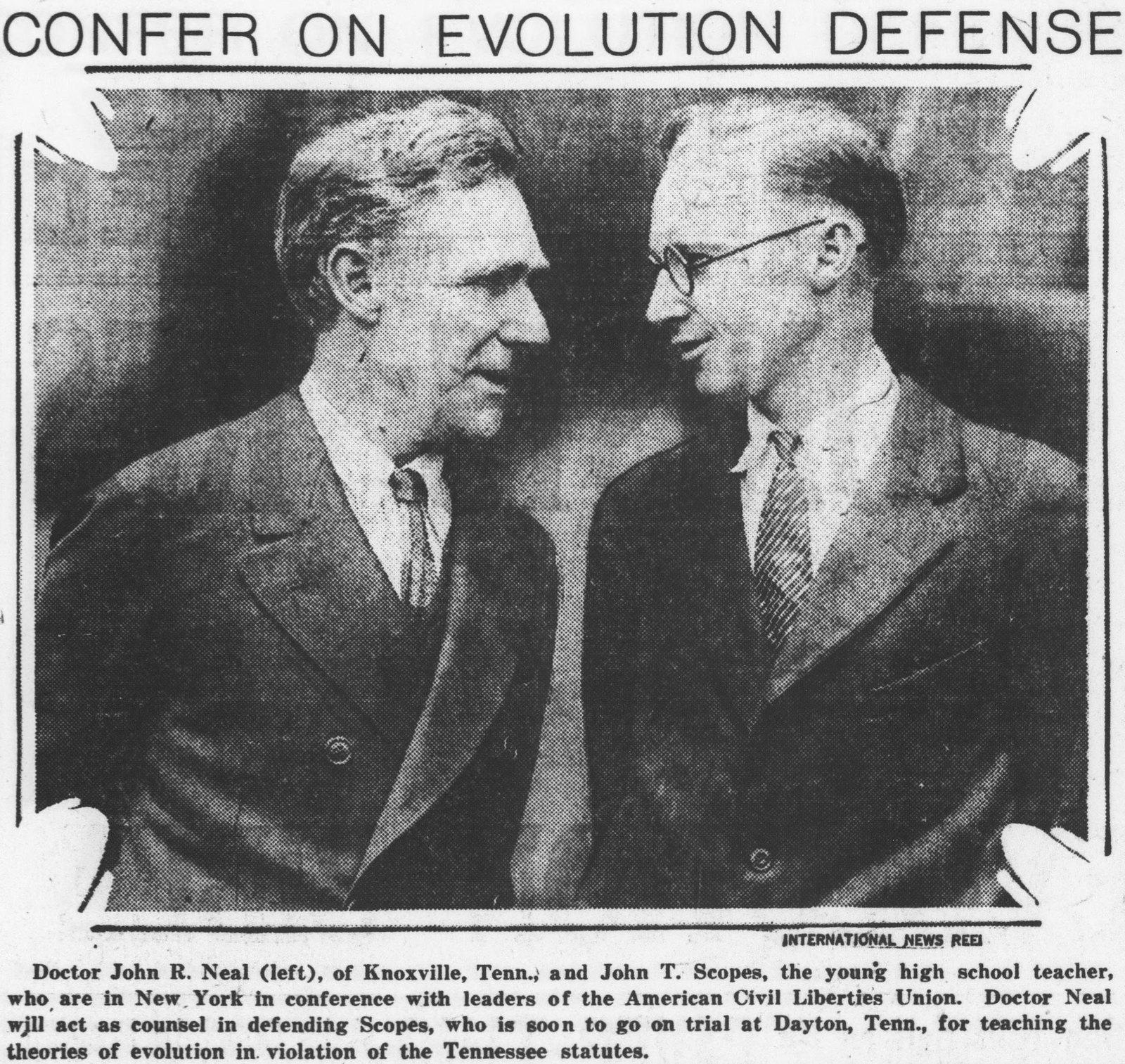
DAYTON, TENN., May 9.—By The Associated Press.—J. T. Scopes, charged with violating the newly enacted Tennessee law against teaching evolution in schools of the state, late today was held for action by the Rhea county grand jury by three justices of the peace who conducted a preliminary hearing of the charges.

Bond was fixed at $1,000 but the state expressed a willingness to accept the recognizance of the defendant and the court acquiesed.

The defense was built upon a theory that the law enacted by the recent legislature was unconstitutional. To this however, Justice Benson, speaking for his two colleagues, Justices Green and Wilbur, said: "We feel that it is not within our rights to pass on the constitutionality or the wisdom of the law. The defendant is at least technically if not intentionally guilty, hence our decision to hold him for action by the grand jury."

After a defense plea of not guilty the state introduced one witness, Walter White, superintendent of public instruction of Rhea county. Mr. White identified the text book as one approved by the state board of education and as a result required as a part of the course of instruction in high schools, Mr. White said.

Mr. Scopes as the teacher of science in the Rhea county school taught the book and the defense made no denial of this charge. Mr. White said Mr. Scopes was "a good teacher."

Wallace C. Haggard, making the first argument for the state, claimed that the text book and the act of the general assembly showed a clear violation of the law. John Randolph Neal for the defense, declared the act incapable of enforcement and called attention to the fact that the word "evolution" appeared in the preamble but not in the body of the act.

"A civic biology" by George W. Hunter, a text book taught in the Rhea county high school was one of the exhibits on which emphasis was laid. A paargraph under the head of "the doctrine of evolution" was quoted as follows:

"We have now learned that animal forms may be arranged so as to begin with very simple one celled forms and culminate with a group which contains man himself. This arrangement is called the evolutionary series. Evolution means change and these groups are believed by scientists to represent stages in complexity of development of life on the earth. Geology teaches that millions of years ago life upon the earth was very simple and that gradually more and more complex forms of life appeared as the rock formed latest in time to show the most highly developed forms of animal life. The great English scientist, Charles Darwin, from this and other evidence, explained the theory of evolution. This is the belief that simple forms of life on the earth slowly and gradually gave rise to those more complex and that thus ultimately the most complex forms came into existence."

Another paragraph stressed was headed "evolution of man." It says:

"Undoubtedly there once lived upon the earth races of men who were much lower in their mental organization than the present inhabitants. If we follow the early history of man upon the earth we find that at first he must have been little better than one of the lower animals. He was a nomad wandering from place to place feeding upon whatever living things he could kill with his hands. Gradually he must have learned the use of weapons and thus kill his prey. First using rought stone implements for this purpose. As man became more civilized implements of bronze and of iron were used. About this time the subjugation and domestication of animals began to take place. Men then began to cultivate the fields and to (Continued on Page Two)

TEACHER HELD TO GRAND JURY EVOLUTION CASE (Continued from Page One.)

have a fixed place of abode other than a cave. The beginnings of civilization were long ago but even today the earth is not entirely civilized."

In connection with today's hearing Walter White, superintendent of schools, pointed out that Rhea county is developing into the testing ground of the state of Tennessee for its school laws. A case from this county state of Tennessee vs. Covell, was decided by the supreme court of the state in 1920 clarifying the compulsory school attendance law. The law provided Mr. White said, for compulsory school attendance from seven to sixteen years of age inclusive. He held that this should be construed to mean compulsory school attendance until the age of 17 while it was held in some counties that 16 was the maximum. A test case was made and decision handed down that children under the law should attend school until they reached 17.

The case will go before the grand jury convening the first Monday in August.

The act Scopes was charged with violating passed at the last session of the Tennessee legislature and became effective March 21.

The preamble to the act designates it as an act "prohibiting the teaching of the evolution theory in all universities, normal and all other public schools supported in whole or in part by public school funds of the state"

The act continues that it shall be a misdemeanor punishable by a fine of from $100 to $500 "to teach any theory that denies the story of the divine creation of man as taught in the Bible and to teach instead that man is descended from the lower order of animals."

The defense offered no testimony and admitted that the book was taught by the defendant in the science department as a part of the course. The defense, however, in argument centered a sweeping attack against the constitutionality of the law, claiming that the legislation violates both the constitution of the United States and that of the state of Tennessee.

John Randolph Neal, counsel for the defense with John L. Godsey, declared also that the act was improperly drawn in that evolution was mentioned in the preamble but not in the body of the act.

"We deny," Neal said, "that the theory of evolution is contrary to the story of divine creation taught in the Bible. Legislative enactment cannot make it so. Many clergymen believe every word of the Bible and accept the theory of evolution."
See the clipping

Bryan agrees to prosecute

Telegraphing from Pittsburg, William Jennings Bryan accepts the Christian Fundamental Association’s invitation to prosecute Scopes, ‘providing the state is willing’. Within a week Clarence Darrow had joined the other side. Bryan went on to lead the prosecution at Dayton, and died there in his sleep on 26 July, five days after the verdict.

Seward Daily Gateway · Seward, Alaska

Seward Daily Gateway · 13 May 1925 · page 8 · transcribed from the page image

BRYAN WILL PROSECUTE MEMPHIS, May 13. (AP)—William J. Bryan telegraphed from Pittsburg his acceptance to the invitation of the Christian Fundamental Association, to prosecute J. T. Scopes, school teacher at Dayton, Tennessee, charged with violation of the anti-evolution law, providing the state is willing.

See the clipping

A Brown junior questions Bryan

In Providence, students booed and hissed Bryan, and a Brown University junior, George L. Cassidy, put questions Bryan apparently could not satisfactorily answer. Pleading that he was an hour late, Bryan tried to excuse himself: ‘I have to retire before this magnificent, bubbling fountain of wisdom on my right.’ Two months later, on the courthouse lawn at Dayton, Clarence Darrow would question him on the witness stand.

The Nome Nugget · Nome, Alaska

The Nome Nugget · 16 May 1925 · page 1 · transcribed from the page image

STUDENTS MAKE WILLIAM J. BRYAN "PULL LEATHER" PROVIDENCE, R. I., May 16, (AP)—After William Jennings Bryan had swayed his apdience in an emotional appeal for the protection of man's faith in God against the teachers of the doctrine of man descended to the level of the lower animals, George L. Cassidy, a Junior of Brown University, stepped to the platform during the question period and repeated questions at Bryan's request. Bryan apparently could not satisfactorily answer the questions, and tried to excuse himself saying that he was an hour late, and added, "I have to retire before this magnificent, bubbling fountain of wisdom on my right."

See moreSee less

The students booed and hissed the speaker before this occurred, however. Bryan told another inquisitor, William G. Chase, a student, "I am sorry for you—I am ashamed of you," when Chase admitted he didn't believe the Bible.

See the clipping

Dayton stands by its football coach

A Washington Daily News feature finds Dayton fond of Scopes, its star teacher and football coach, and angry instead at George W. Rappleyea, the coal company manager who persuaded him to stand as the test case: it was he, they say, ‘who began it all.’ Scopes had to stop friends from beating Rappleyea. Days later a Dayton barber did attack him at a citizens’ meeting.

The Washington Daily News · Washington, D.C.

The Washington Daily News · 16 May 1925 · page 3 · transcribed from the page image

TENNESSEE SCRAPS FEUDS FOR MONKEY WAR

JOHN T. SCOPES, LEFT, SCHOOL TEACHER OF DAYTON, TENN., WHO AGREED TO TEST THE ANTI-EVOLUTION LAW OF TENNESSEE AT SUGGESTION OF GEORGE W. RAPPLEYEA, RIGHT.

See moreSee less

Popular Coach Defendant in Case

So Natives Turn Their Enmity Against Rappleyea, Who Stirred Up Court Test

Special to The News

DAYTON, Tenn. — Your old-fashioned Tennesseean—the man who shoots straight and dies with his boots on—is perplexed.

"Have I been kidding myself all these years?" he asks as he digs into his encyclopedia for enlightenment on the burning question of evolution, "or am I really the last of a long line of monkeys?"

The Tennesseean is up a tree. And the fact that the tree is the natural habitat of the monkey tribe brings no comfort to him in his bewilderment.

Await Court Ruling

Your old-fashioned Tennesseean is used to settling disputes in an old-fashioned way—hard, horny fists with no holds barred, or squirrel rifles at long range.

But now he must wait on the boundary line of the battlefield while a court determines whether the state legislature overstepped itself in prohibiting the teaching of evolution.

John T. Scopes, high school teacher and coach of the Dayton football team, is the central figure of the war.

While the crafty general responsible for the court action is George W. Rappleyea, 30, manager of the Cumberland Coal and Iron Co., a "rabid" evolutionist.

State Approved Text

Scopes, to test the law, will admit he taught his high school students from "Civic Biology," a book adopted by the State textbook commission.

The entire book deals with evolution and somewhere near the end the Darwinian theory is summed up as follows: "We have now learned that animal forms may be arranged so as to begin with the simple ones called forms and. culminate with a group which contains man himself.

Rappleyea, learning of the text book, induced Scopes to become the victim of a court action.

Daytonians Shocked

The good people of Dayton were shocked.

Nine-tenths of them had never heard of the evolution theory until they read of the law in their weekly paper. At first they were strong for the law.

But not when it involved Scopes.

He was the star teacher of the school. And he was the football coach whose team had held Chattanooga to a comparatively low score.

At the same time, they will remain unshaken in their belief that man sprang from Adam and Eve and not from the missing link.

And, doing both, they will take out their spite on Rappleyea, for it was he, they say, "who began it all."

Beating Threatened

One day recently Scopes actually had to step in to prevent several of his indignant friends from way-laying Rappleyea and giving him a beating.

Money to test out the law is plentiful.

On a drugstore window is pasted a list of men and women who offer to pay the cost, whatever it may be. There are 60 names, and the list grows daily. On it are names of liberals from all parts of the country, from Morris Hillquit and the American Civil Liberties Union in New York to Maynard Shipley and the American Science Association in San Francisco.

Town folk are not interested in the reports that an array of nationally known individuals including William Jennings Bryan will come here to be lined up behind the prosecution and defense.

Monkeys are monkeys, but good football coaches have been scarce around here and there may never be another one like John Scopes.

See the clipping

Darrow signs on, likening Bryan to Nero

The Chicago lawyer Clarence Darrow and Dudley Field Malone of New York have had their offers to defend Scopes accepted, and Darrow links Bryan with Nero as men whose opposition helped spread the doctrines they fought. The two offered to pay their own expenses ‘in order that day might triumph over night.’ Darrow adds that the Tennessee lawyers are good and will not need help.

The Union Daily Times · Union, S.C.

The Union Daily Times · 18 May 1925 · page 1 · transcribed from the page image

Part of this page is damaged, so some words could not be read with certainty. Letters and words in [brackets] are our reading of what survives.

DARROW WILL OPPOSE BRAYN

In Tennessee Evolution Trial And Comes Out With Opinion of Commoner

See moreSee less

New York, May 18 (AP).—Clarence Darrow, Chicago lawyer, who is to oppose William Jennings Bryan in Tennessee evolution trial came out today with a few opinions about the commoner. Nero and Bryan were linked by Darrow as men whose irrational opposition enhanced the spread of 'great doctrines.

Offers of Darrow and Dudley Field Malone of New York, to assist in the defense of J. T. Scopes of Dayton Tennessee, public school teacher, charged with violation of law forbidding the teaching of evolution have been accepted. Mr. Bryan is to assist in the prosecution. Mr. Darrow is in New York at present.

"Nero," he said, "tried to kill Christianity with persecution and law. ryBan would blockenlighten m[e]nt with law. Nero failed as will Br[y]an. More persons are studying evolution in Tennessee now than before the law was 'passed just as Nero's acts made Christians.

"Man may be sure of his ideas but if he is intelligent he knows there is room for doubt and debate and he welcomes both. Mr. Bryan would block both because of his views. He was brought up on certain beliefs which he has never questioned or about which he sought to be enlightened to the end that he might be wrong. That is lack of intelligence.

"Had Mr. Bryan's ideas of what a man may do towards free thinking existed throughout history, we would still be hanging and burning [illegible] and punishing persons who [illegible] the earth round.'

[D]arrow said he and Mr. Ma[lone] were willing to pay all their expenses of the Tennessee trial "in order that day might triumph over night."

"Any man of ordinary intelligence could topple Brayn in such a fight," the lawyer continued. "The Tennessee lawyers are good. They will not need help."

See the clipping

Chattanooga and Knoxville want the trial

Bigger Tennessee cities are reported trying to take the trial from Dayton, ‘a little town of 1,800 souls’, and Chattanooga’s grand jury is questioning students about a biology teacher there, Steger Hunt. Neal insists the case stay in Dayton and not become ‘a circus stunt’. The paper names H. G. Wells among the expected counsel; he appears in no later list of the lawyers.

The Indianapolis Times · Indianapolis, Ind.

UnconfirmedNo later report in this collection bears it out.

The Indianapolis Times · 19 May 1925 · page 1 · transcribed from the page image

CHATTANOOGA SEEKS ITS OWN APE TRIAL Tennessee Cities Jealous of Publicity Evolution Case Brings Town.

By Times Special KNOXVILLE, May 19.—Dayton, Tenn., a little town of 1,800 souls, is about to become as famous as Shelby, Mont., and at no cost whatever.

See moreSee less

All of which makes larger Tennesse cities so jealous that their eyes gleam like emeralds.

Incipient moves have started in both Knoxville and Chattanooga to take away from little Dayton the trial of John T. Scopes on a charge of vialoting the State law against teaching evolution. The eyes of the world are expected soon to be directed upon the trial, in which it is already understood that such men as William Jennings Bryan, Clarence [D]arrow and H. G. Wells will function as counsel.

A Chattanooga newspaper asks that change of venue take the trial to its new memorial auditorium where thousands can sit in, and the Knoxville Chamber of Commerce has begun a campaign with the object of bringing the trial here. But Judge John R. Neal, chief counsel for Scopes, insists that the trial, "an honest effort to test the law must not be endangered by making it a circus stunt," and that it will be held in Dayton.

The Dayton Amusement Company is making preparations for a crowd when the trial begins in August and plans are underway to erect a tent city to accommodate the visitors.

The case is another test of the validity of the new anti-evolution law and was initiated by Dr. Lyle B. West, a personal friend of Professor Hunt.

It was claimed that Hunt used in his class room the text book "a civic biology," the same on which Prof. John T. Scopes recently was bound over to the grand jury in Dayton, Tenn.

A TRIAL OF ITS OWN

Chattanooga Jury Seeks Information On "Monkey-Business." By United Press CHATTANOOGA, Tenn., May 19.—Four students of the Central High School were summoned before the grand jury meeting here today to investigate charges that Steger Hunt, biology instructor, violated the State law by teaching evolution.

See the clipping

A barber swings at Rappleyea

The first blows of the evolution fight are literal: at a Dayton meeting called to protest Chattanooga’s bid for a rival test case, barber Thurlow Reed took Rappleyea’s claim that man evolved from lower forms of life as a reflection on his family, and attacked him. The meeting threatened to boycott Chattanooga, and the trial stayed in Dayton.

Evening Star · Washington, D.C.

Evening Star · 20 May 1925 · page 17 · transcribed from the page image

EVOLUTION RIVALS STAGE FIST FIGHT

Strenuous Scenes Mark Efforts to Settle Which Town Gets Case.

See moreSee less

By the Associated Press.

DAYTON, Tenn., May 20.—First blows in Tennessee's famous evolution fight have been struck.

The blows were literal, however, instead of legal, and were exchanged between a proponent and an opponent of evolution at a meeting of Dayton citizens to protest against a contemplated move by Chattanooga to rush to court a case testing the Tennessee anti-evolution teaching law ahead of the trial of J. T. Scopes of Dayton.

An assertion by Dr. George Rappleyea, evolution leader, who swore out the warrant for Scopes' arrest to test the law that man evolved from lower forms of life, was resented by Thurlow Reed, Dayton barber, as a reflection on his family, and he dashed to the rostrum and attacked Rappleyea.

With national organizations and prominent individuals, including William Jennings Bryan, Dudley Field Malone and Clarence Darrow, enlisted in the fight which will center around the Tennessee legislation, [it is] now apparent that a pre-legal c[ontest] is on for the honor of staging th[e c]ourt battle.

Grand Jury Meets in August.

The grand jury which will consider the case of Scopes, who, as a biology teacher in a county high school, discussed the theory of evolution after reading a passage from an authorized State text book, does not meet until August. The grand jury is in session at Chattanooga now and reports from that point indicated that an effort would be made to have Chattanooga teachers indicted, with prospects of the trial opening in June.

A resolution adopted at the meeting here threatened to boycott Chattanooga unless efforts to change the place of the contest were dropped.

Chattanooga teachers selected for the proposed test case were reported reluctant to accept the honor of indictment.

A new offer to the evolutionists has been received in a telegram from an actress promising an "educated moving picture chimpanzee" for the trial.

See the clipping

How a drugstore talk became a test case

As Dayton awaits a special grand jury, the AP tells how the case began: in a drug store that served as ‘the town club to all intents and purposes’, Scopes said he was teaching evolution, and George Rappleyea proposed he submit to arrest. Rappleyea swore the warrant and now finds himself applauded by friends of the law he hopes to overturn. Scopes, meanwhile, is selling automobiles for the summer.

El Dorado Daily News · El Dorado, Ark.

El Dorado Daily News · 24 May 1925 · page 2 · transcribed from the page image

Evolution To Make City Of Wee Village

DAYTON, Tenn., May 23.—(By the Associated Press)—Dayton tonight was dusting off its best bib and tucker in preperation for the first phase of the court test of the constitutionality of the recently enacted Tennessee law against the teaching of evolution in public school.

See moreSee less

Presentment of an indictment to the Rhea county grand jury called in special session Monday, will start the revolution of the wheel that is expected eventually to decide whether evolution is a theory, a science or both in Tennessee, and whatever it can from a part of the school courses as the recent legislature has said it cannot.

John T. Scopes, science teacher in the Rhea county high school, recent graduate of the University of Kentucky and now, released for the summer months from the school room, an automobile salesman, is the central figure in the test. He was formerly charged with a violation of the law and May 9 given a preliminary hearing before three justices of the peace. They held that he was "technically, if not intentionally, guilty and held him for action by the grand jury. His (Continued on Page 2)

Evolution to Make City of Wee Village (Continued from Page 1)

bond was placed at $1,000, but he was not required to post sureties.

The case has thrown Dayton squarrelly in the center of the stage of publicity. The county seat of Rhea County is a small town, its population not being much in excess of 2,000. The court house where the trial will be held if Scopes is Indicted regarded as a certain development is a building of the orthodox court house type, sheltered by scores of trees, a dozen varieties of maples An immense lawn surrounds the 25 yeald old building and it is planned to have most of the crowd, expected to gather for the trial, hear the argument, loud speakers of the mechanical variety being installed in the court room.

The present case, in a fair way to be heard round the world, was started one night when a crowd of Congenial spirits had gathered in a Drug Store, the town club to all intents and purposes.

Mr. Scopes was present and in a discussion of the legislative edict against the Teaching of evolution, he remarked that he was teaching it in the Biology courses of his science department.

Dr. George W. Raphleyea, a chemical engineer, manager of an iron and coal company in Dayton, was in the group and he at once suggested that Scopes submit to arrest that a test case might be had of the new law.

Scopes acquiescing, Dr. Rapleyes went before a justice of the peace ard swore to a warrant for the School Teacher's arrest. HeH can charged with Teaching evolution in a biology review April 21, when the law became effective by approval of the governor March 21.

When news of the test became known the Post Office and Telegraph offices at Dayton showed greatly increased business. Letters and Telegrams came from all parts of the United States for Mr. Scopes and Mr. Raphleyea. Some of the Communications to the School teacher cheered him in his stand, while others were frankly critical. First news of the arrest of Mr. Scopes gave Dr. Raphleyea as the prosecuting witness, but did not bring out that he was friendly to the theory of evolution, se he has found himself in the peculiar position of being applaud[e]d by friends of the law he is trying to have declared unconstitutional

See the clipping

The grand jury indicts Scopes

A brief AP dispatch: the Rhea county grand jury indicts Scopes on a charge of teaching evolution; earlier reports said it had been called in special session instead of waiting for its August term. The Alaska paper’s dateline puts Dayton in Ohio. This indictment did not last: on 10 July, the trial’s first day, a new grand jury reindicted him to meet a thirty-day rule, and the first was quashed.

Seward Daily Gateway · Seward, Alaska

Seward Daily Gateway · 25 May 1925 · page 1 · transcribed from the page image

EVOLUTIONIST INDICTED FOR TEACHING WORKINGS

DAYTON, O., May 25.—(AP)—The Grand Jury of Rhea county indicted John T. Scopes today, science teacher, on a charge that he taught evolution.

See the clipping

Scopes, 24, says what he believes

Visiting the University of Kentucky, from which he graduated the previous June, the 24-year-old teacher says he believes ‘man and all animals ascended from the lower orders’ but has never read any scientific statement that man descended from a monkey. He seems embarrassed by the publicity, and thinks the trial, set for 10 July, concerns the state’s educational progress more than himself.

El Dorado Daily News · El Dorado, Ark.

CorrectionThis set right an article from the day before.

El Dorado Daily News · 28 May 1925 · page 1 · transcribed from the page image

Part of this page is damaged, so some words could not be read with certainty. Letters and words in [brackets] are our reading of what survives.

Scopes Much Embarrassed By Publicity LEXINGTON, Ky., May 27.—John T. Scopes of Paducah, Ky., who is under indictment by a grand jury at Dayton, Tenn., on charges of violating the state's anti-evolution law, believes that "man and all animals ascended from the lower orders, "but I have never seen or read any scientific statement that man 'descended from a monkey' and I do not believe that." Mr. Scopes made his statement here today while visiting the Uni University of Kentucky, from which he was graduated last June. The 24-year-old teacher in the Dayton schools appeared to be somewhat embarrassed by the publicity which the Tennessee test case, instituted by is friends, has brought to him.

See moreSee less

He is looking forward, however, to tn trial at a special term of Rehea county circuit court set for July 10. The trial, he believes, affects not so much himself as the educational progress of the state.

See the clipping

About these pages

Every clipping here was printed in an American newspaper at the time. The text on each card was read from the page by machine and lightly repaired; where it disagrees with the clipping, the clipping is right. Where the scan of an old page was too damaged to read, the text was transcribed again from the page image and is marked so; letters in [square brackets] were supplied where the printing itself is damaged, and the paper’s own misspellings are kept. The dates, papers, headlines and text are the papers’. The notes on why each article matters, and the one-line summaries, are ours.