As the Papers Told It

The Lincoln Assassination

As the Papers Told It

Daily National Intelligencer, 15 April 1865Litchfield Enquirer, 4 May 1865The New York Herald, 1 June 1865New-York Daily Tribune, 7 July 1865

And the Hunt for John Wilkes Booth

April – December 186550 newspaper articles in the story, 7,933 in the full archive

On the night of 14 April 1865 John Wilkes Booth shot President Lincoln in the head at Ford’s Theatre in Washington, and the same night a second man stabbed Secretary of State Seward at his home. Lincoln died at 22 minutes past seven the next morning, and Andrew Johnson was sworn in that day. The first reports got much wrong: one had Seward dead, another had Booth taken aboard a monitor.

The papers followed the hunt to a barn in Virginia, where Booth was shot, and then the military commission that tried eight people accused of the plot. Four were hanged in July, Mrs. Surratt among them. Within weeks the papers were arguing over her guilt, and through the autumn they chased a prisoner taken for John Surratt while the government called in the claims for the rewards.

The numbers

7,933newspaper articles
7,965printings
209newspapers
40states and territories
9months in the papers

Each article is counted once, however many papers ran it. Printings counts every paper that ran it, so an article reprinted in five papers is one article and five printings.

How much the papers printed

Week of 10 April 1865: 75 printingsWeek of 17 April 1865: 805 printingsWeek of 24 April 1865: 740 printingsWeek of 1 May 1865: 731 printingsWeek of 8 May 1865: 635 printingsWeek of 15 May 1865: 791 printingsWeek of 22 May 1865: 516 printingsWeek of 29 May 1865: 426 printingsWeek of 5 June 1865: 389 printingsWeek of 12 June 1865: 201 printingsWeek of 19 June 1865: 255 printingsWeek of 26 June 1865: 158 printingsWeek of 3 July 1865: 249 printingsWeek of 10 July 1865: 481 printingsWeek of 17 July 1865: 337 printingsWeek of 24 July 1865: 188 printingsWeek of 31 July 1865: 205 printingsWeek of 7 August 1865: 107 printingsWeek of 14 August 1865: 62 printingsWeek of 21 August 1865: 63 printingsWeek of 28 August 1865: 43 printingsWeek of 4 September 1865: 26 printingsWeek of 11 September 1865: 29 printingsWeek of 18 September 1865: 27 printingsWeek of 25 September 1865: 37 printingsWeek of 2 October 1865: 23 printingsWeek of 9 October 1865: 34 printingsWeek of 16 October 1865: 27 printingsWeek of 23 October 1865: 44 printingsWeek of 30 October 1865: 32 printingsWeek of 6 November 1865: 16 printingsWeek of 13 November 1865: 37 printingsWeek of 20 November 1865: 41 printingsWeek of 27 November 1865: 27 printingsWeek of 4 December 1865: 31 printingsWeek of 11 December 1865: 27 printingsWeek of 18 December 1865: 31 printingsWeek of 25 December 1865: 19 printings15 April 186515 April 186515 April 186516 April 186516 April 186517 April 186517 April 186517 April 186518 April 186518 April 186519 April 186519 April 186521 April 186521 April 186522 April 186523 April 186525 April 186525 April 186526 April 186527 April 186530 April 18654 May 18654 May 18654 May 18659 May 186512 May 186514 May 186519 May 186525 May 186526 May 18651 June 18657 June 186510 June 186519 June 186522 June 186528 June 186529 June 18657 July 186513 July 186517 July 186518 July 186519 July 186522 July 186524 July 186525 July 186531 July 186511 August 18658 September 186525 November 186515 December 1865AprMayJunJulAugSepOctNovDec805 printings in the week of 17 April 1865

Every printing of every article, by the week it ran. The marks under the line are the articles in the story below; red ones were wrong.

Where it was printed

FewerMore

Printings in 40 states. Most: Ohio (1,209), New York (840), District of Columbia (776). 648 printings could not be placed in a state.

How it unfolded

50 newspaper articles in 6 acts

Act One

The Tragedy of Last Night

15–17 April 1865

Lincoln was shot in the head at Ford’s Theatre on the night of 14 April and died at 22 minutes past seven the next morning. The same night Secretary Seward was stabbed at his home and his son Frederick’s skull was fractured. By ten past four in the morning Stanton had named Wilkes Booth, and that day Chief Justice Chase swore in Andrew Johnson. The first dispatches got much wrong: one had Seward dead, another had Booth captured aboard the monitor Mahopac.

The first account, written at 2 a.m.

Writing at 2 a.m., the National Intelligencer has ‘but little hope’ for the President, shot in the head at Ford’s Theatre, and says Seward was stabbed at home. ‘Evidently conspirators are among us!’ it warns. It holds back the name of a suspect, and reports the actor Mr. Hawk held to testify to the assassin’s identity. At five o’clock Lincoln was still alive ‘but was rapidly sinking’.

Daily National Intelligencer · Washington City, D.C.

This article was wrong. The papers corrected it the next day.

Wrong

Daily National Intelligencer · 15 April 1865 · page 2 · transcribed from the page image

Part of this page is damaged, so some words could not be read with certainty. Letters and words in [brackets] are our reading of what survives.

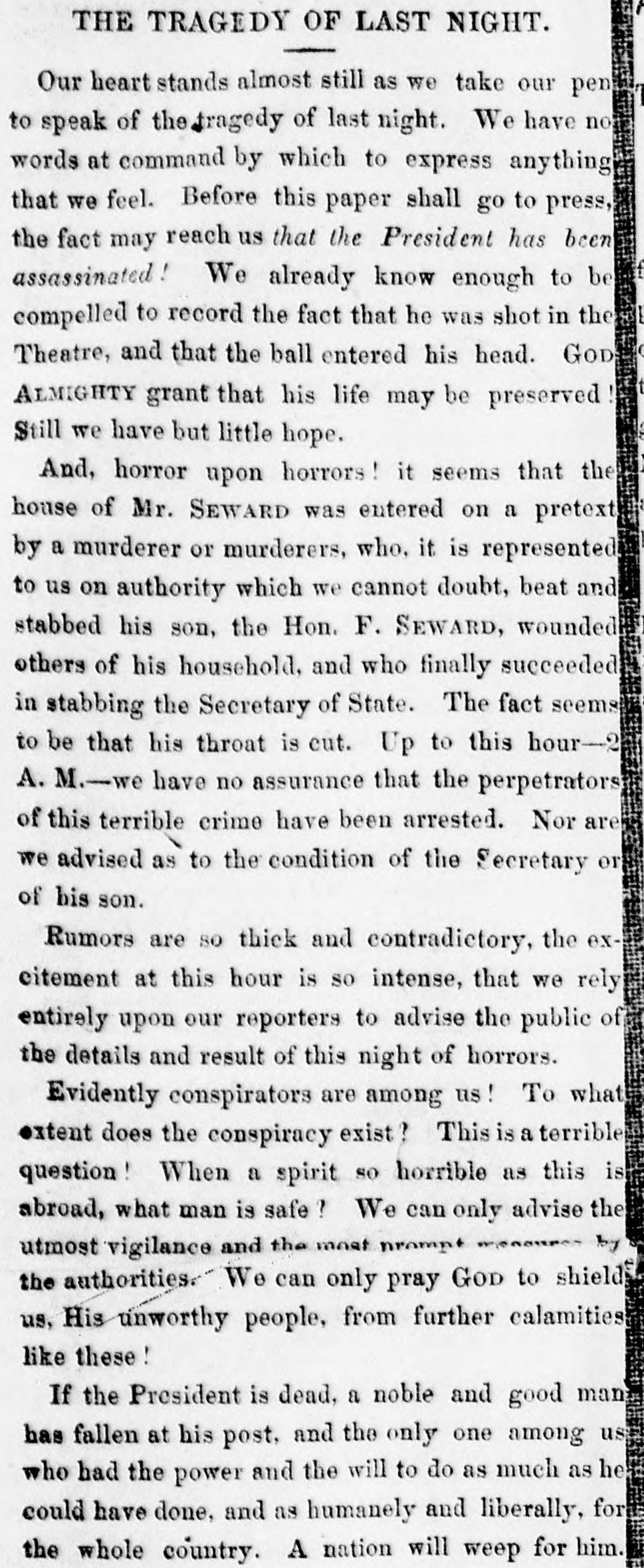
THE TRAGEDY OF LAST NIGHT. Our heart stands almost still as we take our pen to speak of the tragedy of last night. We have no words at command by which to express anything that we feel. Before this paper shall go to press, the fact may reach us that the President has been assassinated! We already know enough to be compelled to record the fact that he was shot in the Theatre, and that the ball entered his head. GOD ALMIGHTY grant that his life may be preserved! Still we have but little hope.

And, horror upon horrors! it seems that the house of Mr. SEWARD was entered on a pretext by a murderer or murderers, who, it is represented to us on authority which we cannot doubt, beat and stabbed his son, the Hon. F. SEWARD, wounded others of his household, and who finally succeeded in stabbing the Secretary of State. The fact seems to be that his throat is cut. Up to this hour—2 A. M.—we have no assurance that the perpetrators of this terrible crime have been arrested. Nor are we advised as to the condition of the Secretary or of his son.

See moreSee less

Rumors are so thick and contradictory, the excitement at this hour is so intense, that we rely entirely upon our reporters to advise the public of the details and result of this night of horrors.

Evidently conspirators are among us! To what extent does the conspiracy exist? This is a terrible question! When a spirit so horrible as this is abroad, what man is safe? We can only advise the utmost vigilance and the most prompt measures by the authorities. We can only pray GOD to shield us, His unworthy people, from further calamities like these!

If the President is dead, a noble and good man has fallen at his post, and the only one among us who had the power and the will to do as much as he could have done, and as humanely and liberally, for the whole country. A nation will weep for him. The loss of the Secretary of State would be irreparable. But our heart is too full to say more.

The President was received with great furore on entering the theatre; his reception was, indeed, extraordinary. One of the actors (Mr. Hawk) had made the remark, (as "Dundreary,") this "reminds me of a story, as Mr. Lincoln says," and was telling the story as the President entered The enthusiasm of the audience interrupted the story for several minutes. After the President was seated the actor was forced by the people to tell the "story" over again.

As to the awful catastrophe, the drift of reliable information is, that when a pistol shot was heard in the second box of the right-hand side of the stage of Ford's Theatre, persons in the theatre imagined that it was part of the play. Hence the confusion of the audience. Meantime, the assassin appeared on the edge of the box, crying, "Sic Semper Tyrannis," and flourishing a dagger, leaped to the stage. He crossed the stage rapidly, exclaiming "Revenge," and again flourishing his dagger disappeared, saying, "I have done it."

All started to their feet, and there being cries that the President was shot, (the first intimation of danger was a call for a surgeon,) the crowd exclaimed, "Secure the assassin!" "hang him!" &c., &c.

Miss Laura Keene appeared on the stage, and with great self-possession implored the audience to be silent.

The President was seen to turn in his seat, and persons leaped upon the stage and clambered up to the box. His clothes were stripped from his shoulders, but no wound was at first found. He was entirely insensible. Further search revealed the fact that he had been shot in the head, as is described elsewhere. Major Potter, paymaster in the army, and Major Rathbone, (the latter having been in the box,) assisted by others, carried the President from the theatre, the blood from the death-wound falling upon the floor, stairway, and sidewalks as he was borne to the nearest house opposite, which was that of Mr.

Ulke. Mrs. Lincoln was assisted in crossing the street with the President in a frantic condition, at the same time uttering heart-rending shrieks. She was attended by Miss Laura Keene and others.

At the house, an army surgeon being at hand, called for a small quantity of brandy, which was administered, and it was thereupon announced to the pressing and excited crowd that he was alive, and not dead, as Mrs. Lincoln, in her agony, insisted.

It was then found that Major Rathbone had received a wound in the arm, which he had intentionally concealed to prevent excitement. He then fainted.

The Surgeon General was sent for, and Drs. Hall [illegible]tone also arrived. An immense crowd had now assembled, but a strong military force arrived and guarded the entire locality. Crowds now gathered in all parts of the city. Nothing was talked of but the murder of the President, of Mr. Seward, and of the members of Mr. Seward's family. Intense excitement was added to the already nearly wild masses by a rumor that Gen. Grant had been assassinated in the cars, en route for Philadelphia, and that Mr. Stanton had barely escaped with his life by being warned in time to exclude the conspirators from his house. (This is discredited.) It may be added that a person who was passing Mr. Seward's house saw the murderer mount his horse, pass up Fifteen-and-a-half street, where Mr. Seward resides, and thence rapidly to H street, where he disappeared.

The alarm of murder from Mr. Seward's house was frightful as the assassin passed out, and much space of time elapsed before pursuit was had. We forbear to give the name of one of the supposed murderers, about whom great suspicion gathers.

The long-roll was beaten all over the city, and every avenue was at once guarded. Such a night of horror has seldom darkened any community. The indefinite dread which conspiracy inspires seized on the public mind, and suspicion, apprehension, and agony pervaded the people."

At the police headquarters it is understood that Mr. Hawk, of Laura Keene's troupe, has been held to bail to testify to the identity of the suspected assassin of the President, whom he is said to have recognized as a person well known to him.

LATEST.--As we go to press, at FIVE o'clock this morning, the President was still alive, but was rapidly sinking.

See the clipping

Rock Island reports Seward dead too

At 10 a.m. on Saturday a Rock Island, Illinois, paper reports both Lincoln and Seward assassinated and dead. Seward was not: a despatch from his family that day called his wounds bad but not mortal, and he recovered. The editor also fears the successor, Andrew Johnson, sworn in that day: ‘A bold, bad man is now to be president’.

The Evening Argus · Rock Island, Ill.

This article was wrong. The papers corrected it the next day.

Wrong

The Evening Argus · 15 April 1865 · page 2 · transcribed from the page image

Part of this page is damaged, so some words could not be read with certainty. Letters and words in [brackets] are our reading of what survives.

A Most Horrible Deed. ABRAHAM LINCOLN AND WILLIAM H. SEWARD ASSASSINATED AND KILLED! The Nation will Mourn this most Shocking Crime. We are astounded by the horrible intelligence of the assassination and death of Abraham Lincoln, President of the United States, and William H. Seward, Secretary of State, of the United States. The few details we have at this writing (10 A. M. Saturday) do not enable us to form any correct judgment of this most horrible crime. But whatever may have been the cause, it is an event which all good citizens will most deeply deplore.

See moreSee less

The loss of these men will be mourned, universally, throughout the north, as a great public calamity. To the people of the south it will also be an event most deeply deplored, for the reason that they may now fear they cannot so easily be restored to peace and the union. We can sincerely say that it is the saddest event of the war, and one which the whole community will mourn with unfeigned sorrow. A bold, bad man is now to be president, and we fear that his election may not lead to such pacific and satisfactory results as would the action of the two distinguished statesmen who have been so horribly murdered.

See the clipping

Death at 7:22, recorded through the night

The Evening Star’s extra: Lincoln died at 22 minutes past seven, ‘closing his eyes as if falling to sleep’. Dr. Abbott’s minutes log his pulse and breathing from 11 o’clock to the end. Dr. Gurley prayed at the bedside, Stanton called the Cabinet together in the room where the body lay, and soon after nine the body went to the White House in a temporary coffin.

Evening Star · Washington, D.C.

Evening Star · 15 April 1865 · page 2 · transcribed from the page image

EXTRA.

THE DEATH OF THE PRESIDENT.

See moreSee less

At 22 minutes past seven o'clock the President breathed his last, closing his eyes as if falling to sleep, and his countenance assuming an expression of perfect serenity. There were no indications of pain, and it was not known that he was dead until the gradually decreasing respiration ceased altogether.

Rev. Dr. Gurley, (of the New York Avenue Presbytrian Church,) immediately on its being ascertained that life was extinct, knelt at the bedside and offered an impressive prayer which was responded to by all present.

Dr. Gurley then proceeded to the front parlor, where Mrs. Lincoln, Capt. Robert Lincoln, Mr. John Hay, the Private Secretary, and others, were waiting, where he again offered prayer for the consolation of the family.

The following minutes, taken by Dr. Abbott, show the condition of the President throughout the night:

11 o'clock—Pulse 41. 11.5—45, and growing weaker. 11.10—45. 11.15—42. 11.20—45. Respiration 27 to 29. 11.25—42. 11.32—48, and full. 11.40—45. 11.45—45. Respiration 22. 12—46. Respiration 22. 12.15—48. Respiration 21. Echmos both eyes. 12.30—54. 12.32—60. 12 35—66. 12.40—69. Right eye much swollen, and echemoses. 12.45—70. Respiration 27. 12.55—80. Struggling motion of arms. 1 o'clock—86. Respiration 30. 1.30—95. Appearing easier. 1.45—86. Very quiet. Respiration irregular, Mrs. Lincoln present. 2.10—Mrs. Lincoln retired with Robert Lincoln to an adjoining room. 2 30—President very quiet. Pulse 54. Respiration 28. 2.52—48. Respiraton 30. 3 o'clock—Visited again by Mrs. Lincoln. 3.25—Respiration 24, and regular. 3.35—Prayer by Rev. Dr. Gurley. 4—Respiration 26, and regular. 4.15—Pulse 60. Respiration 25. 5.50—Respiration 28; regular. Sleeping. 6—Pulse failing. Respiration 28. 6.30—Still failing, and labored breathing. 7—Symptoms of immediate dissolution. 7.22—Death.

Surrounding the death bed of the President, were Secretaries Stanton, Welles, Usher, Attorney General Speed; Post Master General Dennison; M. B. Field, Assistant Secretary of the Treasury; Judge Otto, Assistant Secretary of the Interior; General Halleck, General Meigs, Senator Sumner, F. R. Andrews, of N. Y.; General Todd, of Dacotah; John Hay (Private Secretary;) Gov. Oglesby, of Illinois; General Farnsworth, Mrs. and Miss Kenny, Miss Harris, Captain Robert Lincoln, son of the President, and Drs. E. W. Abbott, R. K Stone, C. D. Gatch, Neal, Hall and Leiberman. Secretary McCullough remained with the President until about 5 o'clock, and Chief Justice Chase, after several hours attendance during the night, returned again early this morning.

SPECIAL CABINET MEETING.

Immediately after the President's death a Cabinet meeting was called by Secretary Stanton, and held in the room in which the corpse lay. Secretaries Stanton, Welles and Usher, Postmaster General Dennison and Attorney General Speed present. The results of the Conference are as yet unknown.

REMOVAL OF THE REMAINS TO THE WHITE HOUSE.

Shortly after nine o'clock this morning the remains were placed in a temporary coffin, under the direction of Mr. Frank Sands, and removed to the White House, six young men of the Quartermaster's Department carrying the body to the house.

An escort of cavalry, (Union Light Guard,) under the command of Lieut. Jamison, accompanied the remains, which were followed by Generals Auger, commanding Department of Washington; Rucker, Depot Quartermaster; Col. Pelouze, of the War Department; Capt. Finley Anderson, A. A. G., Hancock's corps; Captain D. G. Thomas, Clothing Depot; Captains J. H. Crowell and C. Baker.

The solemn procession moved slowly up 10th street to G, and thence to the White House, the large crowd present along the route standing uncovered. Immediately on the guard being removed a rush was made towards the house occupied during the night by the President, remaining about the entrance for some time.

See the clipping

Booth the actor, and his brothers

The Herald’s portrait of the suspect: a younger copy of his brother Edwin, ‘a dead shot, a fine fencer’, open in his sympathy with the rebels and said to have been turned out of Edwin’s house for it. From Boston, a Pittsburg shoe dealer is held for saying Booth had told him he meant to kill the President, and Edwin’s farewell performance is cancelled.

The New York Herald · New York, N.Y.

The New York Herald · 16 April 1865 · page 5 · transcribed from the page image

Part of this page is damaged, so some words could not be read with certainty. Letters and words in [brackets] are our reading of what survives.

he often exhibited a nicked bullet, which, he said, was to do the deed. The truth of these statements may be ascertained by the police upon inquiry of his associates here; but it is certain that he talked in a wild, reckless way about the war, and that his sympathies were entirely with the rebels. Of this, we believe, he made no concealment, and it is reported that his brother Edwin turned him out of the house a short time ago in consequence of his treasonable utterances. Still no one who knew him was prepared to believe him a cowardly assassin.

In person John Wilkes Booth is a younger facsimile of Edwin. It is needless to say, then, that he is a rare specimen of manly beauty. Not tall, but most gracefully formed, with regular features, large dark eyes, dark brown hair and a perfect complexion, this young man possesses the charms of Adonis and almost the strength of Hercules. He dresses with exquisite taste, and his ordinary manner is quiet, reserved, dignified and gentlemanly. He is unmarried and much given to amours. It is said that he is an opium eater; but it is only certain that he frequently drank to excess. Although so slightly built, ninety-five men out of a hundred would be no match for him at fighting. He is a dead shot, a fine fencer, a thorough horseman, and a master of the dagger or bowie-knife. His personal bravery has been unquestioned, and many of his friends have wondered why he did not join the rebel army, in which his sympathies were already enlisted. If he was the assassin of President Lincoln he had the nerve, the skill with weapons, the knowledge of the exits and entrances of the theatre, and the acquaintance with the localities about Washington necessary to accomplish his villanous purpose. Nor were the nervous, excitable, flighty temperament, the unrestrained passions and the unbridled audacity requisite for the conception and execution of such a deed wanting in his composition. But his friends and acquaintances never thought that he had the murderous heart, the moral poltroonery and the inexpressible wickedness which stamp the assassin as the vilest of God's creatures.

See moreSee less

The Booths in Boston.

Boston, April 15, 1865.

This forenoon a gentleman stated in Barton's saloon, No. 41 Congress street, that he had been told by John Wilkes Booth, within a few weeks, that he intended to kill the President. Some of his hearers immediately sent word to the police, and officer Curtis Trask, of the Second station, and detective George R. Curtis immediately proceeded to the saloon and took the person into custody. His name is J. H. Borland, and he belongs to Pittsburg, Penn. He is a dealer in boots and shoes, on Market street, in that city, and was in this city buying goods. We understand that he reports the conversation between Booth and himself to have taken place in Pittsburg. Berland remains in custody.

Edwin Booth, a brother of the assassin, has been playing an engagement at the Boston theatre for the past three weeks, and was to have taken his farewell this afternoon. He was stopping with a friend in this city. When the terrible intelligence was conveyed to him he was thrown into the greatest affliction. It is not likely that he will ever appear upon the stage again. The performance announced for to-day will not take place, and manager Jarrett has issued a notice to the effect that, owing to the appalling calamity which has befallen the nation, dramatic performances will be suspended at this establishment until further notice.

John Wilkes Booth, the assassin, was in this city during the latter part of last week, and, we believe, as late as last Monday of this week. He has frequently visited Boston, having friends here, and we did not hear that his visit on this occasion was in any way connected with business. He has appeared upon the stage only a few times this season, having interested himself in oil speculations, and by that means become quite wealthy. At the beginning of the season he gave up all the engagements he had already made, and for some time devoted himself almost exclusively to his business at Oil Creek, where, at one time, at least, he was associated with an old friend who formerly lived in South Boston. His last appearance on the stage in this city was at the Howard Athenæum, about a year since. At that time he was vehement and bitter in his denunciations of Mr. Lincoln and his administration, and so violent in his expressions of joy over every Union defeat that he was frequently cautioned, and at last avoided by his brother actors.

When he left the city he expressed his undying hatred of the North and the Union, and threw out some vague hints of vengeance, which were not regarded at the time as meaning anything more than a desire that the rebel cause should succeed.

Junius Brutus Booth.

Cincinnati, April 15, 1865.

Junius Brutus Booth, a brother of J. Wilkes Booth, was announced to appear at Pike's Opera House to-night; but it is understood that he was compelled to leave the city in great haste.

See the clipping

Stanton’s night wires name Wilkes Booth

The War Department’s own record, wired to General Dix in New York. At 4:10 a.m. Stanton names Wilkes Booth as the man who shot the President, and says a letter in Booth’s trunk shows the plot was laid before 4 March, then put off until ‘Richmond could be heard from’. Later despatches report Lincoln dead, Andrew Johnson sworn in, and Seward’s wounds not mortal.

The New York Herald · New York, N.Y.

UnconfirmedNo later report in this collection bears it out.

The New York Herald · 16 April 1865 · page 1 · transcribed from the page image

THE OFFICIAL DESPATCHES.

THE PLOT OF THE ASSASSIN.

See moreSee less

Secretary Stanton to General Dix.

War Department, Washington, April 15—4:10 A. M.

To Major General Dix:—

The President continues insensible, and is sinking.

Secretary Seward remains without change.

Frederick Seward's skull is fractured in two places, besides a severe cut upon the head. The attendant is still alive, but hopeless. Major Seward's wounds are not dangerous.

It is now ascertained with reasonable certainty that two assassins were engaged in the horrible crime—Wilkes Booth being the one that shot the President, and the other a companion of his, whose name is not known, but whose description is so clear that he can hardly escape.

It appears, from a letter found in Booth's trunk, that the murder was planned before the 4th of March, but fell through then because the accomplice backed out until "Richmond could be heard from."

Booth and his accomplice were at the livery stable at six o'clock last evening, and left there with their horses about ten o'clock, or shortly before that hour.

It would appear that they had for several days been seeking their chance, but for some unknown reason it was not carried into effect until last night.

One of them has evidently made his way to Baltimore; the other has not yet been traced.

EDWIN M. STANTON, Secretary of War.

DEATH OF THE PRESIDENT.

Secretary Stanton's Second Despatch.

War Department, Washington, April 15, 1865.

To Major General Dix, New York:—

Abraham Lincoln died this morning at twenty-two minutes after seven o'clock.

EDWIN M. STANTON, Secretary of War.

THE NEW GOVERNMENT.

Secretary Stanton's Third Despatch.

War Department, Washington, April 15—3 P. M.

Major General Dix, New York:—

Official notice of the death of the late President, Abraham Lincoln, was given by the heads of departments this morning, to Andrew Johnson, Vice President, upon whom the constitution devolved the office of President. Mr. Johnson, upon receiving this notice, appeared before the Hon. Salmon P. Chase, Chief Justice of the United States, and took the oath of office as President of the United States, and assumed its duties and functions. At twelve o'clock the President met the heads of departments in Cabinet meeting at the Treasury building, and among other business the following was transacted:—

First—The arrangements for the funeral of the late President were referred to the several secretaries, as far as relates to their respective departments.

Second—William Hunter, Esq., was appointed Acting Secretary of State during the disability of Mr. Seward and his son, Frederick Seward, the Assistant Secretary.

Third—The President formally announced that he desired to retain the present secretaries of departments of his Cabinet, and they would go on and discharge their respective duties in the same manner as before the deplorable event that had changed the head of the government.

All business in the departments was suspended during the day.

The surgeons report that the condition of Mr. Seward remains unchanged. He is doing well.

No improvement in Mr. Frederick Seward.

The murderers have not yet been apprehended.

EDWIN M. STANTON, Secretary of War.

ANNOUNCEMENT TO MINISTER ADAMS.

Acting Secretary Hunter to Mr. Derby.

Washington, April 15, 1865.

To J. C. Darby, United States Despatch Agent, New York:—

Send a copy of the following to Mr. Adams at London by the steamer of to-day, if in time:—

Charles Francis Adams, &c., &c.:—

The sad duty devolves upon me to announce the assassination of the President at Ford's theatre last night by a pistol shot from a person who entered his box for the purpose. The assassin escaped, but it is supposed has since been arrested.

The President died at half-past seven o'clock this morning.

Vice President Johnson has assumed the functions of President, having been sworn in by the Chief Justice.

About the same time an attempt was made by, it is believed, a different person to assassinate Mr. Seward; but the murderer only succeeded in inflicting painful and severe wounds, principally upon his face.

Mr. F. W. Seward was beaten over the head with a heavy weapon in the hands of the person who attacked his father, and is grievously hurt. His brother was also wounded by the dagger of the assassin, as was Mr. Hansell, a messenger of the department, who was with the Secretary, and the male nurse in attendance.

WILLIAM HUNTER, Acting Secretary of State.

[The above despatch was sent off by the Portland steamer at three P. M. yesterday.]

MR. SEWARD'S WOUND NOT MORTAL.

Despatch to Mr. Clarence A. Seward, From a Member of the Family.

Washington, April 15, 1865.

I have just left Mr. Seward's house. His wounds are bad, but not mortal. He is composed. He has lost much blood, but no arteries were cut.

Frederick's skull is fractured badly in two places above the temples. He is insensible, and I fear will die. His brother's wounds are very slight.

The Governor's throat would have been cut if he had not rolled out of bed.

LATER.

Governor Seward has been informed of the murder of Mr. Lincoln. He is composed and no worse. Frederick remains unconscious. The doctor says his condition is highly critical, but not hopeless.

SEARCH FOR THE ASSASSINS.

Circular from the Provost Marshal General.

War Department, Provost Marshal General's Bureau, Washington, D. C., April 15—9:40 A. M.

It is believed that the assassins of the President and Secretary Seward are attempting to escape to Canada. You will make a careful and thorough examination of all persons attempting to cross from the United States into Canada, and will arrest suspicious persons. The most vigilant scrutiny on your part and the force at your disposal is demanded. A description of the parties supposed to be implicated in the murder will be telegraphed you to-day; but in the meantime be active in preventing the crossing of any suspicious persons.

By order of the SECRETARY OF WAR. N. L. Jeffers, Brevet Brigadier General, Acting Provost Marshal General.

See the clipping

New York goes into black

The Tribune’s survey of New York in mourning. Broadway from Madison Square to the Battery is ‘literally shrouded in the habiliments of grief’, the 7th Regiment has countermanded its victory illumination, the Union League and Tammany Hall have passed resolutions, and the police have ordered every place of public amusement closed until after the burial. Neither assassin, it adds, had been caught by Sunday night, and detectives had gone to Washington to help.

New-York Daily Tribune · New-York, N.Y.

New-York Daily Tribune · 17 April 1865 · page 8 · transcribed from the page image

The City of New-York Mourning the Loss of a President of the United States.

Never within the memory of man was there such a spectacle presented to the world as that of Saturday in New-York, when news was received of the assasination of President Lincoln. But the day before all hearts were full of joy, all countenances gleamed with satisfaction, every banner was hung upon the outer wall in token of unfeigned delight at the success of the Union arms and the prospective speedy return of peace and prolonged happiness and tranquillity to the land—when this mighty current of popular feeling was suddenly met by the interposition of Providence of a shock so tremendous, so unlooked-for, so appalling, as to cause a transition in sentiment of the utmost violence and overwhelmingness. No one in the entire community could have been fully prepared to meet such an emergency; but so soon as the minds of men were even measurably conscious of the terrible calamity sustained by our nation, they at once commenced preparations to signalize the great national and private grief which had come to them. We have already given accounts of municipal action on this subject; also that of several other important public meetings and associations. We proceed with a brief allusion to the manner in which the fearful tidings were received by smaller meetings, and by individual men.

See moreSee less

NEW-YORK IN MOURNING.

Broadway, from Madison-square to the Battery, with many of the streets leading from it, presents, certainly, a most extraordinary phenomena. Every building of any prominence that we remember, and very many also not so large as to be likely to attract the eye, is literally shrouded in the habiliments of grief. We cannot, in the present overflowing condition of our columns, undertake to particularize in our allusion to this matter. It ought to be enough to say that our principal thoroughfare is decorated with mourning emblems, as if by the spontaneous and unanimous direction of those who abut thereon. And the remarks we make respecting Broadway are almost equally applicable to the other great streets, Bowery, Third, Fourth, Fifth and other avenues, while most of the public parks and squares are very appropriately and, indeed, elegantly dressed in black and white. The hotels, the City buildings, the Post-Office, the Custom-House, the theaters, the hospitals, the banks, the libraries, the newspaper offices, the armories, the shipping, the railway stations and cars—all—everything—is so decorated and trimmed with the insignia of mourning, as to profoundly and solemnly impress all who behold.

ACTION OF THE NATIONAL ACADEMY OF DESIGN.

The Committee of the National Academy of Design met on Saturday and adopted the following resolutions:

Resolved, That the Council of the National Academy of Design hear with profound grief of the assassination of Abraham Lincoln, the late beloved President of the United States.

Resolved, That we cherish a deep reverence for his great character and inestimable services to our country and to the cause of freedom throughout the world.

Resolved, That we devoutly pray Almighty God to save our country from disaster while suffering from the affliction of this base and cowardly murder, the natural fruit of treason and Slavery.

Resolved, That in respect for the memory of our late honored Chief-Magistrate, the ceremony of the inauguration of the Academy Building and the opening of the exhibition be postponed.

Published by order, T. ADDISON RICHARDS, Cor. Secretary. N. A. [Due notice will be given of the opening of the exhibition.]

THE SEVENTH REGIMENT.

The following order has been issued by the Colonel of the 7th Regiment, revoking the order for the celebration on the 20th:

HDQRS. 7TH REGIMENT NATIONAL GUARD, S. N. Y., NEW-YORK, April 15, 1865.

GENERAL ORDER No. 9.—In view of the great calamity which has befallen the nation, in the death of its beloved Chief-Magistrate, General Order No. 8 (for the illumination of the Regimental Armory, and the celebration of recent victories) is hereby countermanded.

The Armory Committee will immediately drape the Regimental Armory and the Council Room of the Board of Officers, with mourning, and the committees of the several companies are directed to drape their respective rooms with the usual emblems of mourning. By order of Col. EMMONS CLARK. J. H. LIEBENAU, Adjutant.

We learn that it is highly probable the 7th Regiment will attend the funeral obsequies of the President at Washington.

TWENTY-SECOND REGIMENT.

The armory of this regiment is profusely decorated with mourning emblems. The following order has been issued:

HDQRS. 22d N. G. S. N. Y., COMPANY C, NEW-YORK, April 15, 1865.

COMPANY ORDERS.— I. The Commandant with extreme sorrow announces to this command the death of the Hon. Abraham Lincoln, President of the United States.

II. In view of the sad calamity which has befallen the nation, and out of respect to the memory of the illustrious dead, the usual drill of the Company on next Wednesday evening will be postponed, and the Company meeting room will be appropriately draped in mourning for the space of thirty days.

III. Lieut. Tate will see that this order is carried into effect. By order of Wm. J. A. McGRATH, Capt. Com. Co. C. R. PARDEW, First Sergeant.

MEETING OF OFFICERS OF THE CUSTOMS.

A large meeting of officers of the customs of this port occurred at the barge office on Saturday afternoon, Mr. J. W. T. Van Riper, President, and Mr. G. C. Burdett, Secretary. Resolutions (to be found elsewhere in this paper,) were adopted expressive of the feeling of those present, in view of the death of the President, and it was voted to turn out en masse on the occasion of the funeral ceremonies to take place in this city.

COUNTY VOLUNTEER COMMITTEE.

The County Volunteer Committee met on Saturday, and adopted the following preambles and resolution:

Whereas, The melancholy intelligence of the death of the President of the United States, and of the murderous attack upon Secretary Seward and his respected son, has this moment been received, and

Whereas, An event so startling, sudden, solemn and afflicting to the nation is well calculated to, and does awaken feelings of the most serious character, unfitting us for the consideration and transaction of public or private business; therefore

Resolved, That the committee do now adjourn.

THE UNION LEAGUE.

The members of the Union League met in large numbers at their rooms in Union Square on Saturday evening, in pursuance of a call from the Executive Committee. Among those present were Gen. Burnside, Gen. Peck and Admiral Breese. The meeting was organized by the choice of Mr. C. H. Marshall, President, and Mr. Otis D. Swan, Secretary. Mr. John Jay offered a series of resolutions, lamenting the death of the President and the attempted assassination of the Secretary and Assistant-Secretary of State, and providing for the appointment of a committee to represent the club at the funeral of Mr. Lincoln, and after remarks by the Hon. George Bancroft, the Rev. Dr. Thompson and other gentlemen, and the following resolutions were adopted:

Resolved, That in the great calamity which has so suddenly befallen not alone this Nation but the world, stricken with awe and overwhelmed with grief we recognise the hand and bow submissively to the will of God; who has taught us by His Word and by His Providence as exemplified in this war that His wisdom is unfathomable and His ways past finding out. That in the midst of our sorrow we humbly thank Him for having preserved the life of Abraham Lincoln so early and repeatedly threatened, until he had accomplished the work appointed him, and completed the measure of his deathless fame until he "held, occupied and possessed" the seaports which had been wrested from the National control, and the Rebel Capital obstinately defended; and we remember with emotion that his last setting sun shone upon the old flag of Sumter as it yesterday rose above the ruined fortress where four years since it was humbled by traitors.

Resolved, That the attempted assasinations at the same time, of the Secretary of State, while stretched helplessly upon a sick bed, and of Assistant Secretary Seward while attempting to protect his father, present a series of crimes heretofore unknown; crimes hardly possible in the darkest ages of the past, whose blackest features are reproduced in the barbarism of Rebels, who, when their armies, conquered in the field in fair combat, had been treated magnanimously by a generous people, have resorted to the bullet and the knife, and struck at those chiefs of our nation, who, in the performance of their official duties, have astonished the world by the gentleness of their tone, their readiness to forgive, and their persistent efforts at conciliation.

Resolved, That the blow thus foully struck at the nation should unite loyal citizens of every shade of party as did the first shot fired at Sumter; and that this new development of the fiendish spirit engendered by a Rebellion in the interest of Slavery, and of the weapons with which it is waged—starvation of Union prisoners, the attempted burning at night of crowded hotels and theaters, and now these atrocious assassinations—will rightly intensify the solemn conviction of the American people that this Rebellion and Slavery, its cause, must be terminated by the strong arm of the law, without delay, hesitation or compromise, instantly, absolutely, and forever. [Prolonged applause.] That in view of the utter failure of the Secession movement, of the truth it has developed that State rights and personal freedom, so sacredly guarded by the National Constitution, have perished under the assertion of State Sovereignty, which has begotten despotism without a parallel and crimes without a name, there is no shadow of apology left for the slightest sympathy at the North with this expiring and infamous treason. We call upon our countrymen to rally with fresh determination around the newly inaugurated President of the United States, himself a Southern man, who knows the value of the Union and the wickedness of the Rebellion, and we reverently invoke for him the favor of Heaven, that sustained as he will be by a Congress of undoubted loyalty recently elected by the people, he may have wisdom and strength to keep the solemn oath he has this day taken, and that, in seeking to restore peace speedily to our afflicted country, he may emulate the virtues of the great statesman whom we deplore, and profit by the lessons taught to the country by the life and by the death of Abraham Lincoln.

Resolved, That this Club will, in accordance with their own feelings with the grief of the nation and with what they trust may be the universal practice, wear the usual badge of mourning for 30 days; and that a committee of 13, with the President of the Club, be appointed to represent the Association at the funeral services in Washington.

Resolved, That this Club propose, on some early occasion, to appoint one of its members to commemorate in a suitable discourse, the character and eminent services of the late President of the United States.

TAMMANY HALL GENERAL COMMITTEE.

The Tammany General Committee met Saturday evening at Tammany Hall, Mr. William M. Tweed presiding. Resolutions of profound regret at the death of the President, of support to the Federal Government, providing for draping the Hall in mourning, and for attendance upon the obsequies of the deceased, were severally adopted, and the meeting adjourned. The Hall is very heavily decorated with black and white.

The following are the resolutions referred to above:

Whereas, The General Committee of Tammany Hall, profoundly realizing the great calamity which has overtaken the nation in the heart-rending death of Abraham Lincoln, President of the United States, at the hand of an assassin, deem it fitting to place on record their estimate of the character and services of the illustrious deceased, and their convictions of the duty which this solemn event devolves upon our citizens.

Resolved, That believing Abraham Lincoln, as a ruler, to have been governed by patriotic motives, honesty of purpose, and an elevated appreciation of the grave and responsible duties imposed upon him in the greatest crisis of our country's history—commanding in so great a degree the confidence of the loyal people of the nation—and exhibiting in the recent events which had culminated in the downfall of the Rebellion, a wise, forbearing and magnanimous statesmanship, the exercise of which gave such hopeful promise of a speedy and perfect restoration of the national Union in the spirit and on the principles upon which it was founded, we regard his sad end and untimely decease as a great misfortune to the whole country.

Resolved, That Tammany Hall pledges its unwavering support to the Federal Government in this hour of national tribulation and grief, and in the future as in the past will deem it a lasting obligation to discharge those duties which are incumbent upon it as the head of the great Democratic party, in such a manner as will best tend to a restoration of the national authority throughout the entire area of our country.

Resolved, That the business of Tammany Hall and the rooms of this committee be draped in mourning, as a testimonial of respect to the memory of the deceased, for the space of thirty days, and that the members of this general committee will attend the solemnities connected with the obsequies of the deceased, under the direction of the city authorities, in a body.

PLACES OF AMUSEMENT.

In view of the general feeling, Mr. Superintendent Kennedy issued the following order:

NEW-YORK, April 15, 1865.

Capt. ——, Precinct ——:

In view of the calamity which has befallen the Nation, and in consonance with the general sentiment of the people, all places of public amusement will remain closed until after the burial of President Lincoln.

You will see that this regulation is observed within your precinct. J. A. KENNEDY, Superintendent of Police.

But by the voluntary action of the several managers, the foregoing order was needless. The saloons and concert halls were mostly closed on Saturday evening, and many other public entertainments have been suspended or postponed.

ACTION OF OTHER SOCIETIES.

The Cooper Institute Literary Class, the Theatrical Managers' Union, the Stock Operators, the Oil Exchange, the Broadway Association, the Brooklyn Navy-yard Ship Joiners' Association, the clerks of the Eighth Collection District, and several other organizations have held meetings and taken action consonant with public feeling on the present mournful and solemn occasion.

AIDS FOR THE DETECTION OF THE MURDERERS.

Notwitstanding reports to the contrary, neither of the assassins of the President and Secretary Seward had, up to last night, been apprehended. Col. Baker and his entire force, together with a detachment of detectives from the Metropolitan Police, have proceeded to Washington for the purpose of aiding in the discovery and arrest of the wretches, while the whole constabulary of the nation, may we not say every man in the nation, is by this time on the alert to detect and safely hold these destroyers of the country's peace.

THE GERMAN CENTRAL COMMITTEE.

A special committee of the above organization, the representative body of the German population of New-York, was summoned for Sunday night. Eloquent speeches in eulogy of the great author of the Emancipation Proclamation, and in bitter denunciation of the fell secession spirit to which Mr. Lincoln fell a victim, were made by G. F. Steinbrenner, A. J. Dittenhoefer, Dr. Charles Kessman, Weil von Gernsbach, Henry Richard, Gustavus Levy, and others. On motion of A. J. Dittenhoefer, the following committee was appointed to draw up appropriate resolutions and to act in conjunction with other bodies to make arrangements for the funeral solemnities: A. J. Dittenhoefer, Weil von Gernsbach, Henry Richard, Andreas Willman, and F. Comlossy. The resolutions will be published hereafter.
See the clipping

The capture that was not Booth

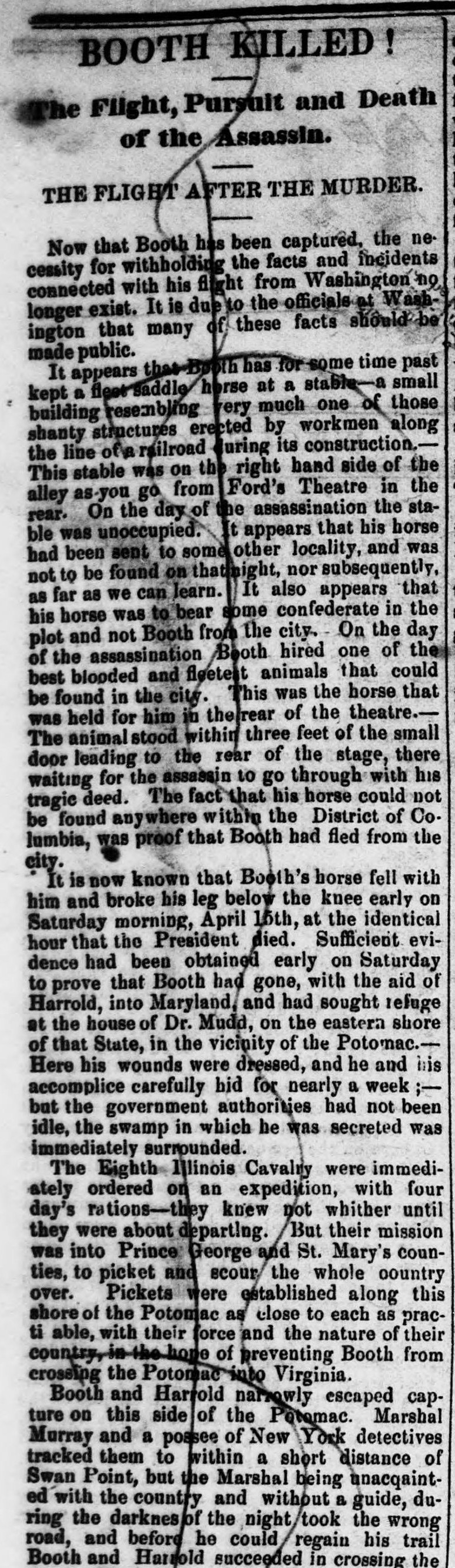
Reports had Booth captured and held on the monitor Mahopac. The Star traces the story to a man taken fifteen miles from Baltimore who looked almost exactly like him but proved ‘quite another party’. By noon on 17 April neither assassin had been found. Booth would be cornered in a barn at Garrett’s farm in Virginia and killed on 26 April.

Evening Star · Washington, D.C.

This article was wrong. The papers corrected it the next day.

Wrong

Evening Star · 17 April 1865 · page 2 · transcribed from the page image

The Report of the Capture of Booth

HOW IT ORIGINATED.

See moreSee less

The report that Booth had been captured and securely lodged on board the monitor Mahopac, seems to have originated as follows:

On Saturday morning a man was captured about fifteen miles this side of Baltimore who answered almost identically the description of Booth, and the authorities here were telegraphed to make due preparation for the safe-keeping of the assassin.

Such preparations were accordingly made, but it was subsequently ascertained that the person arrested, though bearing so singular a resemblance to the criminal, was quite another party.

Up to noon to-day it has not been ascertained that either of the assassins has been found.

See the clipping

Worcester wakes to tolling bells

How the news reached one Massachusetts city: the mayor had the church bells tolled from two till four on Saturday morning, and at three a minister prayed with the crowd outside the Spy office, ‘in striking contrast with the noise of jubilation with which the week was opened’. At a packed Mechanics Hall meeting the chairman said speech was impossible, and the choir sang instead.

Worcester Daily Spy · Worcester, Mass.

Worcester Daily Spy · 17 April 1865 · page 1 · transcribed from the page image

Part of this page is damaged, so some words could not be read with certainty. Letters and words in [brackets] are our reading of what survives.

The Mournful News in Worcester. Address of Mayor Ball—Public Manifestations of Woe—Great Meeting in Mechanics Hall.

The intelligence of the assassination of the president and Secretary Seward was received in this city at a late hour Friday evening, and created intense excitement. The city authorities were at once notified, and by order of his honor Mayor Ball the church bells were tolled from two till four o'clock Saturday morning. Our citizens generally were aroused, and by daybreak a large crowd were in waiting for the publication of the news, and the arrival of later intelligence.

See moreSee less

At about three o'clock a.m. Rev. M. Banvard joined the serious throng which the tolling bells had called together in front of the Spy office, and learning the terrible news, he offered up a fervent prayer for the country, every man in the great crowd devoutly uncovering his head, while a hush pervaded the moonlit street, in striking contrast with the noise of jubilation with which the week was opened.

By order of the mayor the city council was convened at 7 o'clock Saturday morning, and both boards joined in convention, to take such action as might be deemed proper. After an appropriate prayer by Rev. Mr. Richardson, Mayor Ball addressed the convention as follows:

ADDRESS BY MAYOR BALL.

Gentlemen of the City Council: We are assembled here this morning under the saddest and most overwhelming circumstances that have ever called us together in an official capacity. The leader of our nation has fallen by the hand of the ruthless assassin. The president of our beloved country has been murdered by some unknown hand, at an hour when, to our human view, we needed most his guidance, his wisdom, and his calm direction. For the moment the thought staggers our belief that any man could be found in our whole land who should be so recreant to all moral principle, as thus to outrage every dictate of humanity, and so entirely disregard all the protection and shields heretofore thrown around official station. From what spirit, except that foul spirit of treason which has been aiming a death blow at the nation's life for the last four years, this awful act has proceeded, at this moment is entirely unknown. How large is the plot, what are its acts, or parts of acts—to what intent directed, to what extent it is the index of an organized secret conspiracy to ruin the government, cannot now be even surmised, much more definitely known. Soon we may know all; and until we are more definitely informed, and much more can be known by patient, impartial investigation of the real situation, it is to be hoped that all undue excitement will be discountenanced, and all exasperated feelings and demonstrations withheld.

I have called you together under these painful circumstances to consult for the public good, for the safety of the city, to advise such measures as shall tend to good order and a due respect to the law, to insure that measure of personal freedom and security which has for so long a time been the characteristic of our people. For if the present is not the most important era in the whole history of the war, it certainly is the most exciting, and is likely to be the most trying. You are asked not to take council of your fears, but of your reason and judgment, guided and enlightened by the spirit of all light and wisdom from on high. The passions of men will run high at an unparalleled moment like this. And all our energies must be bent upon staying the tide of rash passion and uncontrollable exasperation which may be likely to arise upon an occasion the like of which has never before happened in our country, nor in any other nation under like serious and peculiar circumstances. Victory seems at last to have crowned our efforts to crush the rebellion, the enormity of which no human language can definitely or adequately portray. Peace soon seemed to be ready to smile once more on our distracted land. At this moment the soul seems bewildered, and knows not where to bestow its confidence. But in this hour of our grief let us take counsel of the wise lessons taught us by defeats in the past. When they came, they oppressed our whole community with inexpressible grief; but now as light has dawned on our hopes, we have seen that these very reverses were only the steps in the problem by which the hand of God was conducting us to reap our victory, and do justice to our fellowman. May these experiences increase our faith, that God is conducting the logic of events for wise ends, best known to his holy councils; that out of all these trials, sorrows and reverses, good still may come, and that this may be one of the means used by an all-wise and ever watchful Providence, to secure such vigilance in loyal hearts over treason and rebellion in our land, that when peace shall at last smile truly upon us it shall welcome in "peace on earth and good will to men." in a form of a purer and higher type of christianity and civilization upon this continent, than has ever been known or seen heretofore in the nations among men

So exciting is the intelligence and so sudden and so recent, that no recommendations specially for the occasion have been framed, or yet been deemed necessary; but in the exigency of the moment I have deemed it best to convene you for special consultation, face to face, that all those safeguards may be taken which may ensure for the peace and good order of our city, and to aid all members of our common country in this trying hour. I have called a public meeting at Mechanics Hall, at 10 o'clock A. M., which measure I trust will meet your approbation.

Without transacting any business the council adjourned to the public meeting which had been called at Mechanics Hall. During the morning the excitement steadily increased, and as soon as the dispatch was received announcing the death of president Lincoln, flags were displayed at half mast, and many of them were heavily draped in black. Stores and public buildings were extensively decorated with mourning emblems, many of them of rare and elegant design, and many citizens wore upon their persons the emblems of mourning.

GREAT MEETING IN MECHANICS HALL.

By order of the mayor, the bells of all the churches were tolled from ten to eleven o'clock, and at ten o'clock an immense audience assembled at Mechanics Hall. The hall was appropriately draped in mourning, and the vast crowd presented in their sad countenances and suppressed voices, evidences of their deep sorrow. A large number of distinguished citizens were seated on the platform, after which Mayor Ball announced HON A H BULLOCK as president of the meeting.

In taking the chair, Col. Bullock invited the vast audience to follow the words of Rev. Dr. Sweetser while he invoked God's blessing on the stricken nation.

After an impressive prayer, Dr. Sweetser read the 46th Psalm, "God is our refuge and strength. a very present help in trouble," after which Col. Bullock announced with much emotion that, in this overwhelming, bewildering hour, speech is impossible, and called upon a choir which was on the platform, under the direction of Prof. Stocking, for music. B. D. Allen presided at the organ, and the choir sung the anthem:

"Almighty Lord, before thy throne

Thy mourning people bend."

The effect was indescribable. Strong men wept like children, and there seemed to be not a person in the hall who was not deeply affected.

Dr. Sweetser then read the following hymn, which was also sung by the choir:

Go to the grave in all thy glorious prime--

In full activity of zeal and power,

A Christian cannot die before his time;

The Lord's appointment is the servant's hour.

Go to the grave; at noon from labor cease;

Rest on thy sheaves; the harvest task is done;

Come from the heat of battle and in peace,

Soldier, go home, with thee the fight is won.

Go to the grave; for there thy Savior lay

In death's embrace before he rose on high;

And all the ransomed, by that narrow way,

Pass to eternal life beyond the skies.

Go to the grave;—no; take thy seat above;

Be thy pure spirit present with the Lord,

Where thou for faith and hope hast perfect love,

And open vision for the written word.

Words cannot paint the scene. It was awfully impressive. The measured tolling of the bell mingled with the pealing of the organ and the trembling accents of the singers, almost too filled with emotion to perform their parts. The spirit of mourning, pathetic and tender, filled all hearts.

Rev. Mr. Richardson then read the following hymn:

Servant of God, well done!

Rest from thy loved employ;

The battle fought, the victory won,

Enter thy Master's joy.

The voice at midnight came;

He started up to hear;

A mortal arrow pierced his frame,

He fell, but felt no fear.

Tranquil amid alarms,

It found him on the field;

A veteran slumbering on his arms,

Beneath his red cross shield.

At midnight came the cry,

To meet thy God prepare;

He woke—and caught his captain's eye; Then, in faith and prayer,

His spirit with a bound,

Left its encumbering clay;

His tent at sunrise on the ground,

A darkened ruin lay.

The pains of death are past,

Labor and sorrow cease;

And life's long warfare closed at last,

His soul is found in peace.

Lines more appropriate could hardly have been written, and their simplicity, sung to an air familiar to all, was far more effective than more labored and classic music could have been. It seemed as though there was but one pulse in the vast audience, and that rose and fell with the cadence of the music. Sobbing was heard in all parts of the house, and the general grief testified to the deep affection with which the president has been regarded by the people. Col Bullock then announced that the meeting would adjourn, to be called together again at the pleasure of the mayor, and after the benediction by Rev Mr Richardson, the audience dispersed.

The crowd in the streets continued throughout the day. All business was suspended, and the anxiety manifested by the throngs which besieged the bulletin boards was continually increased till the last dispatches were received.

See the clipping

About these pages

Every clipping here was printed in an American newspaper at the time. The text on each card was read from the page by machine and lightly repaired; where it disagrees with the clipping, the clipping is right. Where the scan of an old page was too damaged to read, the text was transcribed again from the page image and is marked so; letters in [square brackets] were supplied where the printing itself is damaged, and the paper’s own misspellings are kept. The dates, papers, headlines and text are the papers’. The notes on why each article matters, and the one-line summaries, are ours.