As the Papers Told It

King Tut's Tomb

As the Papers Told It

The New York Herald, 30 November 1922Every Evening, Wilmington Daily Commercial, 14 December 1922The Birmingham Age-Herald, 4 January 1923The Bismarck Tribune, 10 February 1923

And the Curse of the Pharaoh

November 1922 – October 193076 newspaper articles in the story, 1,488 in the full archive

In November 1922 Howard Carter, digging in the Valley of the Kings for the Earl of Carnarvon, found what looked like a cache directly below the tomb of Rameses VI and telegraphed his patron to come. Behind its sealed doors lay the funeral furniture of a young pharaoh, Tutankhamen: couches, chariots, a throne, chests piled to the ceiling. The papers called it the greatest discovery in Egypt in modern times, and for two winters they reported nearly every object carried out of it.

Then, in April 1923, Lord Carnarvon died in Cairo of an infection that began with an insect bite, and the papers had a second story. Novelists, spiritualists and Egyptologists argued about a curse; every death of anyone who had stood near the tomb was added to a list; and the list was still growing in 1930, while Carter quarrelled with the Egyptian government, lifted the lid of the sarcophagus and at last unwrapped the king.

The numbers

1,488newspaper articles
1,566printings
178newspapers
37states and territories
96months in the papers

Each article is counted once, however many papers ran it. Printings counts every paper that ran it, so an article reprinted in five papers is one article and five printings.

How much the papers printed

Month of 1 November 1922: 1 printingMonth of 1 December 1922: 29 printingsMonth of 1 January 1923: 68 printingsMonth of 1 February 1923: 296 printingsMonth of 1 March 1923: 200 printingsMonth of 1 April 1923: 259 printingsMonth of 1 May 1923: 47 printingsMonth of 1 June 1923: 38 printingsMonth of 1 July 1923: 13 printingsMonth of 1 August 1923: 6 printingsMonth of 1 September 1923: 12 printingsMonth of 1 October 1923: 51 printingsMonth of 1 November 1923: 43 printingsMonth of 1 December 1923: 65 printingsMonth of 1 January 1924: 46 printingsMonth of 1 February 1924: 143 printingsMonth of 1 March 1924: 38 printingsMonth of 1 April 1924: 26 printingsMonth of 1 May 1924: 11 printingsMonth of 1 June 1924: 13 printingsMonth of 1 July 1924: 5 printingsMonth of 1 August 1924: 3 printingsMonth of 1 September 1924: 5 printingsMonth of 1 October 1924: 5 printingsMonth of 1 November 1924: 6 printingsMonth of 1 December 1924: 4 printingsMonth of 1 January 1925: 14 printingsMonth of 1 February 1925: 4 printingsMonth of 1 March 1925: 9 printingsMonth of 1 April 1925: 2 printingsMonth of 1 May 1925: 2 printingsMonth of 1 September 1925: 5 printingsMonth of 1 October 1925: 7 printingsMonth of 1 November 1925: 23 printingsMonth of 1 December 1925: 12 printingsMonth of 1 January 1926: 6 printingsMonth of 1 February 1926: 2 printingsMonth of 1 March 1926: 2 printingsMonth of 1 April 1926: 2 printingsMonth of 1 August 1926: 1 printingMonth of 1 September 1926: 1 printingMonth of 1 October 1926: 1 printingMonth of 1 November 1926: 1 printingMonth of 1 December 1926: 1 printingMonth of 1 January 1927: 1 printingMonth of 1 March 1927: 2 printingsMonth of 1 April 1927: 1 printingMonth of 1 December 1927: 1 printingMonth of 1 February 1928: 1 printingMonth of 1 March 1928: 1 printingMonth of 1 May 1928: 1 printingMonth of 1 July 1928: 1 printingMonth of 1 October 1928: 2 printingsMonth of 1 February 1929: 1 printingMonth of 1 March 1929: 1 printingMonth of 1 May 1929: 1 printingMonth of 1 June 1929: 1 printingMonth of 1 September 1929: 2 printingsMonth of 1 December 1929: 3 printingsMonth of 1 January 1930: 3 printingsMonth of 1 February 1930: 6 printingsMonth of 1 March 1930: 7 printingsMonth of 1 June 1930: 1 printingMonth of 1 October 1930: 1 printing30 November 19221 December 192214 December 192221 December 192224 December 192226 December 192226 December 192228 December 192228 December 19224 January 192312 January 192321 January 192321 January 192324 January 192324 January 192327 January 192327 January 192331 January 192310 February 192316 February 192317 February 192319 February 192319 February 192327 February 19232 March 19232 March 192318 March 192319 March 192329 March 19231 April 19233 April 19235 April 19235 April 19236 April 19236 April 192312 April 19231 May 192318 May 192327 September 19233 October 19235 October 192323 October 19238 November 19232 December 19233 January 192410 January 192416 January 192412 February 192413 February 192413 February 192418 February 192423 February 192413 March 192414 March 19247 May 19248 October 192418 December 192422 January 192526 January 192510 September 19256 November 192513 November 192514 November 192519 November 192521 November 19259 December 19256 January 19261 September 192621 March 19272 February 192918 March 192919 December 192911 February 193027 February 193025 March 193014 October 1930192219231924192519261927192819291930296 printings in the month of 1 February 1923

Every printing of every article, by the month it ran. The marks under the line are the articles in the story below; red ones were wrong.

Where it was printed

FewerMore

Printings in 37 states. Most: District of Columbia (400), Alabama (112), Indiana (76). 122 printings could not be placed in a state.

How it unfolded

76 newspaper articles in 7 acts

Act One

Wonderful Things

November 1922 – January 1923

The first report appeared on 30 November 1922: a Cairo dispatch, cabled through London, announcing ‘the most sensational Egyptological discovery of the century’ in the Valley of the Kings. Within a day the papers had an inventory of gilt couches, chariots and a throne, and by Christmas Lord Carnarvon was describing the tomb himself. They knew by then what had been found: the first complete funeral furniture of an Egyptian king, untouched except for its gold. Treasures were carried to a nearby tomb to be preserved, Egypt ruled that a royal tomb could not leave its hands, and American correspondents were refused admission to the tomb. A scholar found that a bundle hoped to be papyrus was table napkins. Everyone waited for the sealed door between two guardian statues, to be opened in February.

The first report: a tomb 3,200 years old

A Cairo dispatch, cabled through London by the Associated Press, announces ‘the most sensational Egyptological discovery of the century’. Lord Carnarvon, summoned from England by Howard Carter, who had dug with him for seven years, makes the announcement. Chambers below the tomb of Rameses VI hold the funeral regalia of a heretic king of the eighteenth dynasty: a gem studded throne, gilt couches, royal robes and lifesize statues. Papyri found with them are expected to clear up many points of the dynasty’s history.

The New York Herald · New York, N.Y.

The New York Herald · 30 November 1922 · page 1 · transcribed from the page image

FIND FUNERAL PANOPLY IN TOMB 3,200 YEARS OLD

King Tutenkhomun's Regalia Unearthed in Egypt.

See moreSee less

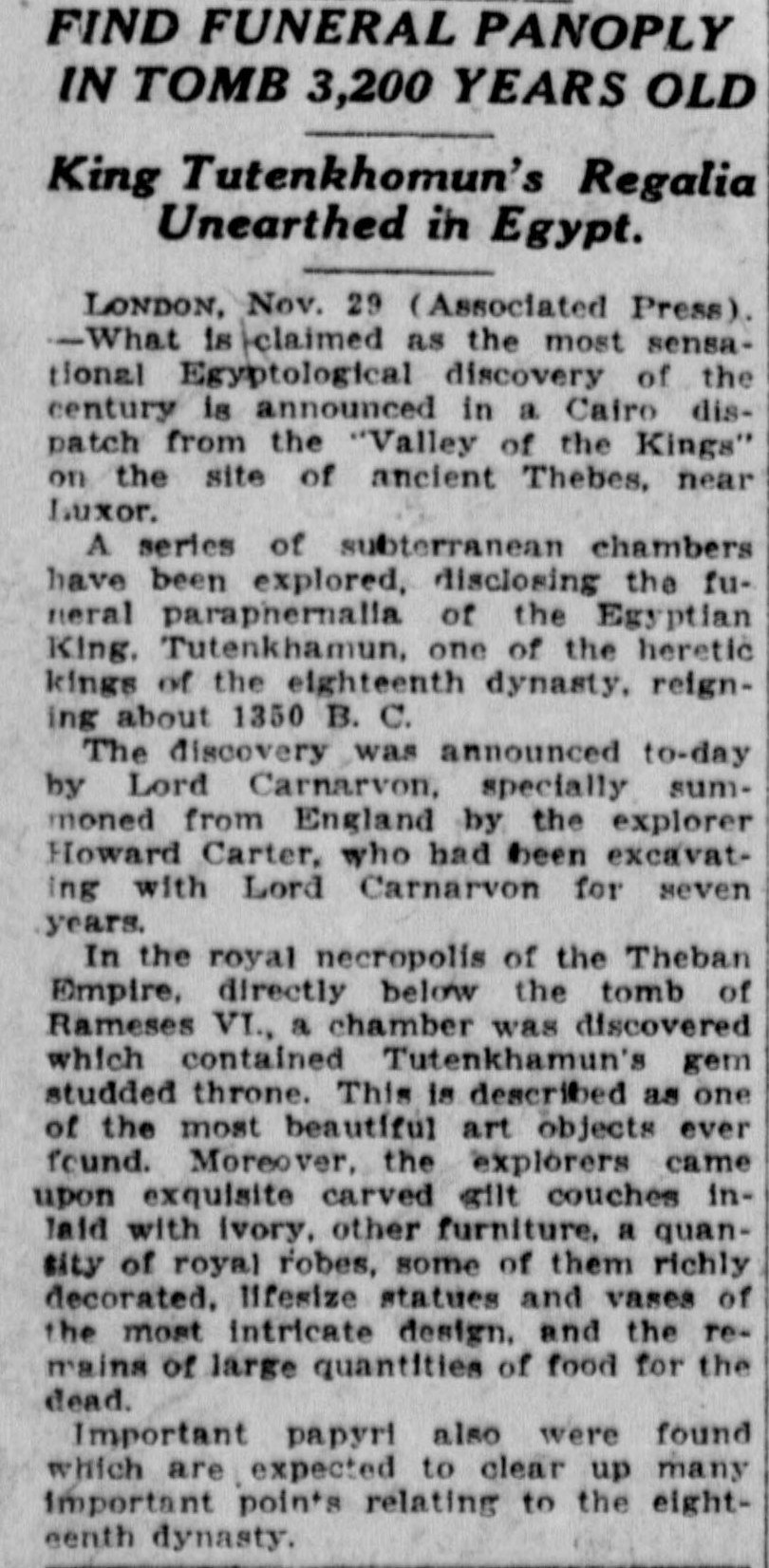
LONDON, Nov. 29 (Associated Press). —What is claimed as the most sensational Egyptological discovery of the century is announced in a Cairo dispatch from the "Valley of the Kings" on the site of ancient Thebes, near Luxor.

A series of subterranean chambers have been explored, disclosing the funeral paraphernalia of the Egyptian King, Tutenkhamun, one of the heretic kings of the eighteenth dynasty, reigning about 1350 B. C.

The discovery was announced to-day by Lord Carnarvon, specially summoned from England by the explorer Howard Carter, who had been excavating with Lord Carnarvon for seven years.

In the royal necropolis of the Theban Empire, directly below the tomb of Rameses VI., a chamber was discovered which contained Tutenkhamun's gem studded throne. This is described as one of the most beautiful art objects ever found. Moreover, the explorers came upon exquisite carved gilt couches inlaid with ivory, other furniture, a quantity of royal robes, some of them richly decorated, lifesize statues and vases of the most intricate design, and the remains of large quantities of food for the dead.

Important papyri also were found which are expected to clear up many important points relating to the eighteenth dynasty.

See the clipping

The first inventory

A day later the Evening World prints the despatch’s list. Past a sealed door and a corridor, the excavators ‘could scarcely credit their eyes’: gilt statues with the heads of a typhoon, panther and lion holding up beds, a chair with portraits of the King and Queen, four chariots, a robing dummy for the royal wigs, and provisions for the dead down to trussed duck and haunches of venison. A third room is believed to hold the king’s mummy, and another chamber is so tightly packed that no one has yet got inside.

The Evening World · New York, N.Y.

The Evening World · 1 December 1922 · page 13 · transcribed from the page image

Priceless Antiques Are Found Under Tomb of Egyptian King

LONDON, Dec. 1.—What is being characterized as one of the most important archoeological discoveries in years was announced here to-day in a despatch from Cairo to the effect that two rooms have been unearthed by British excavators beneath the tomb of Rameses VI., near Luxor, which contained the gem-studded funeral paraphernalia of King Tukankamen, who reigned about 1350 B. C.

See moreSee less

Included in the vast list of priceless antiques was the State Throne of the King, probably one of the most beautiful objects of art ever discovered. Two life-sized statues, in gold work, of the King holding a golden stick and mace, also were in the list. Most of the cache was found in a very good state of preservation, but some objects in it were in a precarious condition. A third room leads off from the two already opened and it is confidently believed this contains the mummy of the king.

The despatch tells of the careful opening of a sealed outer door and the clearing of a passage down about sixteen steps and through a corridor about twenty-five feet long to another sealed door, which was forced open with considerable difficulty. When the excavators managed to squeeze their way into the first room they could scarcely credit their eyes.

"First they saw three magnificent statues, all gilt, with exquisite carving and the heads of a typhoon, panther and lion," says the despatch.

"On these rested beds beautifully carved, gilt and inlaid with ivory and semi-precious stones, and also innumerable boxes of exquisite workmanship. One of these boxes contained royal robes handsomely embroidered with precious stones. There was a stool of ebony inlaid with ivory, with most delicately carved ducks's feet. Also a child's stool of fine workmanship.

"There was also a heavily gilt chair, with portraits of the King and Queen, the whole encrusted with turquoise, cornelian lapis and other semi-precious stones. There were also four chariots, the sides of which were encrusted with semi-precious stones and rich gold decoration.

"Other noteworthy objects were royal sticks, one of ebony with the head of an Asiatic as a handle in gold. Another was of handsomest filigree work. There was also a stool for a throne with Asiatics carved on it, denoting that the King had placed his foot on the necks of Asiatic prisoners taken in war.

"There were some quaint bronze gilt musical instruments and a robing dummy for royal wigs and robes. There were also some exquisite alabaster vases with a very intricate and unknown design, all of one piece, and some handsome blue Egyptian faience and enormous quantities of provisions for the dead, comprising trussed duck and haunches of venison, and all packed in boxes according to the custom of the time.

"There were some remarkable wreaths still looking like evergreen, and one of the boxes contained rolls of paper which are expected to render a mass of information.

"A further chamber revealed an indescribable state of confusion. Here furniture, gold beds, exquisite boxes and alabaster vases similar to those found in the first chamber were piled high one on top of the other, so closely packed that it has been impossible to get inside yet."

See the clipping

Carnarvon and Carter ask for patience

Carnarvon and Carter tell the London Times’ Luxor correspondent that the seals on the unopened doorway point to the king himself. Robbers made only a small hole in it, closed again by inspectors, so they hope to find him intact in three coffins under wooden canopies, as papyri at Turin describe. It is ‘the first instance in which a royal tomb has been found with the doorways intact’. More seals must wait until the first chambers are cleared.

Every Evening, Wilmington Daily Commercial · Wilmington, Del.

Every Evening, Wilmington Daily Commercial · 14 December 1922 · page 12 · transcribed from the page image

HOPE TO FIND PHARAOH INTACT IN HIS TOMB

Explorers Expect to Discover Funeral Equipment of Great Magnificence.

See moreSee less

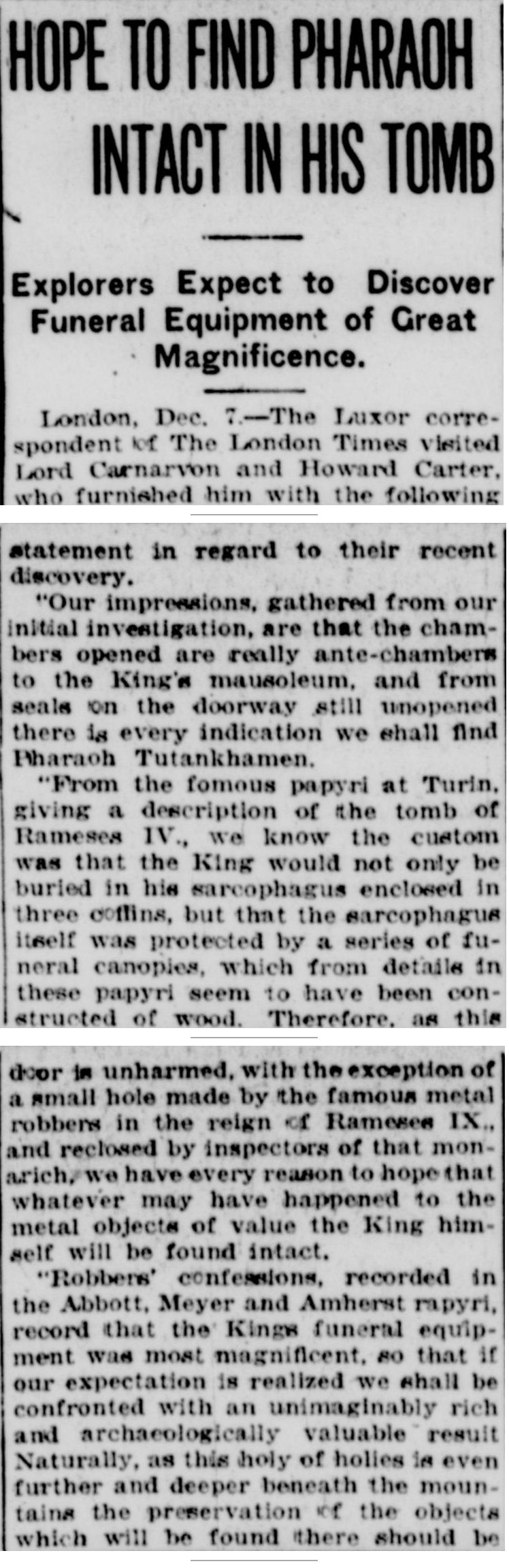
London, Dec. 7.—The Luxor correspondent of The London Times visited Lord Carnarvon and Howard Carter, who furnished him with the following statement in regard to their recent discovery.

"Our impressions, gathered from our initial investigation, are that the chambers opened are really ante-chambers to the King's mausoleum, and from seals on the doorway still unopened there is every indication we shall find Pharaoh Tutankhamen.

"From the famous papyri at Turin, giving a description of the tomb of Rameses IV., we know the custom was that the King would not only be buried in his sarcophagus enclosed in three coffins, but that the sarcophagus itself was protected by a series of funeral canopies, which from details in these papyri seem to have been constructed of wood. Therefore, as this door is unharmed, with the exception of a small hole made by the famous metal robbers in the reign of Rameses IX., and reclosed by inspectors of that monarch, we have every reason to hope that whatever may have happened to the metal objects of value the King himself will be found intact.

"Robbers' confessions, recorded in the Abbott, Meyer and Amherst papyri, record that the King's funeral equipment was most magnificent, so that if our expectation is realized we shall be confronted with an unimaginably rich and archaeologically valuable result. Naturally, as this holy of holies is even further and deeper beneath the mountains the preservation of the objects which will be found there should be even better than that of those in the outer chambers.

"Judging from the plan of this hypogeum, as far as we have got, it appears to be after the style of the El Amarna Royal tombs and not the Ban. If this one chamber to come. Royal tombs of Ban vary from fifty to two hundred meters in length, comprising a series of passages, staircases and chambers hewn in the mountains. The Amarna Royal tombs, as far as we know them, are not so large, and in place of passages connecting chambers the chambers themselves join one another. The plan of the present discovery appears to be of the latter type.

"What makes this find so fortunate and important is that this is the first instance in which a royal tomb has been found with the doorways intact, as sealed by the hands of inspectors of Rameses IX. Naturally, we are most anxious to break the further seals and enter, but this cannot be done with safety until the objects in the first chambers have been removed and preserved.

"We must, therefore, ask for the patience and indulgence of the archaeological world until we are able to carry out this. We hope the next two months will suffice to place us in a position to investigate these farther chambers."

See the clipping

Carnarvon tells it himself

In a cable to the New York Herald, the Earl of Carnarvon writes that most archaeologists thought the Valley of the Kings ‘practically exhausted’, but Carter dug on until he cabled ‘a tomb closed and sealed’. To see the first chamber they tapped the electric wire of Rameses VI’s tomb just above. Carnarvon doubts that any former find ever exceeded this one in magnitude, and gives most of the credit to Carter, who ‘bucked me up’ through seasons of failure.

The New York Herald · New York, N.Y.

UnconfirmedNo later report in this collection bears it out.

The New York Herald · 21 December 1922 · page 1 · transcribed from the page image

EARL OF CARNARVON DESCRIBES WONDERS OF PHARAOH'S TOMB

Discoverer Says Its Glories Eclipse All Former Egyptian Finds.

See moreSee less

IN VALLEY OF KINGS

Value of Jewels, Gold and Historic Treasures Runs Into Many Millions.

THEBES NECROPOLIS OPEN

King Tut-Ankhamen's Throne Found and Sarcophagus Believed Near.

By THE EARL OF CARNARVON. Special Cable to The New York Herald. Copyright, 1922, by The New York Herald. New York Herald Bureau, | London, Dec. 20. }

On the edge of cultivation on the western bank of the Nile, near Luxor, some five miles in length and about a mile and a quarter deep lies the necropolis of ancient Thebes. Here the arid plain and foothills are everywhere dotted with burial pits, with a royal mortuary temple here and there, while mingled among the relics of ancient days stand the mud houses of the modern inhabitants.

The limestone cliffs, which in certain parts reach a height of 500 feet or more, are also honeycombed with an endless succession of destroyed and plundered tombs. In this area some of the greatest, richest and most powerful inhabitants of ancient Egypt were buried, hence this cemetery has been a happy hunting ground for generations of native robbers.

At the northerly end of this vast cemetery, by following a winding track road about two and a half miles leading in a southwesterly direction we come to the most celebrated portion of the Theban necropolis. This is the Valley of Kings, or, in Arabic, "Biban el Moluk." For centuries the spot had been visited by countless travelers, archæologists and tourists.

The almost universal opinion of archæologists and of Sir G. Maspero (director of the Cairo Museum) was that this locality was practically exhausted. As far as was known the only Kings' tombs missing were those of Thutmose II., the somewhat shadowy King Smenkhara and Tut-Ankhamen. Earlier Pharaohs' tombs were still to be found and there are in the valley several open and plundered tombs to which a name cannot be given.

However, Howard Carter, the American Egyptologist and my associate, still thought that there was at least a chance of finding some great dignitary if nothing else, and the Government having given me a more favorable concession than it granted the previous excavators we decided to start excavating at once.

Before the Sealed Tomb.

During the war in the intervals between Carter's military work at Cairo he managed to dig a little every year, but it was only this autumn that I received a cable telling me that he had at last struck something promising—"a tomb closed and sealed."

Arriving at Luxor we at once started operations. A staircase of some eighteen steps had first to be cleared. While we were doing this various damaged objects, such as pottery and broken wood flowers, were found. At the bottom of the staircase we came upon a wall covered with seals. Some bore the name Tut-Ankhamen, while the others were the royal seal on which nine captives with a jackal reposing above is discernible. It then became apparent that the tomb had certainly been opened if not plundered in ancient days and had been resealed by officials of the necropolis.

After affixing a wooden grille over the door, a task that took all day, we proceeded to clear the passage. This was blocked with stones and rubbish right up to the ceiling. It is quite easy to see now where the robber entered. Along the passage, which is nine meters in length, various objects were found, a broken box with the names Khuenten, Smenkhara and his wife being possibly the most important piece. Broken pottery, a few bits of broken jewelry, water skins, flowers and other odds and ends were recovered from the rubbish.

Find the King's Burial Place.

At the end of the now cleared passage another sealed door was visible. After taking a photograph we decided to take down a small portion of it. This was done, and by the uncertain light of a candle a wonderful sight was exposed to our excited eyes. Gilt couches, boxes and all sorts of other objects were visible in the dim light.

Luckily, just above us was the large tomb of Rameses VI. This is a favorite tourist tomb and is lit by an electric light. Having tapped the wire and enlarged the opening, we were able to enter and examine by electric light what proved to be the first chamber. We at first thought that our find was a hiding place of "cache" where we should probably find some royal or semi-royal mummies, hidden there to save them from the sacrilegeous hands of robbers. But the more we examined

Continued on Page Two.

EARL OF CARNARVON TELLS GLORIES OF PHARAOH'S TOMB

Continued from First Page.

the contents of the first chamber the more convinced we became that it was the tomb of Tut-Ankhamen.

The first things one noticed against the wall facing the door were three gigantic carved gilt wood beds, the ends of the bed having carved heads, one head in particular, with large ivory tongue and teeth, looking most weird. Upon these beds were heaped chairs, boxes, smaller carved couches and some wonderful sticks, wonderfully carved and inlaid. Some of the boxes were made of ebony, inlaid with ivory and covered with inscriptions. Others were inlaid with gold and porcelain. Beneath the central couch were heaped twenty to thirty wooden boxes containing mummified legs of mutton, ducks, geese and venison.

Between two of the couches I noticed four of the most beautiful alabaster vases ever found; in fact I may say that nothing to touch them ever came to light before. They are vases on a stand with lotus flowers dropping out of the mouth, and are carved out of a solid block of alabaster. They stand thirty inches high.

Throne of the King.

Beneath another of the beds was a chair of state, or throne of a King. This is one of the most wonderful Egyptian works of art ever found, if not quite the most wonderful. On the back is a picture of the King and Queen, represented in the well known style. All the figures on this chair are carved in carnelian, lapis lazuli, turquoise and other semi-precious stones, and are inlaid with gilded wood. A sun throws its rays over the King and Queen as if to protect them.

A little further on we came across a wooden head and bust of the King, probably a model of the King's head and shoulders upon which to try the royal wigs. Propped against the wall was the most beautiful portrait (shawabti) of the King. Everywhere there was a mass of boxes, some opened and plundered, others seemingly untouched. At the present moment, owing to the profusion of articles, we have no notion of the thousandth part of the contents even of this chamber.

Moving on a little further we found four chariot bodies of gilt wood inlaid with semi-precious stones. Wheels were in a heap on one side, while the poles were stacked against the walls.

Robes of the Pharaoh.

At the other end of the chamber there was a charming box with a painting on it of the King hunting lions and gazelles. This contains robes of the Pharaoh. At the northern end the first thing that strikes our eyes are two life sized portrait statues of the King in bituminized wood. The features are most delicately carved, on his brow is the crown of Egypt and around his neck is a gilt collar, the emblem of royalty. He is clad in a "shenti," a sort of stiff kilt. One hand holds a long gilt stick while the other clasps in a somewhat menacing manner a gilt mace. His bare feet—which are most exquisitely carved and modeled—are shod with solid gold sandals.

By this time the absence of any coffin had made us feel that in all probability the tomb was not a cache as I had at first thought, but the actual burial place of the King. After another examination beneath the furthest southerly couch we discovered a small hole in the wall.

Beyond the Wall.

Looking through this hole an astonishing scene of confusion was visible. Tables, chairs, beds, boxes, alabaster statues, vases, faiences—all jumbled together and piled on top each other, in some places quite five feet high. It was quite impossible to make a closer examination without doing harm, and had we tried to enlarge the hole it is probable the wall would have come down upon our heads, as most of it was hanging, not supported by anything more than cement—that is, as far as we could see.

Further careful scrutiny of the first chamber revealed to us that at the northern end, between two statues of the King, the wall had been plastered over and the entrance again covered with the royal cartouche and the seal of the necropolis. In one place a robber had made a small hole and evidently had entered, and the hole had been carefully plastered up and sealed by inspectors.

In all probability behind that wall we shall come to the funerary chamber of King Tut-Ankhamen, and should we be fortunate enough to find his sarcophagus and coffins undisturbed, then those privileged to be present will look upon a sight that has never been witnessed by any living person.

Although the contents of the outer chamber are certainly not in their original untouched state, for the two outer chambers bear somewhat the aspect of a house entered by burglars yet I think we shall find that what is missing in these tombs consists for the most part of gold and silver bowls, vases and jewelry that formed a great part of the funerary equipment of the Egyptian Kings. In some cases the gold plating has been wrenched from various articles. Still the quantity of objects we have seen in the first two chambers is quite extraordinary.

We have been indeed fortunate to strike the period of Egyptian art that for grace and originality of workmanship was never surpassed. It should be remembered that in this King's reign we see the best work of the Amarna school and Theban art at its highest pitch. It is quite impossible to realize the perfection and beautifully graceful work of some objects.

Such exquisite taste and finish have scarcely been dreamed of, much less seen. And there still remains much to be learned about the romantic period of Khuenaton, the so-called heretic king who changed the worship of Egypt from a multiplicity of gods to that of a single one—Aton, or the rays of the sun.

From the mass of material on hand it is hoped that from some of the papyri which lie in one of the numerous boxes we may obtain most valuable information of the period that is not only somewhat mysterious but peculiarly fascinating.

I do not suppose any former finds ever exceeded this discovery in magnitude. When Muriette discovered the celebrated serapeum of Saqquarah he speaks of the invincible emotion which overcame him upon entering those mysterious caverns. I do not suppose his feelings were any more poignant than ours when we suddenly realized what we had found.

In conclusion I must say that the most credit for the discovery is due to my friend, Howard Carter, who, when, after many seasons of failure and disappointment, I got more and more despondent bucked me up and persuaded me to go on excavating until, as he related his theories, he proved right and at last brought the work to a successful issue.

Early Explorations.

Before the Christian era Greek travelers were in the habit of going to the Valley of the Kings, some inscribing their names on the walls, while allusions are made to these tombs by ancient Greek historians. There is little doubt that many of these tombs, especially those of the Rameside Kings, were always visible, as the vast size of their doors and decorations over the lintels make it almost impossible to believe that these burial places were hidden beneath rocks and dust. We are told that in Rameside times the robbing of these sepulchers attained such scandalous proportions that a commission was formed to examine and report.

Apparently some thieves were caught and suitably punished. A list of the tombs visited and examined is given, but, curiously enough, the tomb of Tut-Ankhamen is not mentioned. The kings of the eighteenth dynasty seemed to exercise a certain care in concealing their last resting places. The opening to the tomb was smaller and could not have been so apparent as those of the nineteenth and twentieth dynasties and their successors. In 1913 we found the wholly plundered tomb of Amenhotelone. This was situated on a plateau far away from the royal valley. So cunningly was it hidden that you could pass within a few yards of the opening and yet not perceive that there was a tomb anywhere near.

Best Preserved of All Tombs.

In these cases it is customary to remove all chips to some distance in order not to arouse suspicion. Still, I have no doubt that even in late Egyptian times all the royal tombs were known to the cemetery officials. All certainly have been opened and heavily plundered, but the tomb of Tut-Ankhamen is without doubt by far the least disturbed that has ever yet been found or probably ever will be.

In modern times (that is beginning with the nineteenth century) Belzoni, Champillion, Dumichon, Lepeius, Schiavialli, Loret, Davis and others have all excavated there. Some of these archæologists were successful while others had little to show for their labors. Although Howard Carter and myself had been working there systematically for eight seasons, until this fall we formed a part of the latter class. The most successful excavator in late years has been Theodore Davis of Boston, who started to work there about 1901 under the direction of Carter, who was then inspector of antiquities in upper Egypt. After Carter resigned the inspectorate the work still was carried on by Davis under the supervision at various times of Messrs. Quibell, Ayrton, Hones and Burton.

Davis for the first few years was brilliantly successful. Scarcely a season passed without his researches being rewarded by rich finds. Thutmose IV., Hatshepsut, "Caches," Yui Thuia and King Khuebaton were a few of the successes that fell to his lot. His last discovery is the painted tomb of Horemheb.

A description of this was published under the title of "The Tomb of Horemheb and Tut-Ankhamen," the reason for this title being that he found a few objects belonging to the latter king in the Horemheb tomb. It was in the year 1914 that Davis gave up his concession to dig in this locality. He had for the last four or five years been singularly unsuccessful. In return for his very real services the Egyptian Government gave him many fine and interesting objects, some of which he presented to the Boston Museum.
See the clipping

Tourists stepping over treasure

Cabling from London, Warren B. Wells calls Carter perhaps the finest living archeological draughtsman, a man who for more than a generation held that tourists in Thebes ‘were stepping over priceless treasures’. He began searching thirty-three years ago, and since Carnarvon joined him seventeen years ago their best reward had been the Hyksos tablet. Then, after four days’ digging, came a step, a stairway, and a door inscribed with the king’s protocol.

Evening Star · Washington, D.C.

Evening Star · 24 December 1922 · page 4 · transcribed from the page image

NEW TOMB FOUND EGYPT'S GREATEST

Sepulcher of Tutankhamen Reveals Splendors of 1550 to 1090 B. C.

See moreSee less

DISCOVER KING'S THRONE

Collection Unearthed Will Bring $15,000,000 on Any Market.

BY WARREN B. WELLS. By Cable to The Star and New York Tribune. Copyright, 1922.

LONDON, December 23.--That the recent unearthing of a royal tomb near Luxor is the greatest archeological discovery in Egypt in modern times already is certain. How great, in the light which it throws on the vanished civilization that has made the wisdom of Egypt proverbial down all the ages the discovery may prove to be--this remains for the secret of the still unopened inner chamber to reveal.

The story of the discovery, made by the Earl of Carnarvon, whose wealth has enabled him to devote himself to the costly hobby of Egyptology, and Howard Carter, perhaps the finest living archeological draughtsman, reads like a romance. The Valley of the Tombs of the Kings, where the find was made, is a desert ravine lying behind the barren cliffs and hills which form the mighty walls of the Nile valley, on the western bank of the river, some 450 miles above Cairo.

Sepulchers Cut in Hills.

Here the Pharaohs of the eighteenth, nineteenth and twentieth dynasties, covering the period from about 1550 to 1090 B. C., were laid to rest in sepulchers cut into the sides of the hills, and burial chambers being deep down in the solid rock, approached by flights of steps and corridors, generally ornamented by rich wall paintings and bas-reliefs. The existence of these tombs has been the common knowledge of all the centuries, though the precise location of each has not been known. For two or three thousand years robbers have been busy with their treasures.

But for more than a generation past Mr. Carter's saith that tourists in Thebes were stepping over priceless treasures in the bowels of the earth has not faltered, despite all that is known of the past rifling of the famous site. The beginning of the story of the discovery goes back thirty-three years, when he began searching the Theban necropolis for a key to ancient Egypt. During that period he found a number of minor prizes, but since Lord Carvaron joined forces with him seventeen years ago, the discovery of the Hyksos tablet was their greatest reward--up to the present.

Another Step Unearthed.

Recently after four days' work in the heart of the small sacred basin he and his party unearthed a step. Continued digging resulted in the excavation of a stairway which led right beneath the tomb of Rameses IX, an unimportant king who lived some 3,000 years ago. At its feet was a door inscribed with the protocol of another Pharoah, Tutankhamen, one of the most important kings of Egypt. It was the one remaining tomb of which there had been any hope of finding in the Valley of the Tombs of the Kings.

But the opening of the tomb showed that the excavators had stumbled upon a discovery of unprecedented importance. No other royal tomb that has been opened in Egypt has contained such treasures as the tomb of Tutankhamen revealed. The lights of the searchers shown upon an age-old collection of gems and gold and alabaster--a collection which would fetch upward of $15,000,000 in any salesroom. But the value of the discovery was not to be stated in terms of money.

The tomb was a treasury of the glories of the Egyptian court of 1350 B. C. There were gilt couches inlaid with ivory and jewels; there was the king's throne and the king's robes. Two statues showed him in his habit as he lived. Chariots were there for the dead Pharoah's riding, masses of food for his eating, musical instruments and documents.

See the clipping

The first throne ever seen by moderns

A Great Falls editorial on the lure of digging in the ruins of old civilizations reprints an eastern paper’s account of the find, the reward of sixteen years’ patient work at Thebes, latterly in a valley others had abandoned. The throne, it says, is ‘the first ever seen by moderns’, Egyptian thrones having been known only from pictures. It hopes the tomb will explain the king’s return to the worship of Amen, a counter reformation of which little is known.

Great Falls Tribune · Great Falls, Mont.

Great Falls Tribune · 26 December 1922 · page 4 · transcribed from the page image

THE NEW AND THE OLD

DIGGING in the ruins of past civilizations must be fascinating work. All over the surface of the world, in India, Persian, the Mesopotamian valley and even in our own South American continent the diggers are rewarded with relics of a cizilivation so old that its history is forgotten, and yet it speaks of culture thousands of years old. Long before Christ was born men lived and pondered on the problems of life and death. They acquired wisdom and skill that amazes us today. In fact, in some lines of knoweldge they seem to have learned as much as we know today.

See moreSee less

We are using the new knowledge that we have attained to interpret and proclaim the forgotten knowledge of the past. Some of the richest finds are coming to light in the excavations in Egypt, especially around Thebes on the Nile which was the ancient capital of Egypt. Egyptian chronology is not so certain as it might be, but it is held by some that its written history goes back almost 10,000 years, and antedates all other carved or written records. Certainly the history of Egypt goes back to a date several thousand years before the birth of Christ and before the days of Abraham, who sojourned in Egypt after he left the land of his birth in Mesopotamia. A particularly rich and interesting discovery has been very recently made in the "Valley of the Kings" where many of the old kings of Egypt were buried, and their burial chambers only recently found. An eastern newspaper thus reports the latest discoveries:

"Egyptologists are greatly stirred by the recent discoveries at Thebes, and there is popular interest also in the finding of the funeral paraphernalia of King Tutankhamen of the 18th dynasty, who was one of the heretic kings of Egypt. Amenhotep IV was the first of them. Much study will be required to extract from the new discoveries all the historical information they contain in regard to an obscure period, but no learning is needed to appreciate the thrilling interest of the first discovery of the complete funeral furniture of an Egyptian king; the gold buried with Tutankhamen has disappeared but otherwise the collection found in the Valley of the Kings seems untouched. For example there is a throne, the first ever seen by moderns, shape of Egyptian thrones having hitherto been known from graphic representations. Also there are the royal robes, a set of quaint bronze gilt musical instruments, and elaborate vases of alabaster.

"This discovery, shared by Lord Carnarvon and the distinguished excavator Howard Carter, is the reward of 16 years of patient investigation of that part of the site of ancient Thebes which lies on the west bank of the Nile at Luxor. Seven years ago work was started in the Valley of the Kings, which had been abandoned by other excavators, but for a long time the rewards were slight. At last Mr. Carter found, directly below the tomb of Rameses VI what looked like a cache, and at once telegraphed to Lord Carnarvon, who was then in England. Together they opened a sealed outer door, cleared a way down 16 steps, and after opening another sealed door found themselves in a chamber filled with a dazzling collection of royal treasures. There were three magnificent state couches, all gilt, with exquisite carving, on which rested beds, also gilt and beautifully carved and inlaid with ivory and semiprecious stones. There were statues, chairs, stools, chariots, portraits of king and queen, a mace, enormous quantities of provisions for the dead, including trussed duck, haunches of venison, and other delicacies; the list would fill a large catalog.

"Merely as objects of art and as touching souvernirs of an almost incrediably remote past these things unearthed in the Valley of the Kings are abundantly interesting and valuable. But it is hoped that from this royal tomb may also be learned much in regard to puzzling enigmas of Greek history. It is known that Tutankhamen reverted to the worship of the deity Amen and was thus the leader of a counter reformation, but of the nature of these changes in Egyptian religion little has been discovered. Thousands of years ago the world had its reforms and its periods of reaction, but we can see only the marks of change like the imprint of ripples on a sandy beach; the thoughts and emotions that inspired change have long since been dead, and every discovery that helps in their recreation is precious to the student of the early life of the race."

See the clipping

Philadelphia: the past unlocked

The Evening Public Ledger finds the most preposterous romance paling beside the discovery. Carter has been compared to Balboa sighting the Pacific, it says, but Balboa was only dimly aware of what he had found, while Carter and his fellow explorers were ‘acutely conscious of the revelation’. The treasures will compel the rewriting of much of the history of the ancient world, and the editorial closes: ‘The key to a stately age imparting sobriety to estimates of civilization today is in Luxor.’

Evening Public Ledger · Philadelphia, Pa.

Evening Public Ledger · 26 December 1922 · page 10 · transcribed from the page image

THE PAST UNLOCKED

THE most extravagant, one might almost say the most preposterous, romance pales before the epochal discoveries in Egypt, re-creating for modern comprehension a civilization of 3500 years ago. After thirty years of the most assiduous labor, Howard Carter, representing Lord Carnarvon, wealthy patron of archeology, has penetrated to the outer chamber of King Tutankhamen, who reigned in the Nile Valley in the fourteenth century B. C.

See moreSee less

Disclosure of the tombs of pharaohs is in itself no novelty. The final resting places of nearly all the important monarchs of ancient Egypt have been discovered. But, save for what seems to have been a hurried and rather harmless visitation of plundering prowlers in some remote age, the treasure of Tutankhamen appears to have escaped those depredations which have proved so embarrassing to archeologists.

Here for once are the burial chambers nearly intact as on the day on which they were sealed. The actual tomb chamber itself, where the mumified ruler lies, will remain tantalizingly closed until Lord Carnarvon returns to Egypt, but the esthetic, cultural, ritualistic and historic riches already disclosed are enough to fire the imagination even of persons with the most imperfect conceptions of archeological thrills.

Carter, amid all the astounding opulence of the ante-chamber, has been compared to Balboa on his first glimpse of the majestic Pacific. But the conquistador was only dimly aware of what he had found. Carter and his fellow explorers in the long-lost tomb were acutely conscious of the revelation. A chryselephantine and jewel-studded crowned statues were viewed shaming in esthetic splendor, it is reported, the highest achievements of Phidias or Praxiteles; gorgeous tapers and candles, diaphanous beaded robes of the pharaoh's consort, gold sandals, royal couches and domestic articles revitalizing a civilization of astounding magnificence.

The funerary treasures sealed with Tutankhamen will compel to an unprecedented degree the rewriting of much of our history of the manners, customs, achievements of the ancient world. Archeology, that patient science, enjoys today an unmatched triumph.

The present, says Anatole France, is a bore. The future is unknown, uncertain. The past with its thrills and glow is for the delectation of mankind.

The key to a stately age imparting sobriety to estimates of civilization today is in Luxor.

See the clipping

Springfield sides with Egypt over the tomb

A Springfield editorial says Egypt’s ruling that the tomb is ‘royal and inviolate’, and so outside Lord Carnarvon’s contract, will disappoint the British excavators who found it. Yet Egypt, it argues, is the right place for such treasures and is now fairly accessible to students, and Carnarvon will still be allowed to take away some of the finds.

Springfield Weekly Republican · Springfield, Mass.

Springfield Weekly Republican · 28 December 1922 · page 1 · transcribed from the page image

Egypt's decision that the tomb of Tutankhamen is royal and inviolate and therefore outside the scope of Lord Carnarvon's contract will be a great disappointment to the British excavators whose sagacity and patience brought it to light. Yet on general principles Egypt is the place for such rare treasures illustrating Egyptian history, and nowadays it is fairly accessible to students. Some of the things found Lord Carnarvon will be allowed to take away.

See the clipping

Out into daylight, to Seti’s tomb

Treasures from the tomb see daylight for the first time in more than three thousand years, carried half a mile to the tomb of Seti II for preserving under Howard Carter and Arthur Mace, ‘excavators of the Metropolitan Museum of Art’. One is an inlaid box depicting the king and queen at a lion hunt, which held the queen’s robes and jewelry, a large black amber necklace among them; another, an alabaster vase of what is believed to be balm for the dead.

The West Virginian · Fairmont, W. Va. · and 1 other paper

The West Virginian · 28 December 1922 · page 1 · transcribed from the page image

Valued Treasures See Daylight After Over 3,000 Years

LUXOR, Egypt, Dec. 28. — Some of the priceless treasures found in the tomb of King Tutankhamen saw daylight for the first time in more than three thousand years yesterday when Howard Carter and Arthour Mace, excavators of the Metropolitan Museum of Art in New York, superintended their removal to the tomb of King Seti II, a half mile away.

See moreSee less

One of the objects thus transferred was a magnificent inlaid box upon which was depicted King Tutankhamen and his queen at a lion hunt. The box contained the queen's robes and jewelry, including a large black amber necklace.

An elabaster vase, containing substance believed to be balm for the dead, similar to that mentioned in the Bible, also was removed to the Seti tomb, where all the treasures will be subjected to a further preserving process.

See the clipping

Forty million dollars

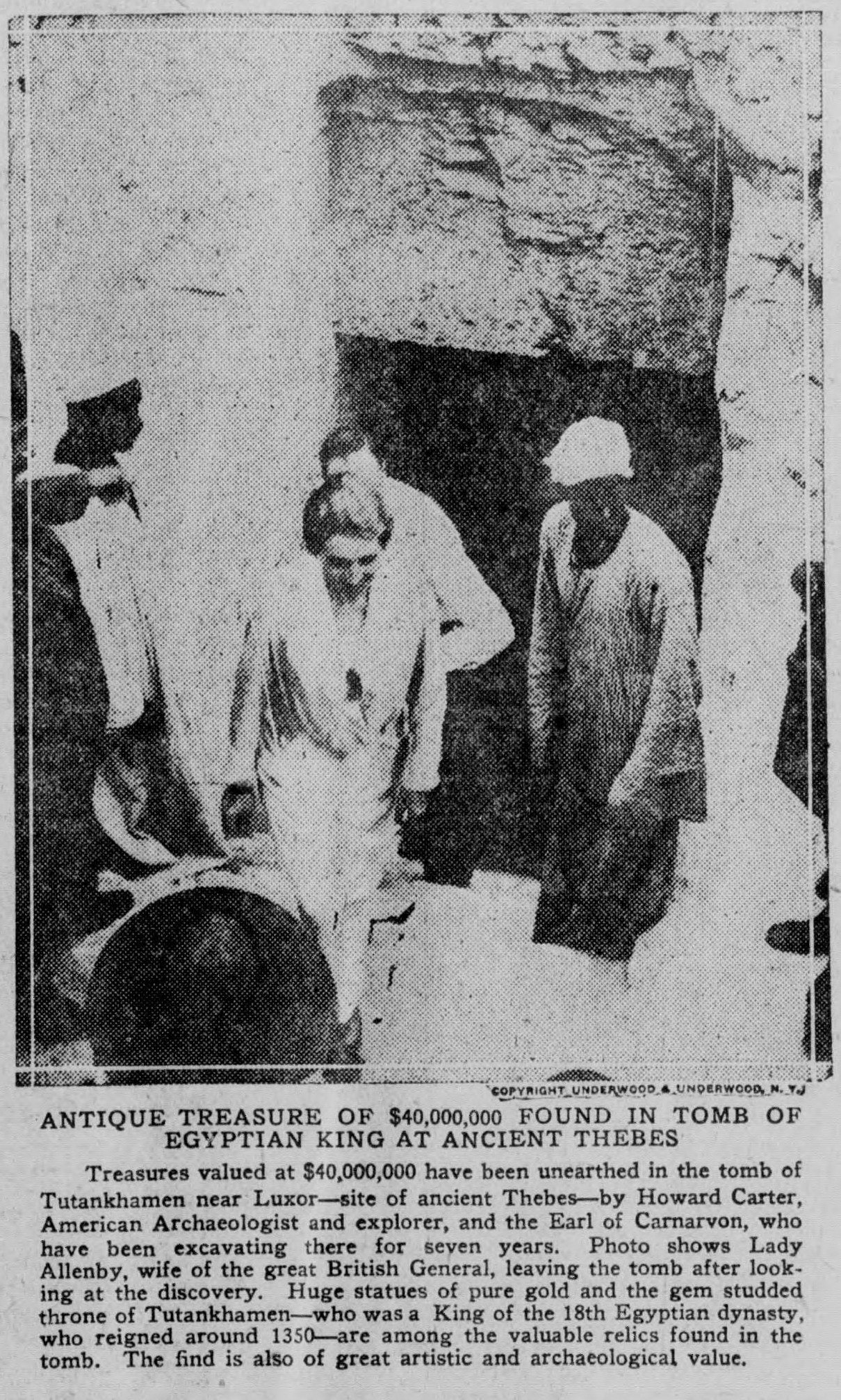
A Birmingham photograph shows Lady Allenby, wife of the British general, leaving the tomb after viewing the discovery, and its caption puts a price on what lies inside: treasures valued at $40,000,000, among them huge statues of pure gold and the gem studded throne.

The Birmingham Age-Herald · Birmingham, Ala.

UnconfirmedNo later report in this collection bears it out.

The Birmingham Age-Herald · 4 January 1923 · page 7 · transcribed from the page image

ANTIQUE TREASURE OF $40,000,000 FOUND IN TOMB OF EGYPTIAN KING AT ANCIENT THEBES

Treasures valued at $40,000,000 have been unearthed in the tomb of Tutankhamen near Luxor—site of ancient Thebes—by Howard Carter, American Archaeologist and explorer, and the Earl of Carnarvon, who have been excavating there for seven years. Photo shows Lady Allenby, wife of the great British General, leaving the tomb after looking at the discovery. Huge statues of pure gold and the gem studded throne of Tutankhamen—who was a King of the 18th Egyptian dynasty, who reigned around 1350—are among the valuable relics found in the tomb. The find is also of great artistic and archaeological value.

See the clipping

Luxor angry at being shut out

Lord Carnavon, as the Washington Times spells him, tells a London meeting that the expedition had almost given up hope when a searcher saw the furnishings through a small hole in the wall. From Luxor the same day comes ‘great indignation’ at word that the Valley of the Kings will be closed to tourists, an arrangement the dispatch lays to the London Times.

The Washington Times · Washington, D.C.

The Washington Times · 12 January 1923 · page 22 · transcribed from the page image

TUT-ANKH-AMEN TOMB FOUND BY CHANCE

Expedition Had Almost Given Up When Small Hole in Wall Revealed Treasure.

See moreSee less

By Universal Service.

LONDON, Jan. 12.—At a meeting here last night Lord Carnavon, describing the discovery of the tomb of King Tut-Ankh-Amen, in the Valley of the Kings, Egypt, said the expedition had almost given up hope of finding the tomb when one of the searchers pushed a candle through a small hole in the wall and saw the rare furnishings of the tomb, decorated with gold and gems.

Gen. Sir John Maxwell announced tonight that the Egyptian Exploration Society has secured the two best archaeological concessions in Egypt, the sites of the ancient cities of Telelamarna and Abydos.

LUXOR, Egypt, Jan. 12.—Great indignation is expressed here today over the announcement that the Valley of the Kings, in which were discovered recently vast treasures of King Tut-Ankh-Amen, would be closed to all. Egyptian tourists as a result of arrangements made by the London Times.

Two small stools, evidently belonging to the children of the king, a rare ebony box and other treasures were recovered from the tomb yesterday.

See the clipping

The papyrus that was table napkins

Arthur Weigall cables from Luxor that Dr. Alan Gardiner has examined the folded squares hoped to be papyrus documents: they are ‘simply folded table napkins’. Gardiner still calls the find the most wonderful collection of treasures ever found in Egypt, and three tiny stools set Carter wondering whether the king’s children lie in the sealed chamber, though Weigall notes the queen was childless.

Evening Star · Washington, D.C.

Evening Star · 21 January 1923 · page 1 · transcribed from the page image

RARE "PAPYRUS" IS PAPER NAPKINS

Noted English Archeologist Dispels Excitement Over Find in King's Tomb.

See moreSee less

OPEN VAULT NEXT WEEK

Theories of Children Buried With Tutankhamen Discounted by Searchers.

BY ARTHUR WEIGALL.

By Cable to The Star.

LUXOR, Egypt, January 19.—Speculation concerning the several squares of folded material found in the first chamber of the tomb of Tutankhamen was dissipated today by the visit of Dr. Alan Gardiner, greatest English authority on ancient Egyptian language and script. This material, which looked like papyrus, was believed to be documents of historic interest, but upon examination turned out to be simply folded table napkins.

Dr. Gardiner, however, found many short inscriptions on several objects in the tomb which were illuminating. On some of the oddly carved boxes were interesting lists of contents which have added some new words to our knowledge of the language. Fortunately Dr. Gardiner had not come all the way from England expressly for the purpose of seeing these supposed documents of papyrus. He and Prof. James Henry Breasted, director of the Oriental Institute of the University of Chicago, are out here working in the Cairo Museum transcribing and translating books of the dead, written on the many coffins of what is called the middle kingdom, 1800 B. C., now exhibited there. This will keep him busy for several months.

Funeral Appointments Fine.

Gardiner says that in spite of a good deal of wild talk the funeral paraphernalia of Tutankhamen is really the most wonderful collection of treasures ever found in Egypt. He was particularly struck, he says, by a wooden casket on the sides and lid of which are most exquisite little paintings, like finest miniatures, representing hunting scenes in the desert and pursuit of ostriches, gazelles, wild asses, hares, and so on. The woodwork, however, Dr. Gardiner added, was in a bad state of preservation, and the only way of saving it was by pouring liquid paraffin and wax over the whole thing to solidify it. I have successfully tried this same method in the past with painted objects which were rotten, and when the wax had been melted off again the colors looked rather fresher than before, but it is nervous work ladling hot wax over priceless works of art.

The opening of the sealed burial chamber will start as soon as Lord Carnarvon arrives, the end of next week, from England. While examining the outer chamber today I found three very small stools, apparently made for children. Mr. Carter, I understand, thinks it possible, therefore, that Tutankhamen's children may be buried with him in the inner chamber, but against this conjecture is the known fact that his legal queen was childless at his death. She, however, had some little sisters, and the stools may have belonged to them.

Find Children's Stools.

In the tomb of Prince Yuna, which we found some years ago, was a child's small chair, and inscriptions on it showed that it had been presented to the prince by his granddaughter, an aunt of Tutankhamen's queen. Similarly these little stools may simply be presents and the bodies of the children, whoever they were, will not necessarily be found in the tomb. I understand that the body or bodies found may be left undisturbed in the vault until Elliot Smith, professor of anatomy of the University College, London, greatest living expert on mummies, is able to come out and see them in position.

(Copyright, 1923, by North American Newspaper Alliance.)

See the clipping

Americans shut out of the tomb

A Reuter’s message from Luxor reports that American correspondents have been refused admission to the tomb, to the surprise of the Americans there. Even George B. McClellan, former mayor of New York, has had only ‘scant attention’ and no invitation to go in, though, the message points out, Carter’s most expert help has come from American sources.

Evening Star · Washington, D.C.

Evening Star · 21 January 1923 · page 2 · transcribed from the page image

AMERICANS SNUBBED.

Correspondents Denied Admission to "Valley of Kings," in Egypt.

See moreSee less

By the Associated Press.

LONDON, January 19.—A Reuter's message from Luxor, Egypt, in connection with the recent remarkable archeological discoveries in the Valley of Kings, says:

"To the surprise of the American travelers here the American correspondents have been denied admission to King Tutankhamen's tomb.

"Considerable feeling is expressed at the indifference shown those who are believed to be in the best position to promote the public interest and support archeological research in connection with the Egyptian antiquities.

"Conspicuous among the Americans here is George B. McClellan, former member of Congress, former mayor of New York, distinguished professor at Princeton and long identified with the Metropolitan Museum of Art.

"Mr. McClellan was introduced by the American archeologists working in the Valley of the Kings, but only received scant attention, and thus far has not been invited to enter the tomb.

"It is pointed out that the most expert aid Howard Carter has received hitherto has come from American sources."

See the clipping

Breasted writes home from the tomb

In a letter to friends in Chicago, Professor James Henry Breasted, whom the paper credits with a share in the discovery, says entering the first doorway ‘seemed more like a dream than a reality’. Through a small opening he has seen two life-size statues of the king guarding a sealed plaster wall, behind which, he writes, the king will be found in February.

San Antonio Light · San Antonio, Tex.

This article was wrong. The papers corrected it 3 days later.

Wrong

San Antonio Light · 24 January 1923 · page 8 · transcribed from the page image

LETTER DESCRIBES DREAM-LIKE TOMB OF EGYPTIAN KING

Writer Confident That Ruler's Body Will Soon Be Found.

See moreSee less

Chicago, Jan. 24. — James Henry Breasted, Egyptologist of the University of Chicago, in a letter to friends here, described the opening of burial chamber of the Egyptian king, Tutankhamen, at Luxor. Professor Breasted, after months of excavating, discovered the tomb in conjunction with other Egyptologists.

The letter said in part:

"As we entered the first doorway, it seemed more like a dream than a reality.

"Before us lay piled to the ceiling paraphernalia of an Egyptian king: golden couches, golden chariots inlaid with precious stones, a golden chair, chests inlaid with ivory in patterns or hieroglyphics, chests of all descriptions.

"One is especially beautiful, with painted designs of hunting scenes, wild animals and processions so delicately drawn and colored that it would vie with any Japanese art of the highest description."

Then Professor Breasted's letter described the second chamber of the tomb, which, as yet, he said, had not been entered.

"One can peer through a small square opening in the wall.

"One sees on the right, against the wall, two life-size statues of the king, with sandals of gold upon the feet and each with a gilded staff grasped in both hands.

"These seem to be guarding the space between them: and this space is of white plaster and covered with the great seals of King Tutankhamen.

"Here, it is believed, is the entrance to the burial chamber of the king, and in February, when this chamber is to be opened, will be found the king."

See the clipping

The perfume still lingers

Arthur Weigall reports from Luxor that four alabaster vases of perfume carried to the workshop still give off ‘a slight scent’. Out of the tomb the same day came the Pharaoh’s fly swatters of horse hair with carved ivory handles, reed pipes and a golden fife, and a footstool inlaid with bearded Asiatics, which Weigall reads as more proof of the king’s contempt for Semitic peoples.

The Birmingham Age-Herald · Birmingham, Ala.

The Birmingham Age-Herald · 24 January 1923 · page 14 · transcribed from the page image

IN PERFUME VASES FROM PHARAOH'S TOMB SCENT STILL REMAINS

By ARTHUR WEIGALL (Copyright, 1923, by North American Newspaper Alliance.)

See moreSee less

LUXOR, Egypt., Jan. 23.—A number of interesting objects were removed from the tomb of Tutankhamen here today and taken to the workshop which has been specially prepared for them. Among these was another footstool on which two golden figures are cleverly inlaid, representing bearded Asiastics—a fact which shows again that this Pharoah had a particular contempt for Semitic peoples.

Four alabaster vases containing perfumes were also removed. Marvellous as it may seem a slight scent can still be detected from them. The Pharoah's fly swatters, made of horse hair, with beautifully carved ivory handles, also appeared and several musical instruments, including reed pipes and a golden fife came up from the tombs.

See the clipping

An X-ray and a moving picture

If the mummy still lies in the third chamber it is to be X-rayed, and for the first time in history its unwrapping is to be filmed. Lord Carnarvon, back in London, says an untouched royal mummy will show for the first time how such a body was wrapped and where its magical amulets were placed. ‘I am taking no risks,’ he says. Further exploration, he adds, is held up for want of funds, and America is among the countries offering help.

The Cordova Daily Times · Cordova, Alaska

The Cordova Daily Times · 27 January 1923 · page 7 · transcribed from the page image

OLD EGYPTIAN MUMMY TO BE X-RAYED IF STILL FOUND IN TOMB

LONDON, Jan. 27. — Pharaoh Tut-Ankh-Amen, the mightiest man in the world 3,000 years ago, is to be X-rayed if his mummy still lies in the mystery chamber of his recently discovered tomb, which Lord Carnarvon will open when he returns to Egypt some time this month.

See moreSee less

When the archaeologists force open the alabaster coffin and take off the thin covering of beaten gold from the body they will carry the shrouded form into the sunlight and photograph it from every angle, and for the first time in history a movie will be taken of that weird sight, the unwrapping of a pigmy.

This film will show the mummy as it was deposited in the tomb, and will follow the long and difficult process from the unwrapping of the mummy cloth until the body of the king meets the light of day for the first time for thirty centuries.

"I am taking no risks," said Lord Carnarvon, who has returned to London after his historic find. "I do not know what we shall find in that third chamber, but as there is every indication that the mummy is still there I am taking every scientific precaution, so that no important fact may be lost to the world.

"It is necessary that X-ray photographs should be taken, because the radiographs of a royal mummy which has not been disturbed by tomb robbers will throw important light on the ancient ritual of embalming.

"If the mummy proves to be untouched it will enable archaeologists to learn for the first time how a royal mummy was wrapped for burial, and how the magical amulets put on it to protect it from evil spirits in the underworld were distributed."

Unfortunately, according to Lord Caranarvon, further exploration is held up for want of funds, but other countries, notably America, are coming forward with offers of help.

See the clipping

Keep the king at Luxor

With the opening of the burial chamber near, the people of Luxor press to keep the mummy, if it is found, in its tomb rather than send it to Cairo: shown there, they say, it would bring thousands of tourists. Only one royal mummy, Amenophis II, now lies in the necropolis. Herbert Winlock of the American mission expects the body to be well preserved if robbers never reached the vault.

The Milwaukee Leader · Milwaukee, Wis.

The Milwaukee Leader · 27 January 1923 · page 8 · transcribed from the page image

Egypt Wants to Use King's Body To Draw Tourist

LUXOR, Egypt—As the day approaches for the opening of the inner or mortuary chamber of the tomb of King Tutenkhamun, recently discovered in the valley of the kings, an air of suppressed excitement pervades the whole upper Nile valley.

See moreSee less

Pressure is being exerted by the local population to have the mummy of Tutenkhamun, if it is found, kept in the tomb instead of being removed to Cairo. They assert that if exhibited in the tomb the mummy of the Pharaoh would attract thousands of tourists to Luxor and stimulate trade.

At present, in all the tombs of the imperial necropolis there remains only one royal mummy, that of Amenophis II. The whole Theban burial area, including the valleys of the kings and queens, contains the bodies of countless generations. Here all, from the mighty Pharaohs to the humblest of citizens, sought their final rest.

Herbert Winlock of the American archaeological mission, declared yesterday:

"If Lord Carnarvon finds the body of Tutenkhamun, as I hope he will, I am confident that it will be in an excellent state of preservation, especially if the burial vault was not previously invaded by robbers."

See the clipping

Every one of us a king

A Bismarck Tribune editorial calls the excavators ‘scientific grave-robbers’, named archaeologists only because the loot goes to museums. Stripped of its gold, it says, the king’s favorite chariot is a plain two-wheeled cart without even rubber wheels, and he would have traded half his kingdom for a Ford flivver. He had no electric lights, no movies, no hot running water: judged by ancient standards, it concludes, each of us is a king.

The Bismarck Tribune · Bismarck, N.D.

The Bismarck Tribune · 31 January 1923 · page 4 · transcribed from the page image

KING'S LUXURIES

Scientific grave-robbers continue bringing loot from the tomb of Tut-ankh-Amen, king who ruled Egypt thousands of years ago. This loot—estimated to be worth as much as 40 million dollars — will go to museums, so the looters are called "archaeologists."

See moreSee less

They would be called grave-robbers, even ghouls, if old Tut-ankh-Amen had been buried recently. Time seems to make a lot of difference, black is black one year and white another.

After a person is dead a few thousand years, the atmosphere of respect and reverence vanishes. So it's considered proper to lug forth and display the mummies and treasure found in Tut-ankh-Amen's tomb.

It must please the old gentleman's spirit at that, for he was forgotten and his tomb buried under drifted sands until recently discovered by excavators. His glory lives again by reason of his grave-robbery.

His tomb had been robbed previously—about 3000 years ago—and resealed by cemetery officials. The robbers left behind a treasure of antiques—beautiful robes, gold-plated furniture, rare vases, etc.

All this was costly in its day—still is—but cost and genuine luxury are two separate things. Many a prospector during the Klondike rush would gladly have traded gold for flour, pound for pound. To a staving man, flour is worth a million times its weight in gold.

From Tut-anka-Amen's tomb, the scienific looters bring the king's favorite chariot. Stripped of its gold and jewels, it is a plain two-wheeled cart such as the average modern boy would scoff at.

This chariot didn't even have rubber wheels. It must have been decidedly uncomfortable, bumping over cobbled pavements or muddy ruts. It's a safe guess that Tut-ankh-Amen would have traded half his kingdom for one of the flivvers that Henry Ford has made available to rich and poor alike.

The king's drinking goblet is found—carved from gorgeous alabaster. But that didn't make the liquor taste any better than if it had been served in a stone mug or cheap drinking glass.

The things we consider necessities today would have been dreamland luxuries for the ancient kings. Tut-ankh-Amen's tomb yields a gold candlestick. He had no convenient electric lights, no movies, no hot running water, no ice, no fast trains, no newspapers to keep him informed of far-off doings.

Of course, maybe he enjoyed his life immensely, not knowing the difference between crude services performed by human slaves and the instantaneous services of electricity, steam and other modern scientific slaves.

Enjoyment is largely a mental attitude. And, if we have proper appreciation of our modern conveniences, we realize that each of us in a king, judged by ancient standards.

See the clipping

About these pages

Every clipping here was printed in an American newspaper at the time. The text on each card was read from the page by machine and lightly repaired; where it disagrees with the clipping, the clipping is right. Where the scan of an old page was too damaged to read, the text was transcribed again from the page image and is marked so; letters in [square brackets] were supplied where the printing itself is damaged, and the paper’s own misspellings are kept. The dates, papers, headlines and text are the papers’. The notes on why each article matters, and the one-line summaries, are ours.