As the Papers Told It

Jesse James

As the Papers Told It

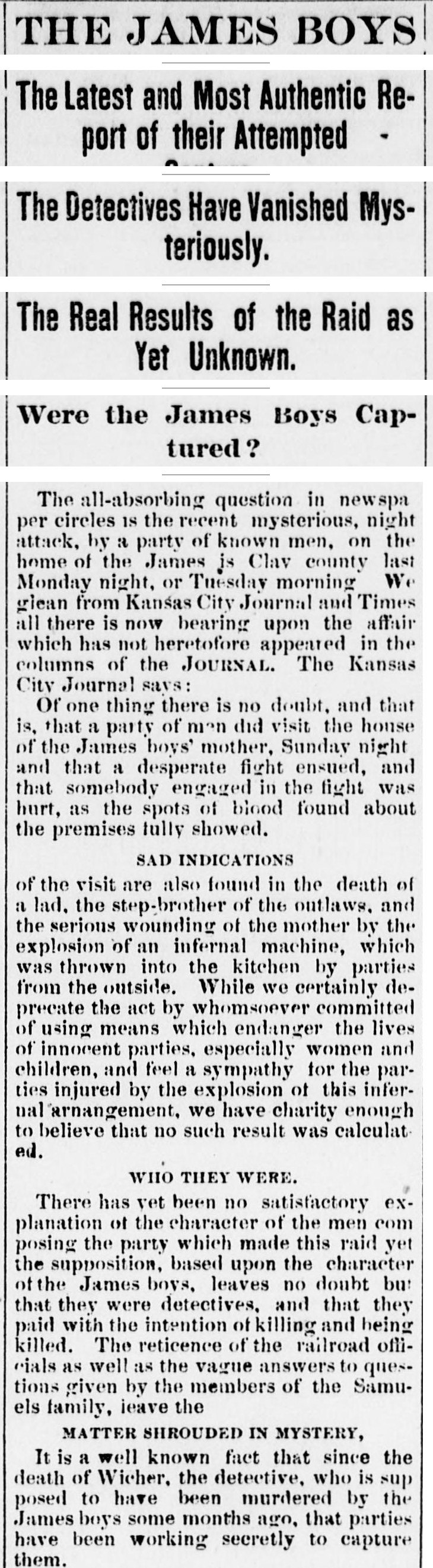
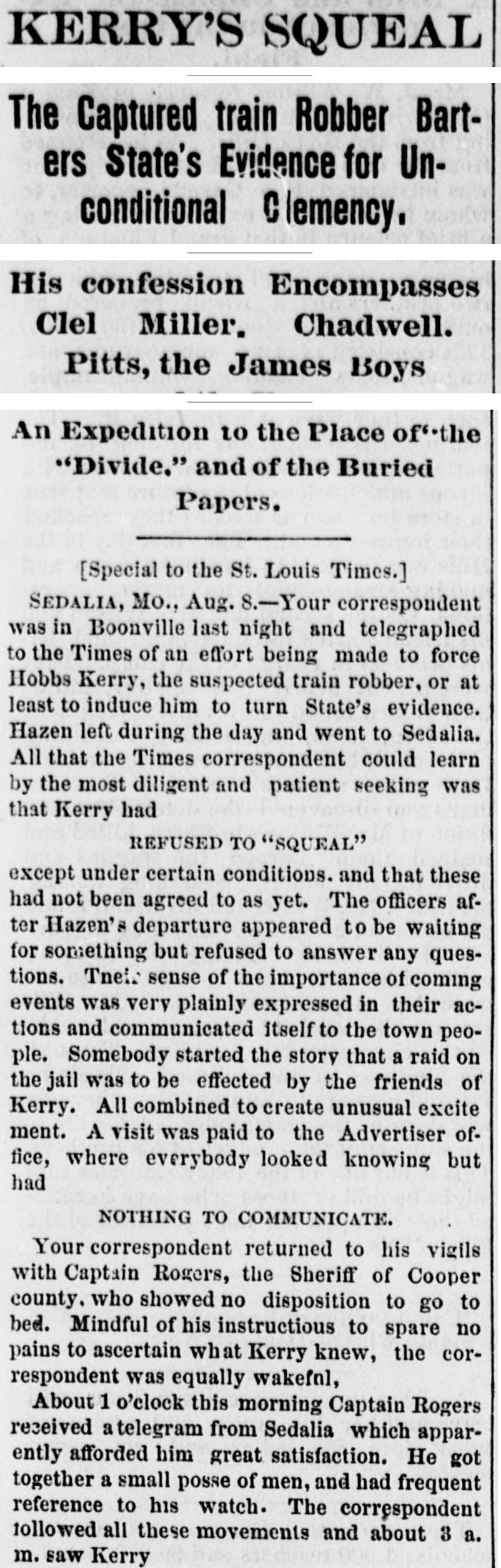
The Weekly Caucasian, 28 February 1874The Weekly Caucasian, 19 September 1874Paper unidentified, 5 February 1875Paper unidentified, 11 August 1876

Original newspaper accounts, 1867–1882

January 1867 – December 188251 newspaper articles in the story, 5,605 in the full archive

For eight years the papers could not agree where Jesse James was, or whether he was alive. In 1874 the papers charged him and his brother Frank with bank and train robberies from Iowa to Kentucky, and the brothers wrote to the press offering to surrender for a fair trial. Men believed to be detectives threw a bomb into their mother’s house. Jesse was reported dead in Kentucky in 1875, and again in 1879 by a man who said he had shot him.

In April 1882 Robert Ford shot him from behind in his house at St. Joseph, where he had been living as Thomas Howard, to collect the State’s reward in a plan the governor had approved. The Fords were sentenced to hang and promptly pardoned. Through the summer the papers followed Bob Ford’s lectures, the Fords at a Chicago theatre and a New York museum, and the trade in relics of the dead man, and that autumn Frank James walked into the governor’s office and surrendered.

The numbers

5,605newspaper articles
5,780printings
393newspapers
50states and territories
192months in the papers

Each article is counted once, however many papers ran it. Printings counts every paper that ran it, so an article reprinted in five papers is one article and five printings.

How much the papers printed

Month of 1 January 1867: 1 printingMonth of 1 June 1867: 1 printingMonth of 1 September 1867: 1 printingMonth of 1 December 1867: 1 printingMonth of 1 May 1868: 1 printingMonth of 1 November 1868: 2 printingsMonth of 1 January 1869: 1 printingMonth of 1 March 1869: 1 printingMonth of 1 May 1869: 1 printingMonth of 1 June 1869: 1 printingMonth of 1 July 1869: 1 printingMonth of 1 September 1869: 1 printingMonth of 1 November 1869: 1 printingMonth of 1 December 1869: 2 printingsMonth of 1 January 1870: 1 printingMonth of 1 February 1870: 2 printingsMonth of 1 August 1870: 2 printingsMonth of 1 September 1870: 2 printingsMonth of 1 October 1870: 1 printingMonth of 1 November 1870: 3 printingsMonth of 1 December 1870: 2 printingsMonth of 1 January 1871: 1 printingMonth of 1 February 1871: 1 printingMonth of 1 May 1871: 2 printingsMonth of 1 August 1871: 3 printingsMonth of 1 January 1872: 2 printingsMonth of 1 March 1872: 1 printingMonth of 1 April 1872: 2 printingsMonth of 1 May 1872: 1 printingMonth of 1 August 1872: 5 printingsMonth of 1 October 1872: 2 printingsMonth of 1 November 1872: 1 printingMonth of 1 May 1873: 2 printingsMonth of 1 July 1873: 2 printingsMonth of 1 August 1873: 2 printingsMonth of 1 September 1873: 3 printingsMonth of 1 October 1873: 2 printingsMonth of 1 November 1873: 1 printingMonth of 1 December 1873: 3 printingsMonth of 1 January 1874: 5 printingsMonth of 1 February 1874: 6 printingsMonth of 1 March 1874: 2 printingsMonth of 1 April 1874: 13 printingsMonth of 1 May 1874: 5 printingsMonth of 1 June 1874: 2 printingsMonth of 1 July 1874: 1 printingMonth of 1 September 1874: 12 printingsMonth of 1 October 1874: 1 printingMonth of 1 November 1874: 1 printingMonth of 1 December 1874: 2 printingsMonth of 1 January 1875: 1 printingMonth of 1 February 1875: 34 printingsMonth of 1 March 1875: 7 printingsMonth of 1 April 1875: 5 printingsMonth of 1 May 1875: 8 printingsMonth of 1 June 1875: 7 printingsMonth of 1 July 1875: 1 printingMonth of 1 August 1875: 4 printingsMonth of 1 September 1875: 44 printingsMonth of 1 October 1875: 33 printingsMonth of 1 November 1875: 1 printingMonth of 1 January 1876: 4 printingsMonth of 1 February 1876: 1 printingMonth of 1 March 1876: 1 printingMonth of 1 April 1876: 1 printingMonth of 1 June 1876: 1 printingMonth of 1 August 1876: 50 printingsMonth of 1 September 1876: 31 printingsMonth of 1 October 1876: 52 printingsMonth of 1 November 1876: 23 printingsMonth of 1 December 1876: 8 printingsMonth of 1 January 1877: 2 printingsMonth of 1 February 1877: 5 printingsMonth of 1 March 1877: 9 printingsMonth of 1 April 1877: 2 printingsMonth of 1 May 1877: 2 printingsMonth of 1 August 1877: 4 printingsMonth of 1 September 1877: 1 printingMonth of 1 November 1877: 6 printingsMonth of 1 December 1877: 1 printingMonth of 1 January 1878: 1 printingMonth of 1 March 1878: 1 printingMonth of 1 April 1878: 1 printingMonth of 1 May 1878: 2 printingsMonth of 1 June 1878: 2 printingsMonth of 1 August 1878: 13 printingsMonth of 1 September 1878: 5 printingsMonth of 1 October 1878: 1 printingMonth of 1 November 1878: 9 printingsMonth of 1 December 1878: 1 printingMonth of 1 January 1879: 3 printingsMonth of 1 February 1879: 1 printingMonth of 1 March 1879: 1 printingMonth of 1 June 1879: 2 printingsMonth of 1 August 1879: 2 printingsMonth of 1 October 1879: 15 printingsMonth of 1 November 1879: 143 printingsMonth of 1 December 1879: 41 printingsMonth of 1 January 1880: 55 printingsMonth of 1 February 1880: 28 printingsMonth of 1 March 1880: 7 printingsMonth of 1 April 1880: 10 printingsMonth of 1 May 1880: 8 printingsMonth of 1 June 1880: 1 printingMonth of 1 July 1880: 28 printingsMonth of 1 August 1880: 12 printingsMonth of 1 September 1880: 20 printingsMonth of 1 October 1880: 10 printingsMonth of 1 November 1880: 7 printingsMonth of 1 December 1880: 6 printingsMonth of 1 January 1881: 20 printingsMonth of 1 February 1881: 12 printingsMonth of 1 March 1881: 27 printingsMonth of 1 April 1881: 10 printingsMonth of 1 May 1881: 10 printingsMonth of 1 June 1881: 9 printingsMonth of 1 July 1881: 79 printingsMonth of 1 August 1881: 77 printingsMonth of 1 September 1881: 173 printingsMonth of 1 October 1881: 39 printingsMonth of 1 November 1881: 74 printingsMonth of 1 December 1881: 17 printingsMonth of 1 January 1882: 22 printingsMonth of 1 February 1882: 38 printingsMonth of 1 March 1882: 117 printingsMonth of 1 April 1882: 1,965 printingsMonth of 1 May 1882: 719 printingsMonth of 1 June 1882: 427 printingsMonth of 1 July 1882: 165 printingsMonth of 1 August 1882: 174 printingsMonth of 1 September 1882: 197 printingsMonth of 1 October 1882: 281 printingsMonth of 1 November 1882: 123 printingsMonth of 1 December 1882: 105 printings14 January 187428 February 187423 April 187419 September 18745 February 187527 February 187520 September 187530 September 187511 August 18761 September 187611 September 187614 October 187616 November 18766 November 187825 October 18798 November 187914 November 18793 January 18808 January 188024 July 188022 July 18813 August 18819 August 188111 August 188115 September 188117 November 18817 March 188214 March 18824 April 18824 April 18825 April 18827 April 18828 April 188211 April 188214 April 188217 April 188218 April 188220 April 188224 April 188228 April 18822 May 188225 May 18827 June 188222 June 188223 August 188227 September 18827 October 188211 October 18821 November 18821 November 188226 November 188218671868186918701871187218731874187518761877187818791880188118821,965 printings in the month of 1 April 1882

Every printing of every article, by the month it ran. The marks under the line are the articles in the story below; red ones were wrong.

Where it was printed

FewerMore

Printings in 50 states. Most: Missouri (519), Tennessee (359), Minnesota (300). 427 printings could not be placed in a state.

How it unfolded

51 newspaper articles in 7 acts

Act One

The Brigands of Missouri

January – September 1874

By January 1874 Frank and Jesse James were charged with robbing the bank at Gallatin, where the cashier was murdered, the gate at the Kansas City fair grounds, an Iowa train whose engineer was killed, and three banks in Kentucky. They answered in a letter to a St. Louis paper, offering to surrender if promised a fair trial and protection from a mob. In April a dead man was found near Elkhorn with a card pinned to his coat, signed with their names, warning off Pinkerton’s detectives.

The James brothers offer terms by newspaper

A Wyoming paper lists the charges against Frank and Jesse James: the Gallatin bank and its murdered cashier, the gate at the Kansas City fair grounds, an Iowa train whose engineer was killed, three Kentucky banks. Writing to a St. Louis paper, they offer to give themselves up if the governor guarantees a fair trial and protection from a mob. The editor calls it ‘a new phase of journalism’.

The Cheyenne Daily Leader · Cheyenne, Wyo.

UnconfirmedNo later report in this collection bears it out.

The Cheyenne Daily Leader · 14 January 1874 · page 2 · transcribed from the page image

The brothers Frank and Jesse James outlaws from Missouri, for whose heads a price is offered are curious people. They belonged during the war to Quantrell's and to Anderson's guerrillas. They are now charged with having robbed the Gallatin bank, killing the cashier; with robbing the gate at the Kansas City fair grounds; with plundering a bank at Sante Genevieve; robbing a train and killing the engineer in Iowa, and robbing three banks and killing two men in Kentucky. From Montana they write to a St. Louis papers ating that if the governor will guarantee them a fair trial; and will give them* his pledge of safety against mob violence, they will deliver themselves up to the law.

See moreSee less

At present they so fear lynching that they keep out of the way, and "will not be taken alive," The newspaper as a medium between outlaws and governors is a new phase of journalism.

See the clipping

An editor recalls the outlaws’ late-night call

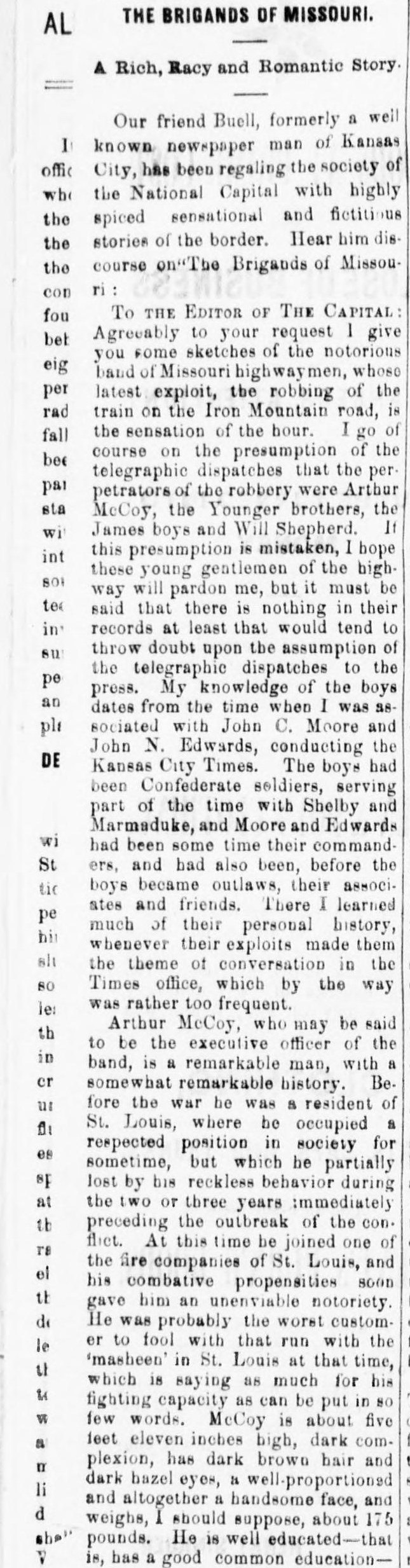
The Weekly Caucasian reprints, as ‘sensational and fictitious’, a letter to a Washington paper by Buell, once of the Kansas City Times, on the men blamed for the Iron Mountain train robbery. He says the Times printed Jesse’s letters unsigned, and that one night in 1872 Jesse, Frank, Cole Younger and Arthur McCoy came to offer the editors a gold watch. Frank asked, ‘Is there anybody you want killed?’

The Weekly Caucasian · Lexington, Mo.

The Weekly Caucasian · 28 February 1874 · page 4 · transcribed from the page image

Part of this page is damaged, so some words could not be read with certainty. Letters and words in [brackets] are our reading of what survives.

THE BRIGANDS OF MISSOURI. A Rich, Racy and Romantic Story. Our friend Buell, formerly a well known newspaper man of Kansas City, has been regaling the society of the National Capital with highly spiced sensational and fictitious stories of the border. Hear him discourse on "The Brigands of Missouri:"

To the Editor of The Capital: Agreeably to your request I give you some sketches of the notorious band of Missouri highwaymen, whose latest exploit, the robbing of the train on the Iron Mountain road, is the sensation of the hour. I go of course on the presumption of the telegraphic dispatches that the perpetrators of the robbery were Arthur McCoy, the Younger brothers, the James boys and Will Shepherd. If this presumption is mistaken, I hope these young gentlemen of the highway will pardon me, but it must be said that there is nothing in their records at least that would tend to throw doubt upon the assumption of the telegraphic dispatches to the press. My knowledge of the boys dates from the time when I was associated with John C. Moore and John N. Edwards, conducting the Kansas City Times. The boys had been Confederate soldiers, serving part of the time with Shelby and Marmaduke, and Moore and Edwards had been some time their commanders, and had also been, before the boys became outlaws, their associates and friends. There I learned much of their personal history, whenever their exploits made them the theme of conversation in the Times office, which by the way was rather too frequent. Arthur McCoy, who may be said to be the executive officer of the band, is a remarkable man, with a somewhat remarkable history. Before the war he was a resident of St. Louis, where he occupied a respected position in society for sometime, but which he partially lost by his reckless behavior during the two or three years immediately preceding the outbreak of the conflict. At this time he joined one of the fire companies of St. Louis, and his combative propensities soon gave him an unenviable notoriety. He was probably the worst customer to fool with that run with the 'masheen' in St. Louis at that time, which is saying as much for his fighting capacity as can be put in so few words. McCoy is about five feet eleven inches high, dark complexion, has dark brown hair and dark hazel eyes, a well-proportioned and altogether a handsome face, and weighs, I should suppose, about 175 pounds. He is well educated—that is, has a good common education—and is a man of considerably more than average intelligence. During the war he did a good deal of service as a spy, and this was the school from which he graduated the desperado he is. I have no time or space to record any of his adventures as a Confederate spy, but those who know what sort of warfare was waged west of the Mississippi, know that the part he played often involved desperate work, and there are several instances which go to show that none of it was ever too desperate for him. McCoy has one of those peculiar organisms whose possessors seem to deserve no credit for their courage. His bravery, which is absolute, is a sort of second nature; the result, not of pride or the fear of being called a coward, but of a fierce insensibility to danger, and a total recklessness of personal hazard that gives him nerve under all circumstances. His hand goes to his revolver butt or his knife hilt by an instinct as tiger like as the aim of his bullet is infallible or the thrust of his bowie decisive.

See moreSee less

I don't suppose McCoy ever shot at a man whom he did not hit, nor that he was ever in a situation where his judgment was not as clear as his impulses were sudden and deadly. I don't know how he will die, but I suppose as he has lived, violently, though I will venture to assert that when he does lie down with his boots on forever, those who brought him down will not soon forget the circumstances, unless they should forget it immediately by keeping him company. I don't know how many thousand dollars in rewards are set on the head of Arthur McCoy, but it amounts to considerably more than a year's salary of a Cabinet officer—quite a snug little fortune. Though avaricious as I am, I haven't the remotest idea of attempting to make money by earning those rewards As between the two I think I would prefer to undertake to earn the same sum by swimming over Niagara Falls. Moreover, most men who know McCoy are in the same fix that I am.

Of the Younger boys, John and Cole, I know but little, having never seen but one of them, and him only for a few minutes one night in Kansas City. Then he was on horseback, all muffled up, so that I could not see his face. But my memory of his conversation is that he was a pleasant-voiced fellow of a rather jovial turn of mind, a rather rapid talker, and capable of saying good things. At all events, I remember one of his observations, which was that he didn't ask any odds of society, but thought it was unjust of the newspapers to rate him with ordinary thieves. He said he supposed his fame would be handed down to posterity, and all he wanted was a fair show, and not to be classified with pickpockets and sneak thieves. He said he never broke into anybody's house, nor picked up any valuables he found lying around loose.

When he wanted to make war upon society he went out on the highway, where evey man had the same show. This was a short time after he and Shepherd, and either his brother or McCoy, probably the latter, had ridden up to the ticket office of the Kansas City Exposition grounds and robbed the gatekeeper, Ben. Wallace, in broad daylight, and in the face of ten thousand people. If anybody wants to know why I did not give the alarm and have this outlaw captured or killed—as the scene of this episode was on Delaware street, in Kansas City, within twenty rods of the police station—I will say that I had some affairs which required settling up, and besides, was not on as good terms with the Almighty as I should like to be before undertaking such a feat as that. I knew that underneath the heavy cape that fell down over his shoulders till it touched his horse's back was a belt studded about with four dragoon pistols, which in the hands of Cole Younger were equivalent to twenty-four dead men, if anything should impel him to set them agoing. So I refrained, as I presume any other law-abiding citizen of ordinary sense would have done under the circumstances. The two Youngers belong in Cass county, where they are very respectably connected, their career bringing sorrow and humiliation to several estimable families.

I know nothing of Will Shepherd or his antecedents, beyond that he belongs in Jackson county, his home,

I believe, being near old Fort Osage.

He was in the Confederate army, though in what command I am not able to say, but I think he was with

Quantrell at Lawrence. He is not as remarkable in person or mind as the rest of his associates, though undoubtedly their peer in recklessness and desperateness.

The James brothers, Jesse and

Frank, are the ornaments of the party. Jesse, the elder, is the administrative leader of the gang. He manages its finances, carries on its diplomacy and devises its strategy. He is altogether a paradoxical fellow. Outside of journalism or the learned professions there is not a better writer nor a more fluent talker than Jesse James in the trans-Mississippi country that I know of. He is about five feet nine in height, slenderly built, of a florid complexion, reddish-brown hair, blue or bluish-gray eyes and has rather sharply defined features. His home, or rather his mother's residence, is near Kearney Station, in Clay county, and his family is one of the most respected in West Missouri. His uncle, Mr. T. M. James, is a wholesale merchant of Kansas City, and one of its most substantial citizens.

I have no idea what made Jesse James the terrible desperado and outlaw that he is. There is nothing essentially savage in his nature, and on the other hand he is a generous, good-hearted fellow. In the time when he was a member of society, and before every man's hand had been raised against him and his against every man in retaliation, he was as genial and inoffensive a young man as there was to be found, and one who gave as good promise of a useful career. But he has become a terror and a scourge, and seems to be all the more dangerous by reason of the intellect that ought to have fitted him to adorn rather than curse his generation.

When I was in the Kansas City Times office as its associate editor, during the campaign of 1872, I used frequently to receive communications from Jesse James on various subjects of public interest, which were always unexceptionable in tone and expressive in sentiment, and which always found place, anonymous of course, in the columns of the Times. There was something in the poor boy's position before the world; in the incongruity of what he was with what he ought to be, a sort of romance about his outlawry that caused my communication with him to beget a sort of mingled sympathy and admiration which I probably ought to be ashamed to confess, but which I assure you I am not. So I always took a perverse delight in being the medium through which Jesse James, from his retreats in the swamps and the fastnesses of the Grand river, impressed his thought upon the public—the thought of the brain upon the head that held which were rewards aggregating $7,000. It seemed to me almost in the nature of poetic justice that society should be humbugged by anonyms in being influenced by the intellect of a man upon whose head it had set a price. I remember one occasion in particular. It was about the time for holding the county conventions in 1872, and the Times was full of letters recommendatory of this, that and the other man for office. One day I received a letter post marked 'Liberty, Missouri,' which, on inspection, I found to be a vigorous, terse and glowing eulogy of a young man who is now sheriff of Clay county, and commending him to the favorable consideration of the people of Clay county for that office. The letter was signed 'Jesse W. James.' The subject of the letter is a most estimable man. I know him, and know him to be as spotless as he is brave, and an empty sleeve whose arm he left at Corinth, attests his bravery. It is no discredit to him as a citizen or as a public officer that a letter recommending him for the position came from the pen of the desperate and blood stained outlaw, Jesse James. He and Jesse had been soldiers together. Nay, babies together, and schoolmates. And wicked, desperate and abandoned as Jesse is, he is not more entirely depraved than his old schoolmate and comrade in arms, the sheriff of Clay county, is upright, honorable, and estimable. Yet I presume there are those who will insist that such a thing is impossible. Well, I won't argue the point, but I will say that the social philosophy of the border is peculiar, and is not easily comprehended by the civilization of the meridian of Washington.

One night about eleven o'clock, in the fall of 1872, Major Edwards and I were sitting in the editorial rooms of the Times, discussing various matters, when the door opened and a man entered the room. He was muffled up to the eyes, and as he came in he gave a quick glance around to see how the land lay. He then said: 'There are some gentleman outside who wish to see you. They are on horseback and do not wish to dismount.' The man who came in was Arthur McCoy. The men on horseback in the street were Jesse and Frank James and Cole Younger. Now, about a week or two before that, the Kansas City Sunday Times had printed an editorial headed, 'The Chivalry of Crime,' in which, while the crime of these men had been denounced, their sublimated hardihood had been commented on admiringly. They had come to thank us for our appreciation of their pluck and daring. As a slight testimonial the boys had brought along a magnificent gold watch and chain which they desired to present to the writer of that article, or the editor of the paper, Jesse James observing that he had a presentation speech prepared, which might be reported in short-hand and the whole affair published in the morning paper. The proffered testimony was, of course, declined on the ground that the owner might recognize the watch and make trouble. At this Jesse became indignant and declared that he hoped we had a better opinion of him than to suppose that he would present to us a watch of which he had despoiled some one else. He had bought that watch, and not only that, but had come honestly by the money he bought it with. However, the testimonial was respectfully, but very firmly declined.

'Well, then,' said Cole Younger, 'what can we do to testify our gratitude?'

'Is there anybody you want killed?' mildly inquired Frank James. 'If there is, just name him, and we'll bring you his scalp at this hour tomorrow night if he is within twelve hours' ride.' This kind offer was also politely declined, as we thought we could get along just as well with our enemies alive as with them dead, and no doubt a good deal better, since it is an important element of success to have enemies.

'Have any more rewards been offered for our capture?' inquired McCoy as they turned their horses' heads to go.

'If you see anybody who wants to earn the price already set on our heads,' interrupted Jesse James, 'tell them they will find us somewhere in Fort Osage township, or down in the Sni Hills. We shall be glad to see them.'

'And we will promise them a warm reception,' said little Frank James, in a demure way. 'If they come, they won't be likely to forget our hospitality very soon.'

'I don't reckon it would be worth while for anybody to come after us,' chimed in Cole Younger; 'the rewards are only a little over $20,000, and that would hardly pay funeral expenses by the time they got all of us.'

Then the boys all laughed at the savage wit of Cole, who is the wag of the party, and they spurred their horses and rode away into the night and back to their wild haunts and their strange, desperate life. I might give other anecdotes, but this sketch is already too long. People may wonder at what I have said, and ask why we did not try to entrap these men and surrender them to justice. Well, I will answer tha question with another. On the heads of the four desperadoes who visited us that night were rewards aggregating, I believe, $21,000. Why did not other law abiding citizens try to capture them? The question answers itself. No man or posse of men will ever take Arthur McCoy, or the James boys, or the Youngers, or Wm. Shepherd, alive. And by the time they have been taken dead, there will be scattered around them enough corpses of their captors to cover them out of sight if all were piled up together. It may be wrong to write of such men as I have written. But there is a dash of tiger's blood in the veins of most men that make them admire such devils as these. BUELL.
See the clipping

A dead man and a warning card

An Iowa news roundup reports a body found in the road four miles east of Elkhorn, shot six times. A card pinned to the coat, signed by Jesse and Frank James, read ‘This shall be the fate of all of Pinkerton's detectives’ who came hunting them; the handkerchief was marked P. K. Cole. In 1882 a Virginia paper told of a like card on a Pinkerton man it called Welcher.

The Weekly Oskaloosa Herald · Oskaloosa, Iowa

The Weekly Oskaloosa Herald · 23 April 1874 · page 3 · transcribed from the page image

NEWS OF THE WEEK

MONDAY.—Another victim to the Missouri bandits. The corpse was found in the road four miles east of Elkhorn, with six shots in his body. A card was pinned on his coat which read as follows: "This shall be the fate of all of Pinkerton's detectives who come to hunt the James Bros." Signed by Jesse James and Frank James. A handkerchief was found on his person marked "P. K. Cole."....The Arkansas muddle

See the clipping

A detective hears the boys were elsewhere

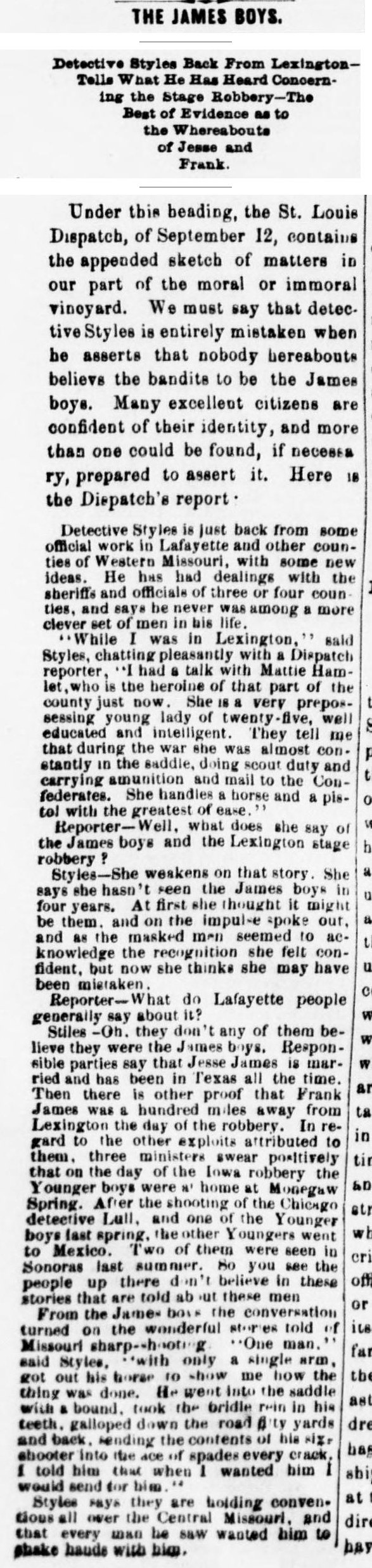
Back from Lafayette County, Detective Styles tells the St. Louis Dispatch that Mattie Hamlet now doubts the masked men who robbed the Lexington stage were the James boys, that Jesse is said to be married and in Texas, and that three ministers swear the Youngers were at home during the Iowa robbery. The Lexington paper disagrees: many citizens are ‘confident of their identity’.

The Weekly Caucasian · Lexington, Mo.

The Weekly Caucasian · 19 September 1874 · page 2 · transcribed from the page image

THE JAMES BOYS.

Detective Styles Back From Lexington—Tells What He Has Heard Concerning the Stage Robbery—The Best of Evidence as to the Whereabouts of Jesse and Frank.

See moreSee less

Under this heading, the St. Louis Dispatch, of September 12, contains the appended sketch of matters in our part of the moral or immoral vineyard. We must say that detective Styles is entirely mistaken when he asserts that nobody hereabouts believes the bandits to be the James boys. Many excellent citizens are confident of their identity, and more than one could be found, if necessary, prepared to assert it. Here is the Dispatch's report:

Detective Styles is just back from some official work in Lafayette and other counties of Western Missouri, with some new ideas. He has had dealings with the sheriffs and officials of three or four counties, and says he never was among a more clever set of men in his life.

"While I was in Lexington," said Styles, chatting pleasantly with a Dispatch reporter, "I had a talk with Mattie Hamlet, who is the heroine of that part of the county just now. She is a very prepossessing young lady of twenty-five, well educated and intelligent. They tell me that during the war she was almost constantly in the saddle, doing scout duty and carrying amunition and mail to the Confederates. She handles a horse and a pistol with the greatest of ease."

Reporter—Well, what does she say of the James boys and the Lexington stage robbery?

Styles—She weakens on that story. She says she hasn't seen the James boys in four years. At first she thought it might be them, and on the impulse spoke out, and as the masked men seemed to acknowledge the recognition she felt confident, but now she thinks she may have been mistaken.

Reporter—What do Lafayette people generally say about it?

Stiles—Oh, they don't any of them believe they were the James boys. Responsible parties say that Jesse James is married and has been in Texas all the time. Then there is other proof that Frank James was a hundred miles away from Lexington the day of the robbery. In regard to the other exploits attributed to them, three ministers swear positively that on the day of the Iowa robbery the Younger boys were at home at Monegaw Spring. After the shooting of the Chicago detective Lull, and one of the Younger boys last spring, the other Youngers went to Mexico. Two of them were seen in Sonoras last summer. So you see the people up there don't believe in these stories that are told about these men

From the James boys the conversation turned on the wonderful stories told of Missouri sharp-shooting. "One man," said Styles, "with only a single arm, got out his horse to show me how the thing was done. He went into the saddle with a bound, took the bridle rein in his teeth, galloped down the road fifty yards and back, sending the contents of his six-shooter into the ace of spades every crack. I told him that when I wanted him I would send for him."

Styles says they are holding conventions all over the Central Missouri, and that every man he saw wanted him to shake hands with him.

See the clipping

About these pages

Every clipping here was printed in an American newspaper at the time. The text on each card was read from the page by machine and lightly repaired; where it disagrees with the clipping, the clipping is right. Where the scan of an old page was too damaged to read, the text was transcribed again from the page image and is marked so; letters in [square brackets] were supplied where the printing itself is damaged, and the paper’s own misspellings are kept. The dates, papers, headlines and text are the papers’. The notes on why each article matters, and the one-line summaries, are ours.