The Bismarck Tribune · 30 September 1919 · page 6 · transcribed from the page image
Part of this page is damaged, so some words could not be read with certainty. Letters and words in [brackets] are our reading of what survives.
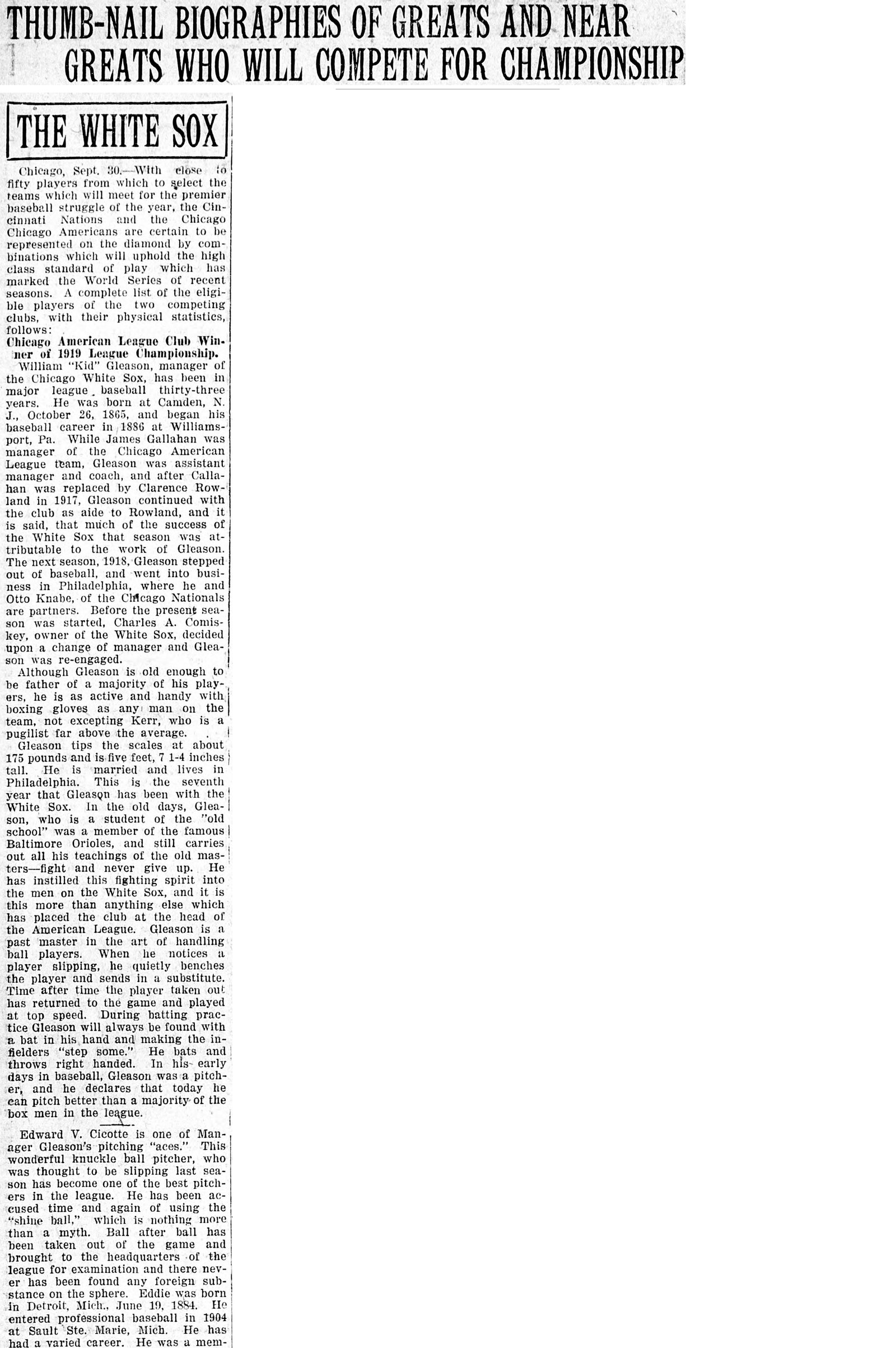
THUMB-NAIL BIOGRAPHIES OF GREATS AND NEAR GREATS WHO WILL COMPETE FOR CHAMPIONSHIP
See moreSee less
Chicago, Sept. 30.—With close to fifty players from which to select the teams which will meet for the premier baseball struggle of the year, the Cincinnati Nationals and the Chicago Americans are certain to be represented on the diamond by combinations which will uphold the high class standard of play which has marked the World Series of recent seasons. A complete list of the eligible players of the two competing clubs, with their physical statistics, follows:
Chicago American League Club Winner of 1919 League Championship.
William "Kid" Gleason, manager of the Chicago White Sox, has been in major league baseball thirty-three years. He was born at Camden, N. J., October 26, 1865, and began his baseball career in 1886 at Williamsport, Pa. While James Callahan was manager of the Chicago American League team, Gleason was assistant manager and coach, and after Callahan was replaced by Clarence Rowland in 1917, Gleason continued with the club as aide to Rowland, and it is said, that much of the success of the White Sox that season was attributable to the work of Gleason. The next season, 1918, Gleason stepped out of baseball, and went into business in Philadelphia, where he and Otto Knabe, of the Chicago Nationals are partners. Before the present season was started, Charles A. Comiskey, owner of the White Sox, decided upon a change of manager and Gleason was re-engaged.
Although Gleason is old enough to be father of a majority of his players, he is as active and handy with boxing gloves as any man on the team, not excepting Kerr, who is a pugilist far above the average.
Gleason tips the scales at about 175 pounds and is five feet, 7 1-4 inches tall. He is married and lives in Philadelphia. This is the seventh year that Gleason has been with the White Sox. In the old days, Gleason, who is a student of the "old school" was a member of the famous Baltimore Orioles, and still carries out all his teachings of the old masters—fight and never give up. He has instilled this fighting spirit into the men on the White Sox, and it is this more than anything else which has placed the club at the head of the American League. Gleason is a past master in the art of handling ball players. When he notices a player slipping, he quietly benches the player and sends in a substitute. Time after time the player taken out has returned to the game and played at top speed. During batting practice Gleason will always be found with a bat in his hand and making the infielders "step some." He bats and throws right handed. In his early days in baseball, Gleason was a pitcher, and he declares that today he can pitch better than a majority of the box men in the league.
Edward V. Cicotte is one of Manager Gleason's pitching "aces." This wonderful knuckle ball pitcher, who was thought to be slipping last season has become one of the best pitchers in the league. He has been accused time and again of using the "shine ball," which is nothing more than a myth. Ball after ball has been taken out of the game and brought to the headquarters of the league for examination and there never has been found any foreign substance on the sphere. Eddie was born in Detroit, Mich., June 19, 1884. He entered professional baseball in 1904 at Sault Ste. Marie, Mich. He has had a varied career. He was a member of the Augusta, Ga., team of the Southern Association at the time Tyrus Cobb was playing there, and both went to the Detroit Americans. Cobb was retained by Detroit but Cicotte was sent back. He later joined the Boston Red Sox, and was found wanting. He was released to the White Sox about eight years ago. He began to show he could pitch and became a fixture on the club. He bats and throws right handed. He is married and resides in Detroit. Cicotte is one of the headiest pitchers in the game. He has a varied assortment of curves and uses his head throughout a game. He is a good judge of batters and much of his success is due to this fact. Cicotte's checkered career in the major leagues extends over about twelve seasons. He is five feet, 8 inches tall and weighs about 160 pounds.
Urban "Red" Faber, who was "discovered" by Clarence Rowland before he became manager of the White Sox in 1917, has been more or less of a disappointment this season. He joined the navy at the Great Lakes last fall after the season closed, and since returning to the club he has not been able to put the same snap in the ball which enabled him to make such a wonderful showing against the New York Giants when the White Sox defeated them for the World's title in 1917. However, Manager Gleason has faith in Faber, and he may take part in the coming series. Faber was born in Cascade, Ia., Sept. 6, 1888. He began his baseball career with the Dubuque club of the Three I league under Clarence Rowland, and came to the White Sox in 1913. He bats either right or left handed, but pitches right handed. When "right", Faber is a hard man to beat. He has an assortment of curves and is a master on the "spit ball" delivery. He is six feet tall and weighs 175 pounds. Faber is not married and makes his home in Cascade.
Claude Williams is one of the best if not the best left handed pitcher in the American league. He is another of Gleason's aces. He was born March 9, 1893, at Aurora, Mo., broke into baseball at Nashville, Tennessee, in 1912. This is Williams' fourth year in major league baseball, always as a member of the White Sox. His effectiveness this season has been another strong point in favor of the White Sox. He and Cicotte have been called upon to do the burden of the pitching for the club and they always have been willing workers. Rarely does Williams lose a game where his teammates go out and get a run or two for him. He bats right handed. He is married and resides in Springfield, Mo. He is 5 feet, 8 1-2 inches tall and weighs 160 pounds. "Lefty" worked in the shipyards last winter and was one of the players whom Manager Gleason brought back to the club. He joined the White Sox from the Salt Lake club of the Pacific Coast League.
Richard Kerr, pitcher, has developed into one of the best left hand pitchers in the league. He is one of the gamest pitchers in the league and in his young days could handle his fists with the best of them around St. Louis where he played ball on the sand lots. Kerr was born twenty-six years ago at St. Louis. He was obtained by the Chicago club from Milwaukee. He broke into professional baseball in 1909 as a member of the Paragould, Ark., team. "Dick" bats and throw left handed. He is married and lives in Paris, Texas. He weighs 160 pounds and is 5 feet, 8 inches tall.
Grover Loudermilk, pitcher, was born in Sandburn, Ind., Jan. 15, 1886. Loudermilk has had a varied career since starting professional baseball at Mattoon, Ill., in 1906. He was with Decatur in 1907-8-9 and in 1910 he played with the St. Louis Nationals and the Springfield, Ill., Three I team. The next year he went back to the St. Louis Nationals and in 1912 was with the Louisville club of the American Association. He was sold to the Chicago Nationals in August the same year but was released in March, 1913, to Louisville and continued with that club in 1914. The St. Louis Americans bought him in 1915 and in September of that year he was sold to Detroit. Detroit sold him to Cleveland in 1916, and he was released to Columbus in 1917. In a trade he went to the St. Louis Americans in August, 1917. He is playing his first year with Chicago. Loudermilk weighs 170 pounds and is six feet, three inches tall. He bats and throws right handed. He is said to possess a great assortment of curves, but his big fault has been wildness. Under Gleason's instruction he has overcome this failing to a certain extent. His home is in Odin, Ill. Loudermilk is not married.
Arnold "Chick" Gandil is the regular first baseman. He was born in St. Paul, Minn., Jan. 15, 1889, and started baseball as a profession in 1908 at Shreveport. He has been in the American League for nine years, first with Chicago, which club later released him. He then went to Washington and after a time became the property of Cleveland club. At the start of the 1917 season, President Comiskey was disappointed in the failure of Jack Ness to report to the club to play the initial sack, and as Gandil would not report to the Cleveland club, the White Sox owner purchased Gandil's contract from Cleveland. Gandil filled the gap to the satisfaction of President Comiskey and he has remained a fixture there ever since. He is a clever fielder, with an abundance of confidence, and has been a great help to the other players on the team, through his ability to gather in wide throws. He is ranked as one of the best first basemen in the league. Gandil is a little better than the average at the bat. He hits and throws right handed, is six feet, two inches tall, and weighs 196 pounds. He is married and lives in Chicago.
Edward T. Collins, second base, is one of the leading ball players in the country. This will be his sixth world's series. Collins went from the Columbia University to the Philadelphia Athletics in 1906, and was one of the stars of Connie Mack's $100,000 infield." When Mack started rebuilding his team, five years ago, Collins was sold to the Chicago club. At the close of the 1918 season Collins enlisted in the Marines, but did not get a chance to go overseas. After his discharge he announced his intention of returning to the White Sox and this season was one of the first to report for spring training. He was born at Millerton, N. Y., May 2, 1887. He is 5 feet, 9 inches tall, weighs 164 pounds, is married and lives in Lansdowne, Pa.'
Charles A. "Swede" Risberg, shortstop, has played a great game for Chicago since joining the team in 1917. This is Risberg's third year in the major league. He was obtained from the Vernon, California club of the Pacific Coast league where his first professional baseball was played in 1912. He is 6 feet tall and weighs 170 pounds, and for a big man is a fast fielder and speedy runner. He possesses a powerful arm and is a dangerous man at bat. Risberg was born in San Francisco, Cal., October 13, 1894, is married and lives in San Francisco.
John Collins, outfielder, is the veteran of the team. He has been in the major leagues for ten years and always as a member of the Chicago club. Collins plays right or center field and also can play a good game at the first corner. "Shano" was born at Charlestown, Mass., December 4, 1885, and started at his baseball career at Haverhill, Mass., in 1907. He bats and throws right handed. He is 5 feet,
11 1-2 inches tall, weighs 175 pounds, is married and lives in Pittsfield, Mass.
Harry Liebold is one of the shortest players in baseball, and is an ideal "lead off" man. He is 5 feet, 5 inches de "elsias.1H-tHiiiioyiii, ET SH CM B tall and is called "Little Nemo." He weighs 154 pounds. Liebold was obtained by the Chicago club from the Cleveland club five years ago, and has been in major league baseball for seven years. He was born at Butler, Ind., February 17, 1892, and broke into professional baseball at Milwaukee in 1911. He throws right handed but bats from the first base aside of the plate. He is married and lives in Detroit.
Edward Murphy, outfielder, came to Chicago five years ago from the Philadelphia Athletics. Murphy has been used very little in the outfield, his long suit being in the role of pinch hitter. Murphy "waits out" a pitcher when at bat, and when the ball comes over the plate he usually hits it safe. He has been in the American league eight years. He started his baseball work in 1911 at Scranton, Pa. He is 5 feet, 10 inches tall and weighs 160 pounds. He was born October 2, 1891, at Hancock, N. Y. He bats left handed and throws right handed, and is one of the fastest men in the league on the bases. He is married and lives in Dunmore, Pa.
Ray C. Schalk, catcher, is one of the most important cogs in Gleason's machine. He is the first string catcher and has played in almost every game this season. Baseball critics declare him to be the receiver in the American League. He is a hard worker, a wonderful general and judge of batsmen and plays, and his work in steadying pitchers and infielders has earned him much praise. Schalk broke into baseball as a member of a team at Taylorville, Ill. Later he joined the Milwaukee American Association club, and from there came to the major league as a member of the White Sox eight years ago. He was born at Harvey, Ill., August 12, 1892, is married and lives at Litchfield, Ill. He is 5 feet, 8 inches tall and weighs 150 pounds. He bats and throws right handed.
Byrd Lynn, catcher, is playing his fourth year with the Chicago Americans. He bats and throws right handed. Lynn was born March 13, 1891, at Unionville, Ill., where he now lives. He is married. In 1913, Lynn began playing baseball at Sacramento, Cal., and later went to the Salt Lake Club, of the Pacific Coast League, from which organization he came to the Chicago club. Lynn weighs 150 pounds and is 5 feet, 11 1-2 inches tall. During the war Lynn left the club and went to work in the shipyards, but after hostilities ceased he reported to Manager Gleason.
Joseph Jenkins, third catcher, also bats and throws right handed. He is not married. Jenkins was born October 12, 1891, at Shelbyville, Tenn., and started his baseball career in 1913 at Memphis, Tenn. Jenkins came to the White Sox from the Houston Club of the Texas league. He joined the army during the world war and went overseas. He was commissioned a first lieutenant, and after his discharge from the service, returned to the White Sox. With Schalk and Lynn ready for duty behind the plate, Jenkins has had little opportunity to show his wares, but has been busily occupied in the "bull pen" where his services in helping the pitchers warm up have been needed. Jenkins is 5 feet, 10 inches tall and weighs 175 pounds. His home is in Hanford, California.
Fred McMullin, infielder, was born at Scammon, Kans., October 13, 1891, and came to Chicago club four years ago from the Los Angeles team. He filled in at third base at the start of the season, but when his batting began to show signs of weakening, he was replaced by Weaver who was shifted from short. McMullin is a dangerous batter an a reliable sacrifice hitter. He is a steady fielder and is fast on the bases. McMullin started his baseball career in 1912 at Seattle, Wash. He is 5 feet, 10 1-2 inches tall and weighs 165 pounds. He is married and lives in Los Angeles. He bats and throws right handed.
Joseph Jackson, is one of the greatest outfielders in the American League and is rated among the leading batters in the circuit. He has a strong arm and with it has thrown out many runners attempting to score on hits of flies in his territory. Jackson bats left handed and throws right handed. He is playing his tenh ointeatttt coi He is playing his tenth year in the major leagues. He joined the Chicago club five years ago, coming from the Cleveland club. His first baseball was played at Greenville, S. C., in 1908. Before the 1918 season was completed Jackson left the club and went to work in the shipyards, but after the armistice he was signed by Manager Gleason. Jackson was born July 16, 1887, at Greenville. He is 6 feet tall and weighs 175 pounds. He is married and lives in Savannah, Ga. Oscar Felsch, outfielder, who is a rival of Tris Speaker as the leading outfielder of the American league, and who by some is said to be better than the Cleveland star, is playing his fifth year with the Chicago club. He came to Chicago from the Milwaukee club of the American Association. Like Jackson, he is the owner of a strong right arm which has thrown many a runner out at the plate. "Happy's first professional baseball engagement was with Fond Du Lac, Wis., in 1913. He is 5 feet, 10 inches tall, weighs 175 pounds, is married and lives in Milwaukee, Wis., where he was born, April 1891.
J. J. Sullivan, alias "Lefty," is playing his first year with the Chicago White Sox. Sullivan started his career as a ball player at Wichita, Kans., in 1915. He has been playing semi-professional baseball about Chicago for the past few years and when he joined the army he was sent to Camp Grant, Ill., where he was the premier pitcher on the 86th division team. He went overseas, and when he returned to Chicago, he reported to the White Sox. He bats and throws left handed. Sullivan was born in Chicago 23 years ago. He is married and is 5 feet, 8 inches tall and weighs 175 pounds.
William James, the big pitcher, tallest member on the club, recently obtained from the Boston Red Sox, throws right handed, but bats left handed. When Bill is "right," he is a very good twirler. James started his professional baseball career at Jackson, Mich., in 1910, and is playing his first year on the Chicago club, although he has been in the American league for several years, as a member of various clubs, this being his eighth year in the "big show." James was born at Detroit, Mich., January 20, 1888. He is 6 feet, 4 1-2 inches tall, weighs 210 pounds, is single and lives at Ann Arbor, Mich.
R. H. Wilkinson, youthful pitcher, of the Chicago White Sox, recently was purchased from the Columbus club [o]f the American Association. Wilkinson was born in 1894 at Canandaigua, New York, where he now lives. He bats and throws right handed, is 6 feet, 1 inch tall, and weighs 170 pounds. Wilkinson broke into professional baseball in Cleveland in 1914.
Hervey McClelan, utility infielder, played in the western league and came to the Sox from Oklahoma City. He bats and throws right handed, is 23 years old, and weighs 165 pounds. He is 5 feet, 8 inches tall and is playing his first year with the White Sox. McClellan lives in Cynthiana, Ky. George Weaver, third base, has a reputation as a daring player. "Buck" as he is familiarly called by the players and fans, plays his position with a fighting spirit which is a big asset to the club. His "pep" which is there in all contests, keeps the other players on their toes. He was born August 18, 1891, at Stowe, Pa., and began playing in 1910 at Northampton, Mass. Eight years ago he joined the White Sox coming from San Francisco. He throws right handed but shifts at bat, sometimes hitting right handed and sometimes left handed. Weaver is exceptionally fast on the bases, a clever runner and one of the most dangerous pinch hitters on the club. He is 5 feet, 10 3-4 inches tall, weighs 168 pounds, is married and lives in Chicago. For a time this season Weaver played shortstop with McMullin at third, but when Risberg returned to the game, "Buck" took up the far corner position.
J. Erskine Mayer, pitcher, was obtained a few months ago via the waiver route from the Pittsburgh Nationals, and is playing his first year with the Chicago White Sox. He is a "side arm" pitcher, and is about 30 years old, and weighs 155 pounds. He is 5 feet, 8 inches tall and bats and throws right handed. His home is in Philadelphia.
CHICAGO WHITE SOX, AMERICAN LEAGUE CHAMPS
Front row, left to right: Kerr, Mayer, McClellan, E. Collins, Wilkinson.
Middle row, left to right: Schalk, Jenkins, J. Collins, Gleason, McMullin, Johnson, Murphy, Liebold, Weaver.
Back row, left to right: Loudermilk, Cicotte, James, Gandil, Risberg, Williams, Lynn, Felsch, Faber, Sullivan.