As the Papers Told It

Seward's Folly

As the Papers Told It

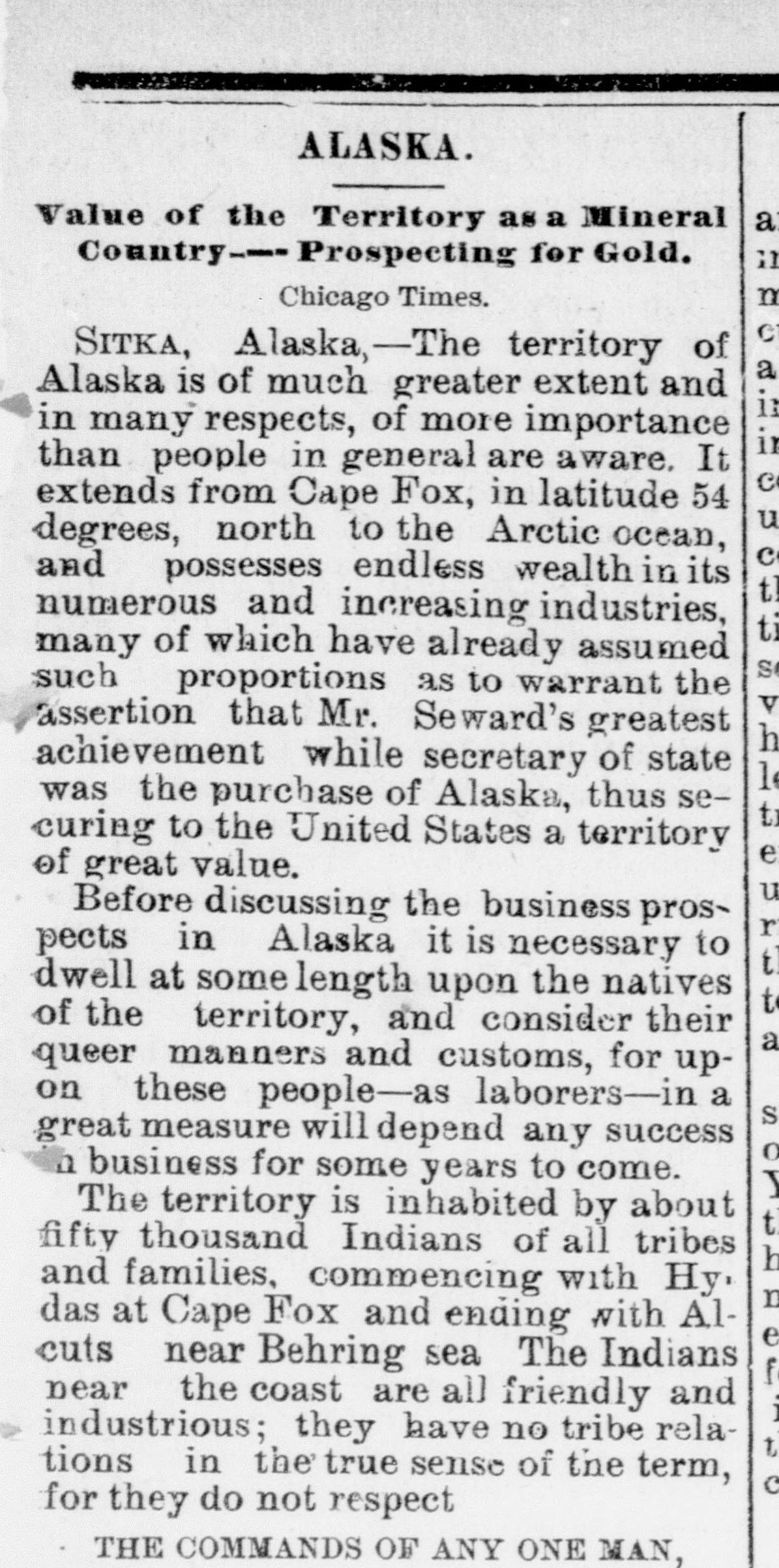
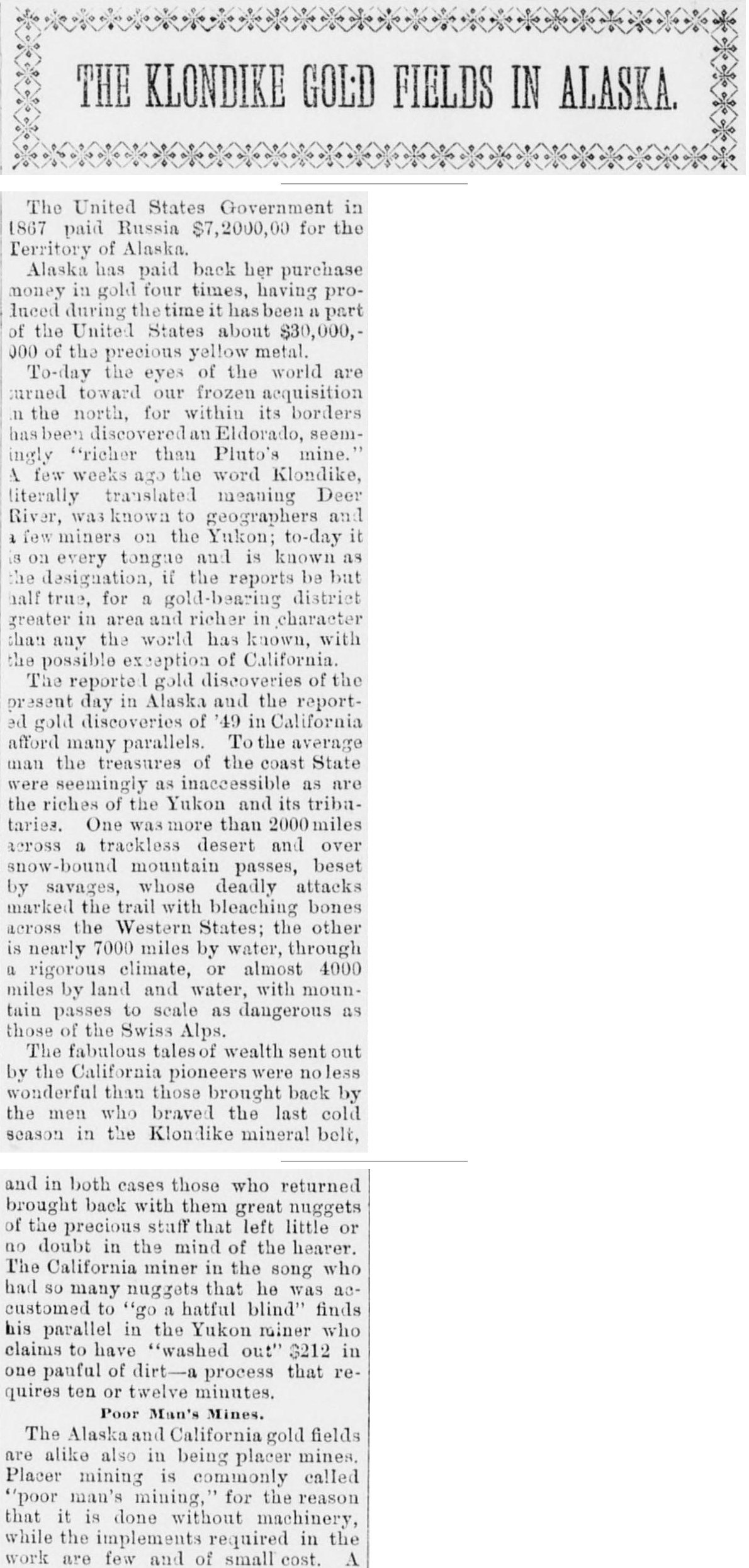
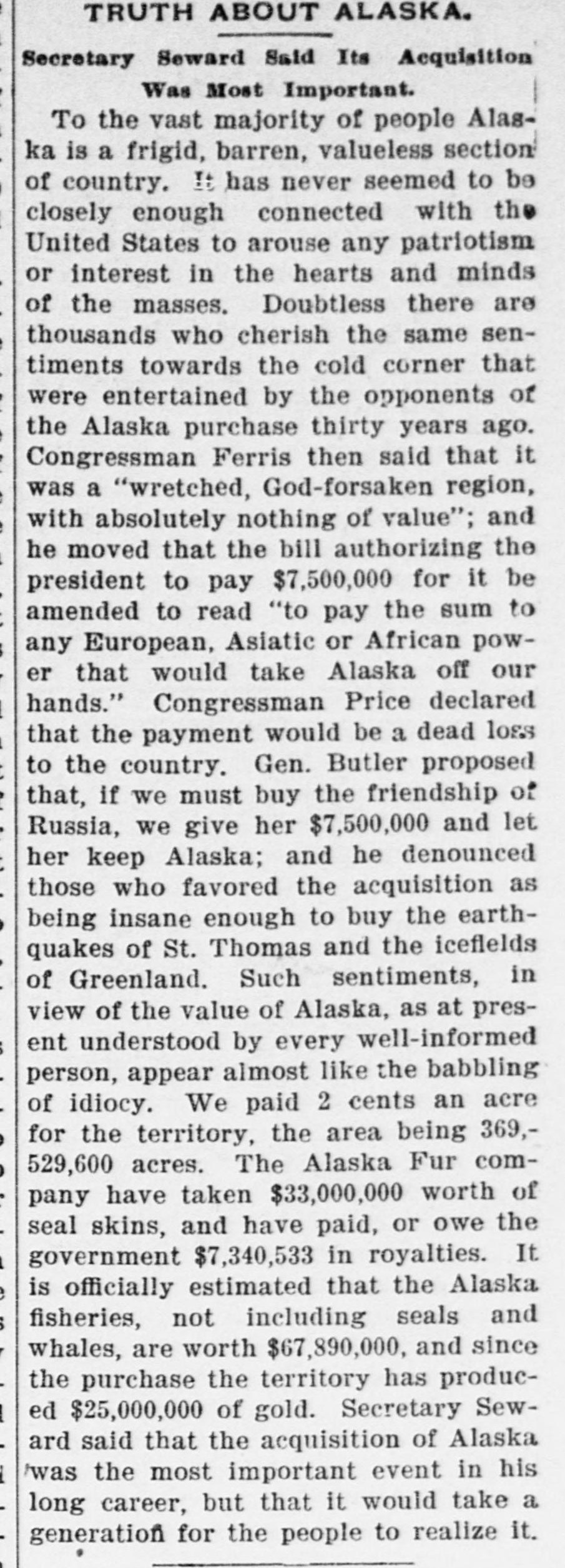
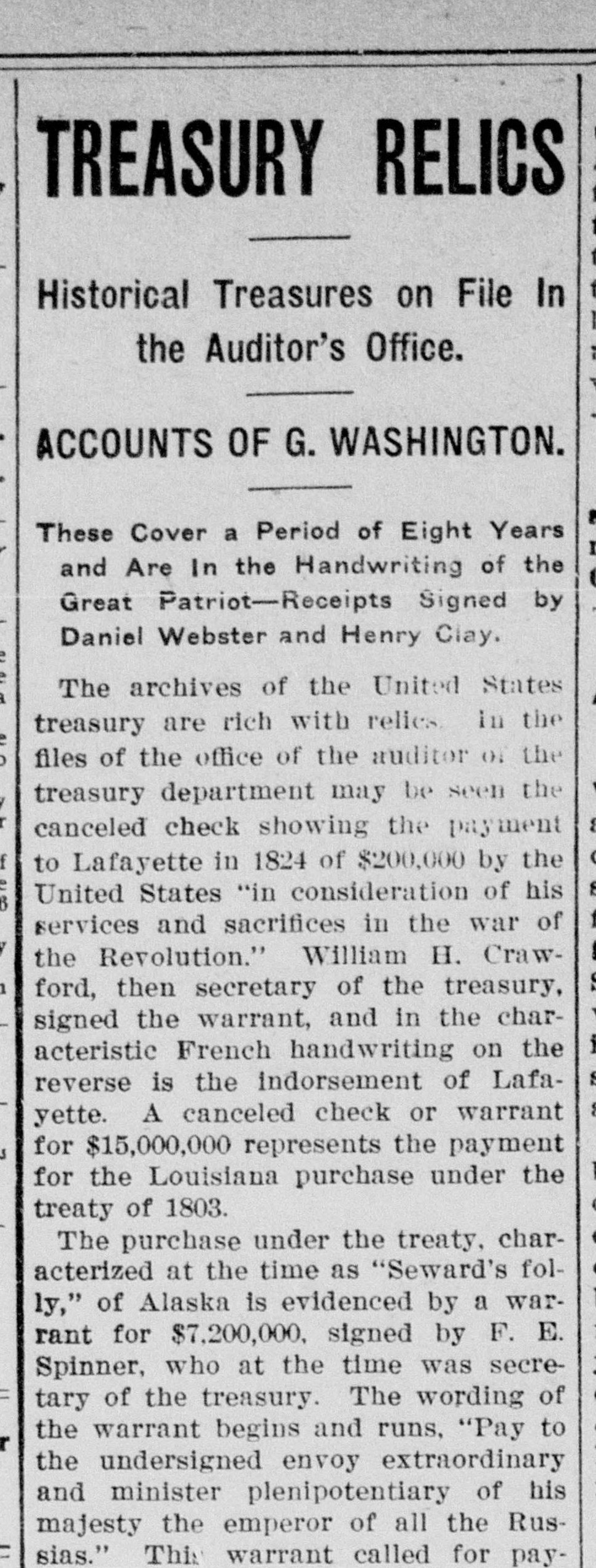
Wood County Reporter, 13 August 1885Freeland Tribune, 6 September 1897The McCook Tribune, 26 April 1901The Butler County Press, 26 September 1913

The Purchase of Alaska

April 1867 – December 193061 newspaper articles in the story, 3,462 in the full archive

In the spring of 1867 the United States bought Russia’s territory in North America, and the papers laughed. The New York Tribune, noting that the place had no name yet, offered one: ‘Walrussia.’ Another paper had Secretary Seward buying sixty thousand Esquimaux, and by the end of May a Kansas editor could look back on a month in which ‘the newspapers have been ringing with ridicule.’ Congress took another year to vote the $7,200,000, and when it was paid an inquiry asked where $26,000 of it had gone.

The name the story is remembered by came later. In these papers ‘Seward’s Folly’ first appears in 1869, in a sentence hoping the territory would one day ‘no longer be known’ by it. For thirty years Alaska was a matter of seals, salmon and quarrels over who controlled them. Then came gold at Juneau, at the Klondike and at Nome, and in 1909 Seattle unveiled a bronze Seward, ‘the Father of Alaska.’

The numbers

3,462newspaper articles
3,752printings
950newspapers
51states and territories
765months in the papers

Each article is counted once, however many papers ran it. Printings counts every paper that ran it, so an article reprinted in five papers is one article and five printings.

How much the papers printed

Month of 1 April 1867: 12 printingsMonth of 1 May 1867: 15 printingsMonth of 1 June 1867: 9 printingsMonth of 1 July 1867: 11 printingsMonth of 1 August 1867: 7 printingsMonth of 1 September 1867: 5 printingsMonth of 1 October 1867: 5 printingsMonth of 1 November 1867: 30 printingsMonth of 1 December 1867: 31 printingsMonth of 1 January 1868: 27 printingsMonth of 1 February 1868: 4 printingsMonth of 1 March 1868: 9 printingsMonth of 1 April 1868: 5 printingsMonth of 1 May 1868: 4 printingsMonth of 1 June 1868: 2 printingsMonth of 1 July 1868: 33 printingsMonth of 1 August 1868: 31 printingsMonth of 1 September 1868: 2 printingsMonth of 1 October 1868: 3 printingsMonth of 1 November 1868: 2 printingsMonth of 1 December 1868: 29 printingsMonth of 1 January 1869: 11 printingsMonth of 1 February 1869: 15 printingsMonth of 1 March 1869: 8 printingsMonth of 1 April 1869: 8 printingsMonth of 1 May 1869: 5 printingsMonth of 1 June 1869: 4 printingsMonth of 1 July 1869: 2 printingsMonth of 1 August 1869: 10 printingsMonth of 1 September 1869: 9 printingsMonth of 1 October 1869: 7 printingsMonth of 1 November 1869: 6 printingsMonth of 1 January 1870: 6 printingsMonth of 1 February 1870: 3 printingsMonth of 1 March 1870: 6 printingsMonth of 1 April 1870: 3 printingsMonth of 1 May 1870: 2 printingsMonth of 1 October 1870: 2 printingsMonth of 1 November 1870: 2 printingsMonth of 1 December 1870: 3 printingsMonth of 1 January 1871: 3 printingsMonth of 1 February 1871: 4 printingsMonth of 1 March 1871: 1 printingMonth of 1 April 1871: 7 printingsMonth of 1 May 1871: 1 printingMonth of 1 June 1871: 7 printingsMonth of 1 September 1871: 1 printingMonth of 1 October 1871: 2 printingsMonth of 1 November 1871: 1 printingMonth of 1 March 1872: 1 printingMonth of 1 May 1872: 3 printingsMonth of 1 June 1872: 3 printingsMonth of 1 July 1872: 7 printingsMonth of 1 August 1872: 1 printingMonth of 1 October 1872: 2 printingsMonth of 1 December 1872: 1 printingMonth of 1 February 1873: 1 printingMonth of 1 June 1873: 2 printingsMonth of 1 July 1873: 2 printingsMonth of 1 August 1873: 2 printingsMonth of 1 September 1873: 1 printingMonth of 1 November 1873: 2 printingsMonth of 1 December 1873: 1 printingMonth of 1 January 1874: 3 printingsMonth of 1 February 1874: 3 printingsMonth of 1 April 1874: 1 printingMonth of 1 July 1874: 1 printingMonth of 1 September 1874: 1 printingMonth of 1 April 1875: 1 printingMonth of 1 July 1875: 1 printingMonth of 1 September 1875: 1 printingMonth of 1 November 1875: 2 printingsMonth of 1 December 1875: 3 printingsMonth of 1 January 1876: 2 printingsMonth of 1 May 1876: 2 printingsMonth of 1 July 1876: 3 printingsMonth of 1 August 1876: 3 printingsMonth of 1 September 1876: 3 printingsMonth of 1 October 1876: 1 printingMonth of 1 February 1877: 1 printingMonth of 1 September 1878: 1 printingMonth of 1 October 1878: 1 printingMonth of 1 November 1878: 1 printingMonth of 1 January 1879: 2 printingsMonth of 1 February 1879: 2 printingsMonth of 1 March 1879: 1 printingMonth of 1 May 1879: 2 printingsMonth of 1 September 1879: 1 printingMonth of 1 January 1880: 1 printingMonth of 1 February 1880: 2 printingsMonth of 1 March 1880: 1 printingMonth of 1 April 1880: 3 printingsMonth of 1 May 1880: 1 printingMonth of 1 July 1880: 3 printingsMonth of 1 November 1880: 1 printingMonth of 1 January 1881: 2 printingsMonth of 1 February 1881: 1 printingMonth of 1 March 1881: 3 printingsMonth of 1 April 1881: 1 printingMonth of 1 May 1881: 4 printingsMonth of 1 September 1881: 1 printingMonth of 1 October 1881: 1 printingMonth of 1 November 1881: 1 printingMonth of 1 December 1881: 1 printingMonth of 1 April 1882: 2 printingsMonth of 1 May 1882: 3 printingsMonth of 1 January 1883: 2 printingsMonth of 1 March 1883: 1 printingMonth of 1 May 1883: 1 printingMonth of 1 July 1883: 1 printingMonth of 1 October 1883: 1 printingMonth of 1 November 1883: 3 printingsMonth of 1 December 1883: 1 printingMonth of 1 January 1884: 5 printingsMonth of 1 February 1884: 6 printingsMonth of 1 April 1884: 1 printingMonth of 1 May 1884: 23 printingsMonth of 1 June 1884: 2 printingsMonth of 1 July 1884: 3 printingsMonth of 1 October 1884: 1 printingMonth of 1 January 1885: 5 printingsMonth of 1 February 1885: 2 printingsMonth of 1 March 1885: 2 printingsMonth of 1 April 1885: 1 printingMonth of 1 May 1885: 1 printingMonth of 1 July 1885: 1 printingMonth of 1 August 1885: 4 printingsMonth of 1 September 1885: 3 printingsMonth of 1 November 1885: 10 printingsMonth of 1 December 1885: 5 printingsMonth of 1 January 1886: 1 printingMonth of 1 March 1886: 1 printingMonth of 1 April 1886: 1 printingMonth of 1 May 1886: 6 printingsMonth of 1 June 1886: 2 printingsMonth of 1 July 1886: 5 printingsMonth of 1 August 1886: 3 printingsMonth of 1 September 1886: 1 printingMonth of 1 October 1886: 1 printingMonth of 1 November 1886: 3 printingsMonth of 1 December 1886: 1 printingMonth of 1 January 1887: 2 printingsMonth of 1 February 1887: 8 printingsMonth of 1 April 1887: 8 printingsMonth of 1 May 1887: 1 printingMonth of 1 June 1887: 3 printingsMonth of 1 July 1887: 1 printingMonth of 1 August 1887: 6 printingsMonth of 1 September 1887: 4 printingsMonth of 1 October 1887: 10 printingsMonth of 1 November 1887: 3 printingsMonth of 1 January 1888: 1 printingMonth of 1 February 1888: 1 printingMonth of 1 March 1888: 8 printingsMonth of 1 April 1888: 4 printingsMonth of 1 May 1888: 2 printingsMonth of 1 June 1888: 2 printingsMonth of 1 July 1888: 6 printingsMonth of 1 August 1888: 5 printingsMonth of 1 September 1888: 2 printingsMonth of 1 October 1888: 2 printingsMonth of 1 November 1888: 4 printingsMonth of 1 December 1888: 1 printingMonth of 1 January 1889: 2 printingsMonth of 1 February 1889: 1 printingMonth of 1 April 1889: 3 printingsMonth of 1 May 1889: 2 printingsMonth of 1 June 1889: 3 printingsMonth of 1 July 1889: 1 printingMonth of 1 September 1889: 1 printingMonth of 1 October 1889: 1 printingMonth of 1 November 1889: 2 printingsMonth of 1 December 1889: 2 printingsMonth of 1 January 1890: 1 printingMonth of 1 March 1890: 3 printingsMonth of 1 April 1890: 7 printingsMonth of 1 May 1890: 4 printingsMonth of 1 June 1890: 3 printingsMonth of 1 July 1890: 5 printingsMonth of 1 August 1890: 1 printingMonth of 1 November 1890: 2 printingsMonth of 1 December 1890: 2 printingsMonth of 1 January 1891: 5 printingsMonth of 1 February 1891: 6 printingsMonth of 1 March 1891: 4 printingsMonth of 1 April 1891: 9 printingsMonth of 1 May 1891: 2 printingsMonth of 1 June 1891: 5 printingsMonth of 1 July 1891: 3 printingsMonth of 1 August 1891: 3 printingsMonth of 1 September 1891: 1 printingMonth of 1 November 1891: 1 printingMonth of 1 January 1892: 3 printingsMonth of 1 March 1892: 3 printingsMonth of 1 April 1892: 4 printingsMonth of 1 May 1892: 1 printingMonth of 1 June 1892: 5 printingsMonth of 1 November 1892: 1 printingMonth of 1 December 1892: 2 printingsMonth of 1 February 1893: 2 printingsMonth of 1 March 1893: 1 printingMonth of 1 April 1893: 7 printingsMonth of 1 June 1893: 4 printingsMonth of 1 July 1893: 1 printingMonth of 1 August 1893: 7 printingsMonth of 1 September 1893: 3 printingsMonth of 1 December 1893: 2 printingsMonth of 1 January 1894: 1 printingMonth of 1 June 1894: 1 printingMonth of 1 July 1894: 1 printingMonth of 1 November 1894: 1 printingMonth of 1 January 1895: 20 printingsMonth of 1 February 1895: 9 printingsMonth of 1 March 1895: 4 printingsMonth of 1 April 1895: 3 printingsMonth of 1 May 1895: 3 printingsMonth of 1 October 1895: 3 printingsMonth of 1 November 1895: 8 printingsMonth of 1 December 1895: 1 printingMonth of 1 January 1896: 7 printingsMonth of 1 February 1896: 8 printingsMonth of 1 March 1896: 2 printingsMonth of 1 April 1896: 8 printingsMonth of 1 May 1896: 3 printingsMonth of 1 June 1896: 12 printingsMonth of 1 July 1896: 1 printingMonth of 1 August 1896: 1 printingMonth of 1 September 1896: 2 printingsMonth of 1 November 1896: 1 printingMonth of 1 December 1896: 4 printingsMonth of 1 January 1897: 6 printingsMonth of 1 February 1897: 4 printingsMonth of 1 April 1897: 2 printingsMonth of 1 May 1897: 4 printingsMonth of 1 June 1897: 3 printingsMonth of 1 July 1897: 41 printingsMonth of 1 August 1897: 51 printingsMonth of 1 September 1897: 44 printingsMonth of 1 October 1897: 19 printingsMonth of 1 November 1897: 14 printingsMonth of 1 December 1897: 9 printingsMonth of 1 January 1898: 26 printingsMonth of 1 February 1898: 18 printingsMonth of 1 March 1898: 9 printingsMonth of 1 April 1898: 10 printingsMonth of 1 May 1898: 7 printingsMonth of 1 June 1898: 2 printingsMonth of 1 July 1898: 5 printingsMonth of 1 August 1898: 3 printingsMonth of 1 September 1898: 5 printingsMonth of 1 October 1898: 16 printingsMonth of 1 November 1898: 2 printingsMonth of 1 December 1898: 7 printingsMonth of 1 January 1899: 9 printingsMonth of 1 February 1899: 4 printingsMonth of 1 March 1899: 3 printingsMonth of 1 April 1899: 12 printingsMonth of 1 May 1899: 3 printingsMonth of 1 June 1899: 5 printingsMonth of 1 July 1899: 6 printingsMonth of 1 August 1899: 7 printingsMonth of 1 September 1899: 3 printingsMonth of 1 October 1899: 6 printingsMonth of 1 November 1899: 3 printingsMonth of 1 December 1899: 4 printingsMonth of 1 January 1900: 7 printingsMonth of 1 February 1900: 5 printingsMonth of 1 March 1900: 13 printingsMonth of 1 April 1900: 15 printingsMonth of 1 May 1900: 8 printingsMonth of 1 June 1900: 4 printingsMonth of 1 July 1900: 2 printingsMonth of 1 August 1900: 2 printingsMonth of 1 September 1900: 4 printingsMonth of 1 October 1900: 10 printingsMonth of 1 November 1900: 2 printingsMonth of 1 December 1900: 7 printingsMonth of 1 January 1901: 4 printingsMonth of 1 February 1901: 3 printingsMonth of 1 March 1901: 5 printingsMonth of 1 April 1901: 9 printingsMonth of 1 May 1901: 7 printingsMonth of 1 June 1901: 3 printingsMonth of 1 July 1901: 3 printingsMonth of 1 September 1901: 1 printingMonth of 1 October 1901: 6 printingsMonth of 1 November 1901: 1 printingMonth of 1 December 1901: 3 printingsMonth of 1 January 1902: 4 printingsMonth of 1 February 1902: 1 printingMonth of 1 March 1902: 4 printingsMonth of 1 April 1902: 2 printingsMonth of 1 May 1902: 1 printingMonth of 1 June 1902: 30 printingsMonth of 1 July 1902: 18 printingsMonth of 1 August 1902: 13 printingsMonth of 1 September 1902: 5 printingsMonth of 1 October 1902: 7 printingsMonth of 1 November 1902: 9 printingsMonth of 1 December 1902: 10 printingsMonth of 1 January 1903: 9 printingsMonth of 1 February 1903: 4 printingsMonth of 1 March 1903: 9 printingsMonth of 1 April 1903: 2 printingsMonth of 1 May 1903: 5 printingsMonth of 1 June 1903: 6 printingsMonth of 1 July 1903: 7 printingsMonth of 1 August 1903: 20 printingsMonth of 1 September 1903: 5 printingsMonth of 1 October 1903: 13 printingsMonth of 1 November 1903: 10 printingsMonth of 1 December 1903: 2 printingsMonth of 1 January 1904: 4 printingsMonth of 1 February 1904: 3 printingsMonth of 1 March 1904: 16 printingsMonth of 1 April 1904: 19 printingsMonth of 1 May 1904: 14 printingsMonth of 1 June 1904: 5 printingsMonth of 1 July 1904: 5 printingsMonth of 1 August 1904: 2 printingsMonth of 1 September 1904: 9 printingsMonth of 1 October 1904: 14 printingsMonth of 1 November 1904: 7 printingsMonth of 1 December 1904: 4 printingsMonth of 1 January 1905: 4 printingsMonth of 1 February 1905: 12 printingsMonth of 1 March 1905: 2 printingsMonth of 1 April 1905: 3 printingsMonth of 1 May 1905: 1 printingMonth of 1 June 1905: 1 printingMonth of 1 September 1905: 9 printingsMonth of 1 October 1905: 7 printingsMonth of 1 November 1905: 3 printingsMonth of 1 December 1905: 3 printingsMonth of 1 January 1906: 10 printingsMonth of 1 February 1906: 10 printingsMonth of 1 March 1906: 5 printingsMonth of 1 April 1906: 4 printingsMonth of 1 May 1906: 5 printingsMonth of 1 June 1906: 5 printingsMonth of 1 July 1906: 5 printingsMonth of 1 August 1906: 6 printingsMonth of 1 September 1906: 14 printingsMonth of 1 October 1906: 5 printingsMonth of 1 November 1906: 32 printingsMonth of 1 December 1906: 13 printingsMonth of 1 January 1907: 10 printingsMonth of 1 February 1907: 17 printingsMonth of 1 March 1907: 12 printingsMonth of 1 April 1907: 6 printingsMonth of 1 May 1907: 1 printingMonth of 1 June 1907: 6 printingsMonth of 1 July 1907: 20 printingsMonth of 1 August 1907: 6 printingsMonth of 1 September 1907: 8 printingsMonth of 1 October 1907: 12 printingsMonth of 1 November 1907: 3 printingsMonth of 1 January 1908: 2 printingsMonth of 1 March 1908: 10 printingsMonth of 1 April 1908: 1 printingMonth of 1 May 1908: 12 printingsMonth of 1 June 1908: 23 printingsMonth of 1 July 1908: 12 printingsMonth of 1 August 1908: 6 printingsMonth of 1 September 1908: 10 printingsMonth of 1 October 1908: 7 printingsMonth of 1 November 1908: 7 printingsMonth of 1 December 1908: 2 printingsMonth of 1 January 1909: 15 printingsMonth of 1 February 1909: 11 printingsMonth of 1 March 1909: 19 printingsMonth of 1 April 1909: 22 printingsMonth of 1 May 1909: 26 printingsMonth of 1 June 1909: 31 printingsMonth of 1 July 1909: 14 printingsMonth of 1 August 1909: 21 printingsMonth of 1 September 1909: 56 printingsMonth of 1 October 1909: 14 printingsMonth of 1 November 1909: 9 printingsMonth of 1 December 1909: 7 printingsMonth of 1 January 1910: 3 printingsMonth of 1 February 1910: 5 printingsMonth of 1 March 1910: 7 printingsMonth of 1 April 1910: 1 printingMonth of 1 May 1910: 4 printingsMonth of 1 June 1910: 20 printingsMonth of 1 July 1910: 4 printingsMonth of 1 August 1910: 2 printingsMonth of 1 September 1910: 1 printingMonth of 1 October 1910: 2 printingsMonth of 1 November 1910: 9 printingsMonth of 1 December 1910: 2 printingsMonth of 1 January 1911: 20 printingsMonth of 1 February 1911: 7 printingsMonth of 1 March 1911: 5 printingsMonth of 1 April 1911: 4 printingsMonth of 1 May 1911: 1 printingMonth of 1 June 1911: 6 printingsMonth of 1 July 1911: 2 printingsMonth of 1 August 1911: 5 printingsMonth of 1 September 1911: 8 printingsMonth of 1 October 1911: 4 printingsMonth of 1 November 1911: 1 printingMonth of 1 December 1911: 4 printingsMonth of 1 January 1912: 4 printingsMonth of 1 February 1912: 1 printingMonth of 1 March 1912: 8 printingsMonth of 1 April 1912: 8 printingsMonth of 1 May 1912: 4 printingsMonth of 1 June 1912: 10 printingsMonth of 1 July 1912: 7 printingsMonth of 1 August 1912: 2 printingsMonth of 1 September 1912: 2 printingsMonth of 1 October 1912: 3 printingsMonth of 1 November 1912: 2 printingsMonth of 1 December 1912: 5 printingsMonth of 1 January 1913: 6 printingsMonth of 1 February 1913: 4 printingsMonth of 1 March 1913: 1 printingMonth of 1 May 1913: 4 printingsMonth of 1 June 1913: 3 printingsMonth of 1 July 1913: 4 printingsMonth of 1 August 1913: 8 printingsMonth of 1 September 1913: 8 printingsMonth of 1 October 1913: 11 printingsMonth of 1 November 1913: 4 printingsMonth of 1 December 1913: 8 printingsMonth of 1 January 1914: 14 printingsMonth of 1 February 1914: 8 printingsMonth of 1 March 1914: 41 printingsMonth of 1 April 1914: 19 printingsMonth of 1 May 1914: 11 printingsMonth of 1 June 1914: 7 printingsMonth of 1 July 1914: 4 printingsMonth of 1 August 1914: 7 printingsMonth of 1 September 1914: 3 printingsMonth of 1 October 1914: 4 printingsMonth of 1 November 1914: 8 printingsMonth of 1 December 1914: 2 printingsMonth of 1 January 1915: 33 printingsMonth of 1 February 1915: 6 printingsMonth of 1 March 1915: 10 printingsMonth of 1 April 1915: 15 printingsMonth of 1 May 1915: 24 printingsMonth of 1 June 1915: 17 printingsMonth of 1 July 1915: 15 printingsMonth of 1 August 1915: 5 printingsMonth of 1 September 1915: 15 printingsMonth of 1 October 1915: 8 printingsMonth of 1 November 1915: 1 printingMonth of 1 December 1915: 5 printingsMonth of 1 January 1916: 16 printingsMonth of 1 February 1916: 5 printingsMonth of 1 March 1916: 11 printingsMonth of 1 April 1916: 14 printingsMonth of 1 May 1916: 3 printingsMonth of 1 June 1916: 3 printingsMonth of 1 July 1916: 4 printingsMonth of 1 August 1916: 3 printingsMonth of 1 October 1916: 1 printingMonth of 1 November 1916: 4 printingsMonth of 1 December 1916: 7 printingsMonth of 1 January 1917: 11 printingsMonth of 1 February 1917: 16 printingsMonth of 1 March 1917: 59 printingsMonth of 1 April 1917: 36 printingsMonth of 1 May 1917: 15 printingsMonth of 1 June 1917: 6 printingsMonth of 1 July 1917: 4 printingsMonth of 1 August 1917: 1 printingMonth of 1 September 1917: 10 printingsMonth of 1 October 1917: 26 printingsMonth of 1 November 1917: 10 printingsMonth of 1 December 1917: 1 printingMonth of 1 January 1918: 13 printingsMonth of 1 February 1918: 3 printingsMonth of 1 March 1918: 6 printingsMonth of 1 April 1918: 2 printingsMonth of 1 May 1918: 2 printingsMonth of 1 June 1918: 2 printingsMonth of 1 July 1918: 6 printingsMonth of 1 August 1918: 2 printingsMonth of 1 September 1918: 1 printingMonth of 1 October 1918: 2 printingsMonth of 1 January 1919: 2 printingsMonth of 1 February 1919: 6 printingsMonth of 1 March 1919: 2 printingsMonth of 1 April 1919: 1 printingMonth of 1 June 1919: 4 printingsMonth of 1 July 1919: 2 printingsMonth of 1 August 1919: 3 printingsMonth of 1 September 1919: 2 printingsMonth of 1 October 1919: 5 printingsMonth of 1 November 1919: 36 printingsMonth of 1 December 1919: 15 printingsMonth of 1 January 1920: 4 printingsMonth of 1 February 1920: 2 printingsMonth of 1 March 1920: 5 printingsMonth of 1 April 1920: 2 printingsMonth of 1 May 1920: 5 printingsMonth of 1 June 1920: 6 printingsMonth of 1 July 1920: 1 printingMonth of 1 August 1920: 2 printingsMonth of 1 September 1920: 5 printingsMonth of 1 October 1920: 10 printingsMonth of 1 November 1920: 4 printingsMonth of 1 December 1920: 1 printingMonth of 1 January 1921: 9 printingsMonth of 1 February 1921: 5 printingsMonth of 1 March 1921: 6 printingsMonth of 1 April 1921: 4 printingsMonth of 1 May 1921: 2 printingsMonth of 1 June 1921: 3 printingsMonth of 1 July 1921: 6 printingsMonth of 1 August 1921: 2 printingsMonth of 1 September 1921: 10 printingsMonth of 1 October 1921: 5 printingsMonth of 1 November 1921: 7 printingsMonth of 1 December 1921: 8 printingsMonth of 1 January 1922: 3 printingsMonth of 1 February 1922: 3 printingsMonth of 1 March 1922: 10 printingsMonth of 1 April 1922: 7 printingsMonth of 1 May 1922: 4 printingsMonth of 1 June 1922: 4 printingsMonth of 1 July 1922: 4 printingsMonth of 1 August 1922: 7 printingsMonth of 1 September 1922: 5 printingsMonth of 1 October 1922: 4 printingsMonth of 1 November 1922: 1 printingMonth of 1 December 1922: 6 printingsMonth of 1 January 1923: 8 printingsMonth of 1 February 1923: 1 printingMonth of 1 March 1923: 11 printingsMonth of 1 April 1923: 1 printingMonth of 1 May 1923: 5 printingsMonth of 1 June 1923: 13 printingsMonth of 1 July 1923: 27 printingsMonth of 1 August 1923: 4 printingsMonth of 1 September 1923: 3 printingsMonth of 1 October 1923: 8 printingsMonth of 1 November 1923: 2 printingsMonth of 1 December 1923: 3 printingsMonth of 1 January 1924: 1 printingMonth of 1 February 1924: 7 printingsMonth of 1 April 1924: 3 printingsMonth of 1 May 1924: 2 printingsMonth of 1 June 1924: 1 printingMonth of 1 July 1924: 5 printingsMonth of 1 August 1924: 4 printingsMonth of 1 September 1924: 3 printingsMonth of 1 October 1924: 3 printingsMonth of 1 November 1924: 4 printingsMonth of 1 December 1924: 3 printingsMonth of 1 January 1925: 3 printingsMonth of 1 February 1925: 1 printingMonth of 1 March 1925: 1 printingMonth of 1 April 1925: 1 printingMonth of 1 May 1925: 1 printingMonth of 1 June 1925: 3 printingsMonth of 1 July 1925: 1 printingMonth of 1 August 1925: 5 printingsMonth of 1 September 1925: 2 printingsMonth of 1 October 1925: 9 printingsMonth of 1 November 1925: 2 printingsMonth of 1 December 1925: 10 printingsMonth of 1 January 1926: 2 printingsMonth of 1 March 1926: 7 printingsMonth of 1 April 1926: 2 printingsMonth of 1 May 1926: 1 printingMonth of 1 June 1926: 1 printingMonth of 1 August 1926: 6 printingsMonth of 1 September 1926: 1 printingMonth of 1 October 1926: 7 printingsMonth of 1 November 1926: 5 printingsMonth of 1 December 1926: 4 printingsMonth of 1 January 1927: 5 printingsMonth of 1 March 1927: 5 printingsMonth of 1 April 1927: 3 printingsMonth of 1 May 1927: 5 printingsMonth of 1 June 1927: 1 printingMonth of 1 August 1927: 4 printingsMonth of 1 September 1927: 2 printingsMonth of 1 October 1927: 11 printingsMonth of 1 November 1927: 6 printingsMonth of 1 December 1927: 4 printingsMonth of 1 February 1928: 3 printingsMonth of 1 March 1928: 2 printingsMonth of 1 May 1928: 3 printingsMonth of 1 June 1928: 2 printingsMonth of 1 July 1928: 2 printingsMonth of 1 August 1928: 1 printingMonth of 1 September 1928: 2 printingsMonth of 1 October 1928: 2 printingsMonth of 1 November 1928: 3 printingsMonth of 1 December 1928: 6 printingsMonth of 1 January 1929: 5 printingsMonth of 1 February 1929: 2 printingsMonth of 1 March 1929: 12 printingsMonth of 1 April 1929: 8 printingsMonth of 1 May 1929: 2 printingsMonth of 1 August 1929: 5 printingsMonth of 1 September 1929: 5 printingsMonth of 1 November 1929: 4 printingsMonth of 1 December 1929: 1 printingMonth of 1 January 1930: 2 printingsMonth of 1 February 1930: 1 printingMonth of 1 March 1930: 2 printingsMonth of 1 May 1930: 2 printingsMonth of 1 July 1930: 3 printingsMonth of 1 August 1930: 2 printingsMonth of 1 September 1930: 2 printingsMonth of 1 October 1930: 3 printingsMonth of 1 December 1930: 2 printings1 April 18671 April 18674 April 18676 April 18679 April 186710 April 186711 April 186712 April 186712 April 186723 April 186729 April 18677 May 186710 May 186716 May 186721 May 186731 May 186716 June 186722 June 186711 July 186724 August 18671 October 186714 November 186712 December 186721 December 186726 December 186721 January 186823 January 18685 February 18689 May 18682 July 186818 July 18684 August 18683 November 186818 December 186820 December 186823 December 186813 February 186912 August 18698 September 18693 November 186928 January 187623 January 188011 February 188118 May 188313 August 18859 April 189111 February 189628 January 18976 September 189710 September 189720 February 189824 January 190026 April 190114 August 19028 September 19062 February 190711 September 190917 January 191126 September 191312 November 191914 December 1928186718681869187018711872187318741875187618771878187918801881188218831884188518861887188818891890189118921893189418951896189718981899190019011902190319041905190619071908190919101911191219131914191519161917191819191920192119221923192419251926192719281929193059 printings in the month of 1 March 1917

Every printing of every article, by the month it ran. The marks under the line are the articles in the story below; red ones were wrong.

Where it was printed

FewerMore

Printings in 51 states. Most: Alaska (523), District of Columbia (253), New York (219). 229 printings could not be placed in a state.

How it unfolded

61 newspaper articles in 7 acts

Act One

Walrussia

April – June 1867

Washington dispatches of 30 March 1867 announced a treaty already made: between a Cabinet meeting on Friday night and early Saturday morning, terms were settled by which Russia gave up all Russian America for about $7,000,000. For a fortnight the papers argued it. The Chicago Tribune hailed Russia as the country’s one friend in Europe, the Tribune, reprinted in Philadelphia, found ‘the Polar bear reclining among roses’ in Seward’s documents, and another Philadelphia paper admitted that ‘nobody knows exactly what it is.’ The Senate ratified it, 37 to 2. The jokes outlasted the vote. The Tribune proposed ‘Walrussia,’ and the name went round the country. By June the tone was turning: the Tribune, reading the government’s new map, saw an American Scandinavia, a German paper thought the country might prove ‘an eldorado in furs,’ the Alta Californian counted a hundred thousand seal skins a year from two islands, and Californians sent a steamer north to prospect for gold. In June President Johnson proclaimed the treaty ratified by both parties, adding to the country ‘the Territory of Alaska, late Russian America.’

Russia, the one friend in Europe

The Tribune hails the treaty as proof of Russia’s friendship: the United States ‘has never had a friend among the nations of Europe save Russia.’ The ceded land, about 400,000 square miles, is more than seven times the size of Illinois, and leaves the country’s territory, for the first time, ‘disconnected by foreign soil.’ Not since Louisiana, it says, has any event so enlarged the nation’s boundaries.

Chicago Tribune · Chicago, Ill.

Chicago Tribune · 1 April 1867 · page 2 · transcribed from the page image

THE ACQUISITION OF RUSSIAN AMERICA.

The announcement of the negotiation of a treaty between the United States and Russia, by which the latter cedes all her American possessions to the United States, will be hailed with pleasure by the whole American people, and will give new vigor to the friendship which has hitherto made the two nations allies under all circumstances. The United States has never had a friend among the nations of Europe save Russia. In peace and in war, in prosperity and distress Russia has confronted the nations of the world as the devoted friend of the United States. That friendship she has made practical by her magnificent cession of her vast American domain to the American Union.

See moreSee less

The territory which has thus been ceded is of about 400,000 square miles, or more than seven times as large as the State of Illinois. It contains over seventy thousand inhabitants, and more than doubles our Pacific coast. It locks the British possessions on the Pacific, leaving but a comparatively small distance of coast between our present and our newly acquired possessions. The United States for the first time has her territory disconnected by foreign soil, and in order to reach the new dominion, her people must go by water, or acquire the right of way over the British possessions.

Since the acquisition of Louisiana, by which the possession of the Mississippi River and the vast regions now covered with organized States, no event has occurred of such importance with regard to the extension of our boundaries, as this acquisition of Russian America. It settles the future of the Pacific coast of North America. The possession of that part of the coast now in British hands is not needed at this moment, but when the States on the Pacific shall fill up, when American enterprise shall have gathered wealth, commerce and population there, Columbia will obey the laws of empire, and the laws of gravitation, and be included in that continuous coast of the United States, extending from the extreme north to the Isthmus. No previous acquisition of territory by the United States has ever attracted the attention in Europe that this will do. Texas was essentially an American State before its annexation. California was regarded as hardly worth the expense of conquering it even from feeble Mexico. But now that the United States have erected strong States upon that coast, have peopled it with her enterprising citizens, is rapidly spanning the Continent with her connecting railroads, and has already opened direct commercial intercourse by her steamers with Japan and China, every inch of that coast has become of priceless value, and the possession of it a matter of deep national concern. The cession by Russia of her possessions determines the fate of the whole. It decides that the Pacific, as the Atlantic coast of this continent, must be under the same flag, and that European occupation shall never extend beyond its present limits, and that, obeying the laws of destiny, progress and freedom, they must eventually and rapidly pass into the control of the one great central American power.

We publish this morning a description of the newly acquired Territory, which we know will be read with interest. Its cession to us at this time may have a significance pointing to a conflict in Europe. The reorganization of Kingdoms and Empires in the old country which has been going on, and which is still progressing, may not be acquiesced in, or may become more extensive than is yet known. The great Powers are fast strengthening themselves and preparing for the mastery. What may come of it our people know not, and though their hearts are always enlisted on the side of human freedom and human liberty, they have but little concern in the relative supremacy of this or that despotism. But, grateful for past and present friendship, the feelings of the American people will be in the future, as they have been in the past, with Russia in all her conflicts with other nations, where the issue is which shall rule and dictate to the other monarchies.

See the clipping

The treaty goes to the Senate

Washington dispatches of March 30, printed in Evansville, report that the President has sent the Senate a treaty by which Russia gives up all Russian America for about $7,000,000, and has called the Senate to meet on the first day of April. Russia is said to sell for the reasons that led Napoleon to sell Louisiana: in a war it would probably lose the territory. The English representative is ‘deeply chagrined.’

The Evansville Journal · Evansville, Ind.

The Evansville Journal · 1 April 1867 · page 1 · transcribed from the page image

Adjournment of Congress.

Executive Session of Senate.

See moreSee less

Important Treaty with Russia.

The Purchase of all Russian America.

COST SEVEN MILLIONS OF DOLLARS.

GREAT BRITAIN TO PROTEST.

WASHINGTON.

President calls an Executive session of the Senate for to-day—All bills Passed by Congress Signed—Important Treaty with Russia—Cession to the United States of Russian America—Price $7,000,000—Great Britain to protest—Adjournment of Congress.

WASHINGTON, March 30.—The President to-day issued the following, a copy of which was addressed to each Senator:

"WHEREAS, Objects of interest to the United States requires that the Senate should be convened at 12 o'clock on Monday, the first day of April next, to receive and act upon such communication as may be made to it on the part of the executive;

"Now, therefore I, Andrew Johnson, President of the United States, have considered it to be my duty to issue this, my proclamation, declaring that an extraordinary occasion requires the Senate of the United States to convene, for the transaction of business, at the Capitol, in the city of Washington, on Monday, the first day of April next, at 12 o'clock on that day, of which all who shall at that time be entitled to act as that body, are hereby required to take notice.

"Given under my hand and seal of the United States, at Washington, the 30th day of March, in the year of our Lord 1867, and of the independence of the United States of America the 91st.

[Signed.] "ANDREW JOHNSON, "President. "WM. H. SEWARD, Sec. of State."

Speaker Colfax was in the chair to-day, his step-father having passed the crisis of his disease yesterday, and is now regarded as out of danger.

It is believed that all the bills which passed the two houses have become laws by the President's signature.

WASHINGTON, March 30.—The President communicated to the Senate in Executive Session the Treaty with Russia, by which that power surrenders to the United States its sovereignty over all Russian America and adjacent. It especially includes the strip 400 miles long which extends down the coast, thus nearly excluding British America from the ocean. The treaty was laid on the table and will be taken up next week. This cession excites intense interest. Influential parties regard it as significant of Russian policy in view of impending European complications on the Eastern question. Russia cedes her American Territory for the same reasons that induced Napoleon to sell Louisiana.. In event of war Russia would probably lose this territory, and by parting with it the Czar secures the friendship of our Government.

The English Representative is deeply chagrined, and it is said that Sir Frederick Bruce will telegraph to Earl Derby for instructions to protest against its acceptance by our Government. This acquisition more than doubles the United States coast on the Pacific.

Another dispatch from Washington, dated 30th, says it is true, as reported, that the President communicated to the Senate to-day a treaty with Russia, by which that power surrenders to United States sovereignty all Russian America and adjacent islands. The price to be for this territory is about $7,000,000. The treaty was signed early this morning and sent to the Senate shortly afterward.

WASHINGTON, March 30.—At 12 o'clock to-day the Senate adjourned, under resolution of yesterday, until the first Wednesday in July.

See the clipping

A bargain struck overnight

An Ohio paper tells how the bargain was struck. The negotiation was discussed at a Cabinet meeting on Friday night, the Russian Minister then called at the State Department, and early on Saturday morning the terms were settled. The territory, everything west of longitude 141°, has about 60,000 inhabitants, ‘half of whom are Esquimaux,’ and its fur trade would henceforth be ‘altogether controlled by American merchants.’

Belmont Chronicle · St. Clairsville, Ohio

Belmont Chronicle · 4 April 1867 · page 2 · transcribed from the page image

RUSSIAN AMERICA CEDED TO THE UNITED STATES. The President on Saturday, communicated to the Senate, in its Executive Session, a treaty with Russia, by which that power surrenders to the United States its sovereignty over all of Russian America and the adjoining islands. It especially includes the strip 400 miles long, which extends down the coast, thus excluding British America from the Ocean. The Treaty was laid on the table, and will be taken up this week.—The Treaty was concluded between the Secretary of State, on behalf of the President of the United States, and the Russian representatives, on behalf of the Emperor of Russia.

See moreSee less

The Russian Government agrees to convey to the United States Government all its possessions on the American Continent, known as Russian America, in consideration of the payment of $7,000,000. The negotiation was discussed at a Cabinet meeting on Friday night. The Russian Minister afterward visited the State Department to arrange the terms, and at an early hour on Saturday morning the arrangement was definitely perfected. The English representatives here are deeply chagrined, and it is said that Sir Frederick Bruce will telegraph to Earl Derby for instructions to protest against its acceptance by our Government. This acquisition more than doubles the United States coast on the Pacific, which now extends from Lower California to Behring's Straits, with the exception of the narrow strip comprising British Columbia. The teritory ceded by Russia comprises the whole of the Continent of North America west of longitude 141°. It is bounded by British America and the Pacific and Arctic Oceans. It includes a great number of islands, and is of the highest importance as a naval depot, and for strategic purposes. It is a valuable fur country, and embraces a vast section of territory, the possession of which will influence in our favor the vast trade of the Pacific. The purchased territory covers upward of 400,000 square miles, and contains about 60,000 inhabitants, half of whom are Esquimaux. The fisheries are very extensive, but the principal commercial wealth of the country is in its fur trade, which would, henceforth, be altogether controlled by American merchants. The requisition of this territory would give our Government the control of the Russian American telegraph, in case the work should be completed.

See the clipping

Letters for the treaty

A Rock Island paper prints testimony for the treaty. Commissioner General Rogers thinks that if the territory is worth anything, the price is ‘a bagatelle.’ Quartermaster General Meigs would value its fisheries and mines ‘beyond the plains of Mexico or the fertile plantations of Cuba.’ From San Francisco, General Halleck wires the Secretary of War that rejecting the treaty would cause great dissatisfaction, ‘especially in California.’

The Evening Argus · Rock Island, Ill.

The Evening Argus · 6 April 1867 · page 2 · transcribed from the page image

A letter from Commissioner General Rogers says he thinks the Russian American acquisition would be valuable, and if worth anything the price would be a bagatelle.

A letter from Quartermaster General Meigs expresses surprise that objections are made to the acquisition of Russia America. He says, "I can conceive of no greater boon to our Pacific States. I should value Russia America—its fisheries and mines, beyond the plains of Mexico or the fertile plantations of Cuba. I trust no effort needed to secure this great acquisition will be omitted."

See moreSee less

The following telegram from Gen. Halleck shows the state of feeling on the Pacific coast, in regard to the matter:

SAN FRANCISCO, April 4.—Hon. Edwin M. Stanton, Secretary of War:

I learn from a gentleman who has recently visited many parts of Russian America that its value is greater than supposed. The rejection of the treaty would cause great dissatisfaction and especially in California.

[Signed] H. W. HALLECK, Maj. Gen.

See the clipping

The young elephant

A Philadelphia paper likens Russian America to the young elephant in a comic verse: ‘nobody knows exactly what it is.’ It runs through the opinions, from the World’s ‘sucked orange’ to the Herald’s ‘pretty good egg,’ and finds itself in ‘a labyrinthine muddle.’ Then, soberly, it advises prompt ratification: ‘We can lose nothing by it, and we may gain much.’

The Evening Telegraph · Philadelphia, Pa.

The Evening Telegraph · 9 April 1867 · page 6 · transcribed from the page image

THE PLUM;

OR, WHAT WILL WE DO WITH IT?

See moreSee less

A NEAT LITTLE WESTERN STORY.

Once upon a time there was a number of youngsters—naughty, of course—who became tired of the restraint placed upon them by their parents and guardians, and determined to travel to see the world for themselves. This they did, for has not Peter Peripatetic written the history of their singular adventures? First they beheld a barn:—

"One said it was a barn, Another said nay, The other said it was a church With the steeple cut away."

This was a joke, and they all laughed at it quite heartily, but in due course of time they came across a young elephant, when

"One said it was a cow, Another said nay, The other said it was 'Old Nick,' And they all ran away."

This was no joke, and so the boys did not laugh at it.

But all of this is like an event in modern times. There has recently been made a treaty between the "Great Bear of the North" and the "Hunkee-Doree Bald Eagle of the West," which the latter has been allowed the privilege of purchasing, for a very small amount of money, a very large tract of land. The said tract, called Russian America, is like the young elephant—nobody knows exactly what it is. The question has racked and divided parties, and has puzzled the brains of statesmen, diplomatists, editors, and politicians. No one can tell what kind of a bargain has been made, or what advantage will accrue to us from this gift.

Mr. Johnson, a citizen of Tennessee, looks upon the cession as a gift. It appears so cheap that the sum asked can only be regarded as earnest-money.

Mr. Seward, who has "fixed this little affair up," thinks that unless we accept the gift of Russian America, "no great war can last more than sixty days," and that it will be necessary to bring again into requisition that famous "little bell." In fact, unless we have Russian America the Union cannot be saved.

The Czar of all the Russias desires us to accept his "almost a gift," because he can no longer take care of it with profit to himself. It is so isolated, and then, too, he loves the Monroe doctrine, and has no doubt that the "boundless continent is ours." God bless the dear soul for those few words of comfort!

Napoleon looks upon the matter with pure nonchalance. He is absorbed in his attentions to the sick Prince Imperial, and the Paris Exposition.

England fumes over the matter. She sees danger in the 'ole haffair. By accepting this gift the continent will be turned into a huge pair of shears, and they some day may cut some poor Giles of an English Prince's love in twain. Besides, it savors of aggrandisement. It looks as if Russia desires to divide the world with the United States! and that would be 'orrible to the subjects of her Majesty, "on oose dominions, by 'eavens, the sun never sets!"

Senator Sumner, the Chairman of the Senate Committee on Foreign Relations, thinks the treaty is a neat thing, and quotes the classic Penn on treaties generally in support of his position. Yet he bids us look to the helm, lest, by avoiding this Scilla (silly?) rock in the ocean of affairs we wreck our ship of state (the radical party?) on the Charybdis of Democratic success in the coming campaign.

General Halleck (old Brains) is sure that Russian America is worth having, and thinks that the inhabitants of the Pacific will demand its purchase.

Simon Cameron says "wigwag," and Colonel Forney "sees disaster in the whole thing," unless more radical influences can be brought to bear upon "His Accidency."

General Meigs goes into exstacies over the new acquisition. He wants to see the doings of the old Norse kings repeated in that country. General Meigs is probably the most poetic Quartermaster-General that has ever lived.

The New York World thinks Russian America is a "sucked orange," but the world is full of snap judgment.

The Herald thinks it is a "pretty good egg," and is probably worth taking as a gift.

The Tribune opines that it would have been all well enough if we had carried Connecticut.

The Times, in a "little villanish" way, compliments Mr. Seward for his diplomacy in the matter.

The Commercial Advertiser is non-committal like most of our Philadelphia journals. Mr. Thurlow Weed would not refuse the gift if it could be shaped into a plank for the new conservative platform, with Grant and Farragut for the Presidency.

But we must have done. We have got into such a labyrinthine muddle over the opinions of these great men, that we are almost distracted. Soberly speaking, THE EVENING TELEGRAPH advises a prompt ratification of the treaty. We can lose nothing by it, and we may gain much. Ten years ago we could have had British America for the asking. We asked not because we thought its possession would not be at once advantageous. We can see now what we have lost—a country full of wealth and vitality. We have gained a viceroy and a quantity of humiliation. Ten years ago we could have had Mexico, on the promise to exclude slavery. We refused to do this, and the result is a country torn and bleeding, robbed of its richest treasures, and forever blighted by a robber called an Emperor. The same of Cuba—the same of the whole continent. In fine, we ought to have it all as soon as we are sure that we can govern ourselves properly and keep cutthroats out of office.

See the clipping

Polar bears among roses

Reprinting the Tribune, a Philadelphia paper mocks the rosy accounts in Seward’s telegrams and documents, where it finds ‘the Polar bear reclining among roses’ and ‘barley ripening on icebergs.’ On the authority of Mr. G. V. Fox, it says Prince Gortchakoff called the country ‘valueless to Russia,’ yet Seward chose to pay $7,500,000 in gold for what he could have had for nothing. It trusts the Senate will not confirm the bargain.

The Evening Telegraph · Philadelphia, Pa.

The Evening Telegraph · 10 April 1867 · page 2 · transcribed from the page image

The Russian Humbug.

From the Tribune.

See moreSee less

Mr. Seward's geographical discoveries continue to be telegraphed over the country, and every man who has known another man who has ever been in Russian America is produced to give a description of the country. On paper there is no place like Russian America. The climate is delicious, and quite warm in winter; yet the ice fields are inexhaustible, and in the burning heat of the Arctic summer the Esquimaux take refuge in their shade. The country is covered with pine forests, and vegetable gardens flourish along the coast, whereon the walrus are also found in vast multitudes. Wheat, seals, barley, white bears, turnips, icebergs, whales, and gold mines are found as far north as the sixtieth degree. All the luxuries and necessities of life are grouped together, so that in a comparison of Mr. Seward's documents we find the Polar bear reclining among roses, barley ripening on icebergs, grass of luxuriant growth over which the Equimaux shuffle with snow-shoes; and Winter everywhere sleeping in the lap of May. It is the isothermal line which works these wonders. It can be ciphered out, as Mr. Seward shows, that the peculiar influence of the isothermal line makes the climate of the most extraordinary kind, so that while the Russians and Esquimaux have always shivered the year round in their furs, the American settler in a loose linen coat will be compelled to carry an umbrella to protect him from the sun. Let if he would be cold, he may be. Ice is always handy. Would he roam through a grand and solitary waste, where the Polar bear is monarch of all he surveys, he has only to step out to his front door. Voilà! cries the delighted Secretary of State. Would he prefer a thickly settled country, with farms and gardens, peaceable Esquimaux, and Arcadian Indians, then he has only to step out of his back door. All tastes are gratified in Mr. Seward's land, which is not Russian America, but Utopia. On paper it is a wonderful country; on ice it is what is generally called a big thing.

But the rose colors in which Mr. Seward drapes his telegrams will fade long before the unhappy immigrant reaches the Zero Islands. Martin Chuzzlewit bought town lots in the flourishing city of Eden, and found his front door in the middle of a swamp. The poor settler who goes to Sitka—on which little island the Russians have with difficulty made a settlement—to raise wheat, or barley, or oats, will find that his fields are ice fields, and need to be cultivated with snow-ploughs. We have heard of people going to Russian America, but never heard of anybody staying there, except those who were frozen in the snow; nor is it probable that the enthusiasm of the Secretary of State will result in his immigration.

The country is so delightful, so rich in furs and fish and timber, that the Czar thinks it entirely too good to keep. He is not worthy of it. It would hardly be credited, were not Mr. G. V. Fox authority for the statement, that the Czar has signified his readiness to give Russian America to the United States, and that his only doubt was of our willingness to accept such a miserable present. "It is valueless to Russia," said Prince Gortchakoff to Admiral Fox, "and has always been an expense and a trouble." Mr. Seward immediately conceived the brilliant idea of paving $7,500,000 in gold for what he could have got for nothing. Russia does not care for the money, we suppose, but is very glad to get rid of the country, whales, wheat, walrus, copper-mines, and all. We may be sure nothing is said in St. Petersburg about the value of the land; there they will talk about the value of the money. It is this bargain, dressed up in a secret treaty, which the Secretary of State is ashamed or afraid to publish with his telegrams, that the Senate is asked to confirm and the people to approve. We trust the Senate will not; we know the people will not.

See the clipping

Ratified, 37 to 2

A Rock Island paper reports the treaty ratified by the Senate, 37 to 2, and traces it to a proposal made to Russia under President Pierce. Quoting the National Intelligencer, it guesses the purchase may prepare the way for British Columbia, which a round sum and a relinquishment of the Alabama claims might buy. Taken alone, it says, the Russian coast ‘would be of little value to us.’

The Evening Argus · Rock Island, Ill.

The Evening Argus · 11 April 1867 · page 2 · transcribed from the page image

THE RUSSIAN TREATY.

The treaty just ratified by the United States senate, by a vote of 37 to 2, by which we acquire several hundred miles of Pacific coast, immense fisheries, &c., &c., was based upon a proposition made to the Russian government by the United States during the administration of President Pierce. It is founded, says the National Intelligencer, on a policy of territorial acquisition which has been pursued under all administrations, beginning with the surrender of the British posts, and the consequent opening of the west for immigration and settlement. It was pursued by Mr. Jefferson in the purchase of Louisiana, followed by the acquisition of Florida, Texas, California, Arizona, &c. The purchase of Cuba was attempted, but, failing for the time, awaits future chances.

See moreSee less

At present there are no territorial acquisitions in serious agitation except those of Lower California, Sonora, Sinaloa, and a few other Mexican provinces. The Canadas cannot be acquired, unless either upon one or the other of the contingencies referred to by Mr. Bright—war or voluntary annexation. Still, British Columbia may be in the diplomatic market, and a round sum, added to a relinquishment on our part of the Alabama claims, might bring it into our possession. This last-named territory has disappointed the expectations formed as to its progress in settlement and prosperity, and Great Britain may be induced to let it go.—Probably it has been thought expedient to prepare the negotiations for the acquisition of British Columbia by the purchase of Russian America.

Considered by itself, the Russian portion of the northwest coast would be of little value to us, but if we are to possess the entire shore of the Pacific, from Cape St. Lucas to 54° 40′, it will be convenient for the purposes of a great maritime nation to have the rest up to the Polar Sea. Navigation and the shore and ocean fisheries will, in the future, become essential interests to the states of the Pacific.

The territory to be ceded by Russia is of no value to her. Her interests are becoming more than ever concentrated in Europe and Asia. Her American territory has been abandoned to the government of one or two rigid and unthrifty monopolies, and, of course, has been unprofitable. But it does not follow that this would be the case in our hands. Our people are already seeking for the privilege of using this Russian coast and its islands for the purpose of whale and other fisheries. These seas are alive with all the fish that enter into the commerce and consumption of the world. These fisheries will become highly important as the future nurseries of seamen for our mercantile and military marine. To the sixty thousand inhabitants of Russian America, five-sixths of whom are Esquimaux, the change of mastery will be beneficial. The Aleutians and Kurilians will fare better, and the Esquimaux, who are now independent, will be soon occupied by the radical universal suffrage and education principle, which they can now hardly comprehend, but which they may imagine will give them an abundance of seals and otters.

See the clipping

The price of a telegram

A Washington dispatch says the only extra expense the government incurred in acquiring Russian America was the cost of a telegram and its reply. During the negotiation Washington asked General Halleck at San Francisco what would be a reasonable price, and he answered that it would be ‘from five to ten millions of dollars.’

The Evening Telegraph · Philadelphia, Pa.

The Evening Telegraph · 12 April 1867 · page 8 · transcribed from the page image

WASHINGTON, April 12. Expense of the Russian Negotiation. The only extra expense incurred by the Government in the acquisition of Russian America was the cost of a telegram sent during the negotiation from Washington to General Halleck, at San Francisco, asking what would be a reasonable price, and of his reply, that a reasonable price would be from five to ten millions of dollars.

See the clipping

Not ten millions after all

A Charleston paper prints a bracketed correction to the previous day’s news: the amount paid for Russian America is $7,200,000, ‘and not $10,000,000, as reported in yesterday’s telegram.’

The Charleston Daily News · Charleston, S.C.

The Charleston Daily News · 12 April 1867 · page 1 · transcribed from the page image

[Correction.—The amount paid Russian America is $7,200,000, and not $10,000,000, as reported in yesterday's telegram.]

See the clipping

St. Petersburg approves the sale

In a line of foreign news, an Evansville paper reports that the Journal of St. Petersburg expects the sale of Russian America to prove advantageous and to promote the commercial interests of both countries.

The Evansville Journal · Evansville, Ind.

The Evansville Journal · 23 April 1867 · page 4 · transcribed from the page image

The French press are outspoken regarding Luxemberg. The Journal of St. Petersburg says the sale of Russian America will prove advantageous, and the commercial interests to both countries will be promoted.

See the clipping

The Tribune suggests Walrussia

The Tribune notes that the Arctic territory bought from Russia still has no name. In recognition of its ‘most valued inhabitants’ and as a compliment to the nation ‘which does us the honor to pocket our money,’ it proposes that Seward’s hard bargain be known as Walrussia.

New-York Tribune · New York, N.Y.

New-York Tribune · 29 April 1867 · page 4 · transcribed from the page image

The future name of the Arctic territory recently purchased from Russia remains in abeyance. We have heard of parents too poor to give their children fit names, but never before of bantlings too sorry to receive such names. We venture to suggest, at once in recognition of the most valued inhabitants of this western Greenland, and as a compliment to the great nation which does us the honor to pocket our money, that Gov. Seward's hard bargain be known as Walrussia.

See the clipping

The official map, and a German view

Reading a new official map made for the State Department, the Tribune finds the ‘Seven Million purchase’ more attractive: a counterpart to Denmark, Sweden, Norway and Iceland, rugged and cold but rich in pine, fish and furs. A translation from the Cologne Gazette follows, calling the country ‘no paradise’ but perhaps ‘an eldorado in furs,’ and prizing above all the ‘cordial good understanding’ with Russia.

New-York Tribune · New York, N.Y.

New-York Tribune · 7 May 1867 · page 4 · transcribed from the page image

WALRUSSIA.

An official map of North-Western America, "compiled for the Department of State at the "U. S. Coast Survey Office, 1867," gives our Seven Million purchase from Russia a more attractive aspect. It there seems to be the American counterpart of non-Russian Europe north of the Baltic—that is, of Denmark, Sweden, Norway, Iceland and the Ferroe Isles. Its chain of islets (Aleutian) seem an interrupted continuation of the large peninsula of Aliaska, and stretch nearly across the North Pacific in an easterly direction for about 1,200 miles, Several other considerable isles are included in the purchase, beside several bold peninsulas and deep bays—the latter said to teem with edible fish. The principal river (Knitchpeck) heads in British America, through its chief affluents, the Yukon and Porcupine, and has a length of over 1,000 miles, pursuing a generally south-west direction, and debouching by several mouths in lat. 61° to 63°, below Norton Sound, instead of running northwest to the Arctic Ocean, as it is generally made to do on the maps. We are assured that the whole course of this river and its affluents, as well as of the less considerable rivers farther south, lies through an immense forest of the choicest pine. There are several large rivers north of the Knitchpek, but the region is so cold that they can be of little value. The average temperature is said to be ten to twelve degrees warmer than on this side of the continent. Valuable mines are vaguely reported, but little is known of them. Generally, the region is rugged as well as cold, and there seems little probability that much of its soil will ever be cultivated. The fact that the Russians sojourning on this coast were long ago accustomed to grow their grain in California, 1,000 miles away, is significant. In fish and fur-bearing animals, the country is hardly surpassed. The following article translated from the Cologne Gazette, probably gives as intelligent and dispassionate an account of the territory as can now be presented:

See moreSee less

THE CESSION OF RUSSIAN AMERICA.

If the cession of the whole of Russian America to the United States is ratified, it will be a very important event: not because the acquisition of a large tract of land by the United States promises an increase of power; for territorial extension is not desirable, and Russian America is no paradise; yet it may prove an eldorado in furs, and its situation on the north-west coast of the Continent will be of great significance. The territory is 17,500 (German) square miles in area, lying on the north-west slope of the Rocky Mountains; has many snow-peaks and volcanoes, and is densely wooded in the valleys, and on the rivers and inlets of the coast-range. The coast has many harbors, shut in by the Prince of Wales's and George IIId's Archipelagoes. The Kossack Dechenes first discovered Behring's Straits, which were explored by Behring 80 years afterward, and received his name. The volcanoes are generally very high, and streams are abundant, though unemployed. The climate is very diversfied, and much milder than between the same parallels on the eastern coast of America or Eastern Asia. The coast, as far as the peninsula of Aliaska, has mild Winters and cool Summers, with abundant rains, very favorable to vegetation; but fruit-trees do not prosper. There are scarcely 700 Russians among the 70,000 inhabitants, just one to a hundred; 1,500 are half-breeds of Russians and Indians. Only 15,000 Indians are civilized, and the rest are scattered over the vast region. Esquimaux inhabit the eastern half of Aliaska, and there are about 2,500 Aloots in the eastern portion; they also inhabit the islands of their name. The seat of government of the country is New-Archangel, containing 2,200 inhabitants. Twenty-five years ago, it had not a population of more than 850 souls. The timber and furs of the country became very useful when the Russians settled on the Amoor; up to that time, it was more of a burden than a blessing. For America, the case is quite different. This purchase annexes the middle portion, on the west of the British auriferous regions, that England has long regarded with a covetous eye. This north-western coast of America is out of the regular course of commerce. This will now change; and the year 1867 will be the beginning of a new era for it.

About the middle of January, the Colorado arrived at Shanghai from San Francisco to open a regular trade across the Pacific, and the steamer Great Republic, of 4,000 tuns, is soon to follow. The telegraph company reports the line already laid as far as New-Westminister, the capital of British Columbia.

Steamships and telegraph lines will unite those distant regions to the civilized world and give them new life; and lands that were once called desert wastes will become mines of untold wealth to a persevering and industrious race of people. But the greatest good of this treaty—far more important than the acquisition of territory—is the winning of a cordial good understanding between the two enlightened nations of the northern hemisphere. These friendly relations between Petersburgh and Washington take place at the very time when Napoleon III., hoping for a dissolution of the American Union, is speculating upon the establishment of a throne in the Western World. The French, therefore, have hated to see this friendly feeling increase, and they say in contempt: "Russia is to be well compensated for this loss!" What compensation can the United States afford! They have no possessions in the Old World; but they have abundant means, quite enough to make an offensive and defensive alliance, and such trifles, of immense importance to the Czar. Now that Russia is casting a longing look on Western Asia, her sovereign is conscious of the importance of a friendly union with a mighty naval power on the Western Continent.

For these reasons the negotiations in Washington are watched with great anxiety by France and England.

As Prussia has a good understanding with the United States, as well as Russia has, this entente cordiale between Washington and Petersburgh, in case of war in Europe, may be more beneficial than detrimental to the cause of Germany.

See the clipping

A jibe about Seward’s Esquimaux

A Romney paper reprints a squib from the Day Book: the ‘50,000 Esquimaux’ Seward has bought from Russia are ‘rather an elephant to the Mongrel party.’ Said to be ‘the greatest liars on earth’ but unwilling to steal, they would serve that party in one way and fail it in another, it jokes, and might split its affections with ‘the negroes.’

South Branch Intelligencer · Romney, Va. W. Va.

This article was wrong. The papers corrected it 6 days later.

Wrong

South Branch Intelligencer · 10 May 1867 · page 2 · transcribed from the page image

The 50,000 Esquimaux which Mr. Seward has recently bought of Russia, are rather an elephant to the Mongrel party. In some respects that party might make them useful members. For instance, travelers agree that they are the greatest liars on earth, and in this they would be serviceable to the party; but, it is said that they will not steal, which if true, would certainly render them very bad party "men and brothers." Then again there is great danger that they will divide the popular affections of the party between themselves and the negroes. This may cause Sambo, "beautiful black darling," to be jealous, and thus introduce a new element of discord.--Day Book.

See the clipping

Furs, fish and perhaps minerals

A Memphis paper, which finds Walrussia ‘a good name enough,’ passes on the Alta Californian’s account of the territory’s value. Two islands of the Prebilor group have shipped 100,000 seal skins a year for the Russian American Company, walruses haunt the Aleutian shores, and the volcanic islands promise minerals, though the fur trade beyond Sitka would mean beating the smugglers already there.

Public Ledger · Memphis, Tenn.

CorrectionThis set right an article from 6 days earlier.

Public Ledger · 16 May 1867 · page 2 · transcribed from the page image

VALUE OF OUR NEW PURCHASE. The Alta Californian gives us, in some statements about "Walrussia" (a good name enough, by the way), a favorable impression of the value of the territory sold to us by the Czar. The Aleutian islands are, it says, rich in furs, and probably minerals. The islands known as St. Paul and St. George, of the Prebilor group, have been for several years a source of very handsome income to the Russian American Company. One hundred thousand seal skins have been exported thence per annum. The shores of Oonalashka (a word which figures in one of the poet Campbell's sonorous lines) with the other islands of the Aleutian group are haunted by walruses, whose skin and bones are valuable articles of traffic.

See moreSee less

The fisheries so far as known are among the Choumagin group and in Bristol Bay. The trade in furs, etc., along the coast as far as Sitka would be but small, while beyond that point as far as the island of Kodiak, it would simply depend upon a successful competition with the smugglers who are already upon the ground. In the vicinity of Oonimak Pass and off the peninsula of Alaska good fishing grounds have been found, and the volcanic nature of all the islands skirting the coast promises well for the development of their mineral resources.

See the clipping

Walrussia credited to Sam Wilkinson

A Wheeling paper reprints the New York Citizen, which praises the Tribune’s Walrussia and credits the name to Sam Wilkinson. The Citizen regrets that Wilkinson, made rich by his connection with Jay Cooke, no longer works regularly on the press but takes his ease at Willard’s or on his farm in Western New York.

The Wheeling Daily Intelligencer · Wheeling, W. Va.

The Wheeling Daily Intelligencer · 21 May 1867 · page 2 · transcribed from the page image

—The Tribune's name for the new territory purchased by Mr. Secretary Seward, is capital—"Walrussia." That is one of Sam. Wilkinson's latest, in Sam's best style. What a pity it is that Sam no longer works regularly on the press; but since his connection with Jay Cooke made him a rich man, Mr. Wilkinson has grown idle and takes his ease either at Willard's or on his own farm in Western New York.—New York Citizen.

See the clipping

The ridicule gives way

A Kansas paper sees the ridicule giving way. Harper’s Weekly has been ‘an unfailing mine of raw material’ for editors, and one editor proposed the name ‘Alas ka.’ But the June Atlantic Monthly reports pines and spruces up to 160 feet high, and Robert Kennicott found many acres covered with the eggs of the canvas-back duck. The paper concludes that Seward ‘has made a good bargain.’

The Emporia News · Emporia, Kan.

The Emporia News · 31 May 1867 · page 2 · transcribed from the page image

THE NORTH WESTERN TERRITORY.

THE NORTHWESTERN TERRITORY.

As intelligence concerning our new domain increases, there is a corresponding change to a more favorable opinion. For a month or so, the newspapers have been ringing with ridicule. One sapient editor decreed that this sorry region should be appropriately called "Alas ka", after the peninsula of that name. The N. Y. Tribune styles it "Walrussia."

See moreSee less

Harper's Weekly has been overflowing with would-be witty illustrations of the general worthlessness of the whole purchase. It has been an unfailing mine of raw material to editors hard up for something funny. Late arrivals from Europe have changed all of this. The Continental statesmen see great wisdom in the purchase at whose folly all Yankeedom has been sneering. Leading German papers pronounce this region fully equal to Scandinavia, having cool, moist summers and mild winters, abounding in magnificent pine forests, and yielding large annual returns of the most valuable furs. These writers also lay much emphasis upon the fisheries, which they consider immensely valuable.

The Atlantic Monthly for June contains an elaborate article on the subject. It is here stated that the pine and spruce trees of this region form forests of immense size and extent, individual trees often being found 100 to 160 feet high, and five to seven feet in diameter. The annual average of temperature at Sitka is four degrees warmer than at Portland, Maine, and the harbor is never frozen. The various crops of northern latitudes are raised in abundance. The salmon of the rivers grow to a size unknown on the Atlantic coast, and the cod and halibut fisheries are of no less importance than those off Newfoundland. Iron, gold, copper, and coal, are already mined, and are reported to exist in immense abundance. The profusion of animal life is specially remarked upon by explorers. After seventy years of exterminating warfare, the supply of fur-bearing animals does not seem to have diminished in the least, and the quantity and variety of game is equally wonderful. Robert Kennicott found many acres covered with the eggs of the canvas-back duck, which, with numerous allied birds, resorts to this region to feed upon the wild fruits that abound here, principally raspberries and cranberries. He reports that these ducks, also geese and brant, become wonderfully fat and delicious after a few weeks of this sort of fare, and so unwieldy as to be killed by the Indians with but little trouble, by myriads.

Blodgett's Climatology estimates the cultivable area of territory at 300,000 square miles, and the soil seems to be very fertile. Russian America is no Paradise, but after a careful examination of evidence, we must conclude that Mr. Seward has made a good bargain.

See the clipping

A northern paradise?

A New Orleans paper credits Senator Sumner’s long speech with turning opinion: it made Russian America ‘a kind of northern paradise.’ Californians have already sent a steamer north to prospect, and San Francisco’s customs collector writes that the climate is no harder than Maine’s. ‘Time will show.’

New Orleans Republican · New Orleans, La

New Orleans Republican · 16 June 1867 · page 4 · transcribed from the page image

WALRUSSIA. —Our new acquisition on the northwest coast is attracting more and more attention, and it is more and more appreciated as a valuable addition to our territory. To this nothing has conduced more than the elaborate speech of Mr. Sumner, which describes Russian America as a kind of northern paradise, abounding in everything necessary for a prosperous, comfortable, and happy people. The Californians are already excited on the subject, and a steamer has sailed from San Francisco loaded with passengers, bent on prospecting the country for gold, silver, or anything else that may turn up.

See moreSee less

General J. F. Miller, collector at San Francisco, in a letter to the secretary of the treasury, speaks of our new Russian purchase as follows: "Russian America is susceptible of development equal to that of the New England States. The country is rich in minerals and coal. The waters afford the best fishing grounds known to this continent. The fur trade is immense. The climate is not more rigorous than that of Maine or Vermont. Gold and copper will be found in abundance when the country is opened to American settlement. The wisdom of acquiring this territory will be fully appreciated and acknowledged in a very short time." Time will show, and if "Walrussia" proves to be all that it is represented, we shall have no reason to repent its purchase.

See the clipping

Johnson proclaims the treaty ratified

The Alexandria Gazette reports in one sentence that President Johnson has proclaimed the treaty ratified by both contracting parties. The treaty adds to the country ‘the Territory of Alaska, late Russian America.’

Alexandria Gazette · Alexandria, D.C.

Alexandria Gazette · 22 June 1867 · page 2 · transcribed from the page image

President Johnson, by proclamation, officially announces the ratification by both the contracting parties of the treaty which adds to this country, the Territory of Alaska, late Russian America.

See the clipping

About these pages

Every clipping here was printed in an American newspaper at the time. The text on each card was read from the page by machine and lightly repaired; where it disagrees with the clipping, the clipping is right. Where the scan of an old page was too damaged to read, the text was transcribed again from the page image and is marked so; letters in [square brackets] were supplied where the printing itself is damaged, and the paper’s own misspellings are kept. The dates, papers, headlines and text are the papers’. The notes on why each article matters, and the one-line summaries, are ours.